
A cyber security analyst monitors, detects, and responds to security threats to protect an organisation’s information systems. That is the short version. The fuller picture is that the role sits at the intersection of continuous threat monitoring, incident response coordination, and applying risk management controls aligned with frameworks like the Australian Cyber Security Centre’s Information Security Manual (ISM).
In practice, the role of a cyber security analyst looks different depending on where they work. In a large enterprise, you might have a dedicated Security Operations Centre (SOC) with tiered analyst teams. In an Australian SMB with 20 staff, the analyst is often doing everything from patching to writing the incident response plan from scratch.
Here is a quick summary of what the role covers:
- Continuous monitoring of networks, endpoints, and systems for suspicious activity
- Triaging and investigating security alerts and potential incidents
- Coordinating incident response when a breach or attack occurs
- Conducting vulnerability assessments and managing remediation
- Implementing and maintaining security controls aligned with the ISM
- Communicating risk to business owners and executives in plain language
- Supporting compliance with Australian regulatory and industry requirements
Table of Contents
- What does a cyber security analyst do day to day?
- How do you become a cyber security analyst in Australia?
- What skills do you need to be a cyber security analyst?
- Common mistakes Australian businesses make about the analyst role
- How workplace maturity shapes what a cyber security analyst actually does
- How IT Start supports Australian businesses with cyber security
- FAQ
- Key takeaways
What does a cyber security analyst do day to day?
The daily reality of a cyber security analyst role is less glamorous than most people expect. Honestly, a lot of it is alert triage, patch management, and chasing down misconfigurations. The high-stakes incident response moments happen, but they are not every Tuesday.

In Australian SMBs, which is where IT Start works most often, the day typically starts with reviewing overnight alerts from endpoint detection tools, firewalls, and SIEM platforms. Most alerts are noise. The skill is knowing which ones are not. From there, analysts move into vulnerability management: checking what patches are outstanding, what systems are exposed, and what the risk priority looks like.
Core daily tasks include:
- Reviewing and triaging security alerts from tools like Microsoft Sentinel, Defender for Endpoint, or similar SIEM/EDR platforms
- Investigating suspicious login attempts, unusual data transfers, or anomalous network behaviour
- Managing patch cycles and tracking remediation of known vulnerabilities
- Enforcing MFA policies and auditing access controls
- Documenting incidents, near-misses, and remediation steps
- Liaising with IT support teams to action security fixes
- Updating threat intelligence feeds and reviewing new advisories from the ACSC
We see this a lot: early-career analysts spend most of their time on basic security hygiene rather than advanced threat hunting. Patching, MFA enforcement, and cleaning up messy configurations are the bread and butter. That is not a criticism. Getting the fundamentals right is genuinely where most organisations fail.
Pro Tip: If you are stepping into an analyst role at an SMB, your first week should include auditing who has admin access, what is exposed to the internet, and whether backups are actually working. You will almost certainly find problems in all three.
Incident response coordination is the other major pillar, supported by digital risk and fraud awareness training to improve preparedness and response effectiveness. When something goes wrong, the analyst is the person who needs to contain the threat, preserve evidence, notify the right people, and document everything. Without a documented incident response plan, that process becomes chaotic fast.
How do you become a cyber security analyst in Australia?
Most people do not walk straight into a cyber security analyst role. Australian cyber security careers typically begin in general IT roles, with analysts progressing from helpdesk or systems administration into security positions over roughly 3 to 5 years. That foundational IT experience matters because you cannot protect systems you do not understand.
The typical progression looks like this:
- Entry level: IT helpdesk, desktop support, or junior systems administrator
- Transition: Junior SOC analyst or security support role, often within an MSP or larger IT team
- Analyst: Cyber security analyst or SOC analyst (Tier 1/2), handling monitoring and incident response
- Senior: Senior analyst, security engineer, or team lead
- Leadership: Security manager, CISO, or specialist roles (penetration tester, threat intelligence analyst)
Relevant certifications for the Australian market:
- CompTIA Security+ (widely recognised entry-level certification)
- CompTIA CySA+ (focused on threat detection and analysis)
- AICS Foundations (Australian Institute of Cyber Security)
- Certified Information Systems Security Professional (CISSP) for senior roles
- Microsoft SC-200 (Security Operations Analyst) for Microsoft-heavy environments
The career pathways into cyber security in Brisbane and across Australia are becoming more defined, but there is still a gap. Initiatives like CyberPath Australia are working to formalise career progression and skills standards, partly because unclear pathways have been linked to analyst burnout.
On the job market side, the numbers are significant. The Australian government expects a significant shortfall in the cyber security workforce in the coming years, and Cyber Security Analyst (ANZSCO 262116) is recognised as a high-priority occupation for visa sponsorship under the 482 and 186 pathways. Demand is real and growing.
Salary snapshot: Entry-level analyst salaries in Australia typically start in the mid five-figure range. Experienced analysts earn substantially more, with senior roles commanding higher salaries. Canberra commands the highest rates due to government sector demand.
For anyone considering this path, a degree in IT, computer science, or cyber security helps, but it is not always required. Certifications combined with hands-on experience in a helpdesk or MSP environment can get you there. IT Start has seen people move from Level 1 support into solid analyst roles within three years when they are deliberate about building the right skills.
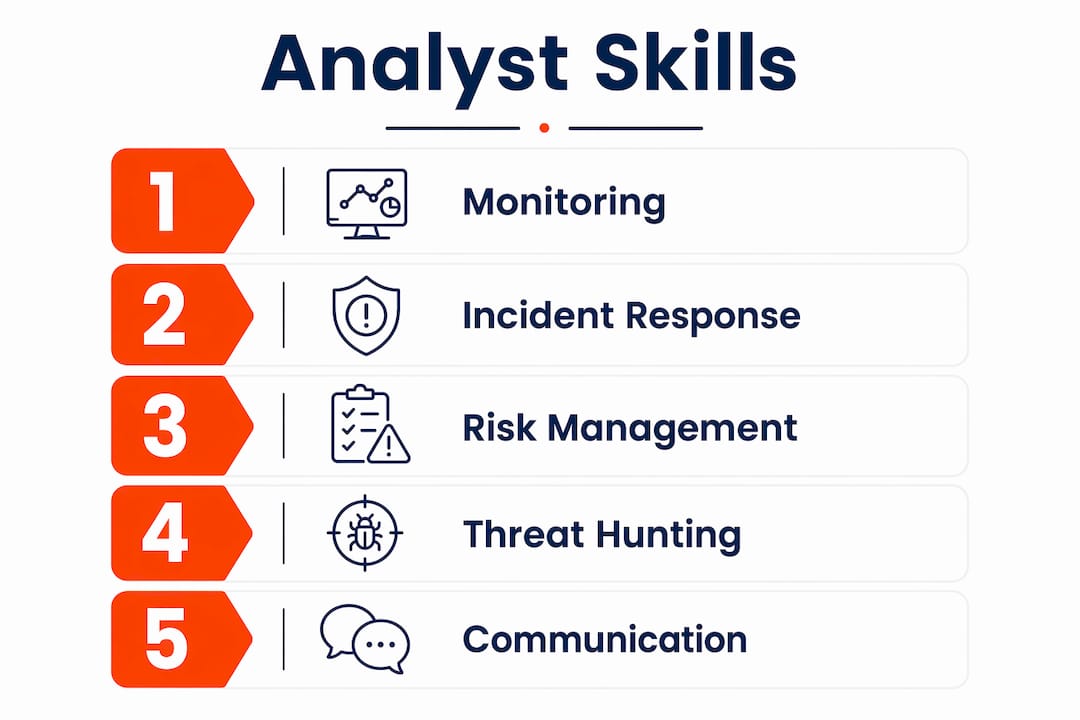
What skills do you need to be a cyber security analyst?
The technical skills get most of the attention, but the soft skills are what separate a good analyst from a great one. Especially in SMBs, where you are often the only security-focused person in the room.
Technical skills:
- Intrusion detection and analysis (understanding what an attack looks like in log data)
- Vulnerability assessment and management (tools like Nessus, Qualys, or Microsoft Defender Vulnerability Management)
- Incident response methodology (containment, eradication, recovery, lessons learned)
- Network security fundamentals (firewalls, VPNs, DNS, traffic analysis)
- SIEM operation and log analysis (Microsoft Sentinel, Splunk, or similar)
- Identity and access management (MFA, conditional access, privileged access controls)
- Understanding of the ACSC’s Essential Eight and ISM controls
Soft skills that actually matter:
- Communicating risk clearly to non-technical business owners
- Staying calm under pressure during an active incident
- Prioritising when everything feels urgent
- Writing clearly (incident reports, risk assessments, policy documents)
- Adapting quickly when the threat picture changes
The ability to translate technical risk into business language is genuinely undervalued. We work with clients who have a firewall, think they are secure, and have never heard of MFA. Getting them to act on a real risk requires communication skills, not just technical knowledge. An analyst who can only talk to other analysts is limited in an SMB environment.
Common mistakes Australian businesses make about the analyst role
This is where we get opinionated, because we see the same mistakes repeatedly.
The most common mistake is confusing a cyber security analyst with an IT support technician. Analysts do not reset passwords or fix printers. Their job is threat monitoring and incident response, not general IT help. When businesses blur that line, analysts end up spending half their time on helpdesk tickets and the security monitoring suffers.
The second big issue is the absence of an incident response plan. When a breach happens, and it will happen eventually, the analyst needs a documented process to follow. Without one, you get chaos: people calling each other, nobody sure who has authority to isolate systems, evidence getting destroyed. We have seen this play out. It is not pretty.
The third problem is poor executive engagement. Analysts cannot fix a culture problem from the bottom up. If the board does not understand cyber risk, budgets stay thin, MFA rollouts get delayed because “it is inconvenient,” and the analyst is fighting uphill on every recommendation. Honestly, this is the most frustrating situation for any security professional to be in.
In practice, the SMBs we support often have:
- No MFA on email or remote access
- Outdated hardware running unsupported operating systems
- Backups that have never been tested (or are not actually running)
- Admin accounts shared across multiple staff members
- No documented security policies at all
An analyst walking into that environment has a lot of work to do before they can focus on threat hunting.
How workplace maturity shapes what a cyber security analyst actually does
The analyst’s role changes significantly depending on how mature the organisation’s security posture is. In a low-maturity environment, the analyst is essentially building the programme from scratch. In a high-maturity environment, they are refining and optimising an existing framework.
The ACSC’s cyber security principles are clear that cyber security accountability must sit with executives and boards, not just the technical team. When a CISO or senior analyst reports directly to the board, governance is cleaner and conflicts of interest are reduced. When security reports through the CIO or COO, it often gets deprioritised against operational concerns.
Maturity levels and what analysts typically focus on at each stage:
- Low maturity: Basic hygiene work, building policies from scratch, enforcing MFA, patching backlogs, educating staff
- Developing maturity: Formalising incident response plans, implementing SIEM monitoring, aligning with Essential Eight
- Established maturity: Threat intelligence integration, regular penetration testing, security metrics reporting to the board
- Advanced maturity: Proactive threat hunting, red/blue team exercises, continuous compliance monitoring
Coordination between the security team and other business units is a daily reality. Analysts work with IT support teams on remediation, with HR on security awareness training, with legal on breach notification obligations, and with finance on budget prioritisation. The role is not siloed. A cyber risk management strategy that involves the whole business is far more effective than one that lives only in the IT department.
Initiatives like CyberPath Australia are helping Australian organisations build more defined career frameworks for analysts, which supports retention and reduces the burnout that comes from unclear expectations and no progression pathway.
How IT Start supports Australian businesses with cyber security
Most Brisbane SMBs do not have the budget for a full-time in-house analyst, and that is fine. IT Start’s managed cyber security services give you the monitoring, incident response capability, and security expertise of a dedicated analyst team without the overhead of a full-time hire.
We work with businesses of 10 to 50 staff across financial services, healthcare, legal, and professional services. We have seen the full range: clients with no MFA, clients who think their cloud backup is running when it stopped six months ago, clients with shared admin passwords on sticky notes. We fix those things, and then we build the security posture that actually holds up.
IT Start holds SMB 1001 Gold certification, which means our processes meet a recognised industry standard for managed security. If you want to know where your business actually stands, start with a free security assessment. You can reach the team directly through IT Start’s business IT support page to book a conversation.
FAQ
What exactly does a cyber security analyst do?
A cyber security analyst monitors systems and networks for threats, investigates security incidents, manages vulnerabilities, and coordinates incident response. Their work is aligned with frameworks like the ACSC’s Information Security Manual to protect organisational data and systems.
What skills do you need to be a cyber security analyst?
Core technical skills include intrusion detection, SIEM operation, vulnerability management, and knowledge of the ACSC Essential Eight. Equally important are soft skills like communicating risk clearly to non-technical stakeholders and staying composed during active incidents.
What is the salary outlook for cyber security analysts in Australia?
Entry-level analysts earn mid-level salaries that grow with experience, and senior roles are well compensated in the Australian market. Demand is strong, with the Australian government forecasting a workforce shortfall of over 17,000 cyber security professionals by 2026.
Can you move into cyber security from a general IT role?
Yes, and that is the most common pathway in Australia. Most analysts start in helpdesk or systems administration and transition into security roles over 3 to 5 years, building the technical foundation needed to work effectively in a security context.
What is the main purpose of cyber security in an organisation?
The main purpose is to protect information systems, data, and operations from threats that could disrupt the business or cause harm. Cyber security analysts are the people responsible for making that protection active and ongoing, not just a one-time setup.
Key takeaways
A cyber security analyst’s core job is continuous threat monitoring, incident response, and risk management aligned with the ACSC’s Information Security Manual, and in Australian SMBs that work almost always starts with fixing basic security hygiene.
| Point | Details |
|---|---|
| Core analyst duties | Monitor systems, triage alerts, coordinate incident response, and manage vulnerabilities aligned with the ISM. |
| Australian workforce demand | The government forecasts a shortfall of over 17,000 cyber security workers by 2026, making this a high-priority occupation. |
| Typical career entry | Most analysts start in IT helpdesk or systems administration and move into security roles within 3 to 5 years. |
| Salary range | Entry-level roles pay mid five-figure salaries; experienced analysts earn substantially more; senior roles command higher salaries. |
| IT Start | IT Start provides managed cyber security services for Australian SMBs, covering monitoring, incident response, and security posture improvement. |