

TL;DR:
- Effective cyber security governance is a formal structure that clarifies decision-making, policies, and response processes. For small to medium-sized businesses, implementing a practical governance model based on recognized frameworks like NIST CSF 2.0 ensures continuous oversight and accountability.
A cyber security governance policy is the formal structure that defines who makes security decisions, what rules apply, and how your business responds when things go wrong. Without it, security becomes reactive, inconsistent, and nearly impossible to audit. For small to medium-sized businesses, the industry term is an Information Security Management System (ISMS), and building one around a recognised framework like the NIST CSF 2.0 Govern function gives you a practical starting point. This guide walks you through how to implement cyber security governance policy in a way that actually works for a business with 10 to 50 staff, not a 500-person enterprise.
What does it mean to implement cyber security governance policy?
Governance is not a document. It is an operating model. Effective governance defines who makes decisions and why, rather than policing staff. That distinction matters because most SMBs treat governance as a compliance checkbox, write a policy document, file it away, and never look at it again.
The NIST CSF 2.0 Govern function introduced in 2024 formalised this thinking. It places governance at the centre of the framework, covering risk appetite, roles, accountability, and oversight. The message is clear: security decisions need a structure behind them, not just good intentions.
For a Brisbane SMB, this means three things. First, someone must own security decisions. Second, there must be written policies that staff can actually find and follow. Third, leadership must receive regular, plain-language reporting on security posture. Without all three, you do not have governance. You have paperwork.
Pro Tip: Start by asking one question: “If we had a breach tomorrow, who would make the call on what to do?” If the answer is unclear, your governance gap is already visible.
What do you need in place before you start?

Getting the groundwork right saves months of rework. Before you write a single policy, do a current-state assessment. That means reviewing what policies already exist, identifying your key regulatory obligations (Privacy Act 1988, industry-specific requirements for healthcare or financial services), and mapping the biggest security risks your business actually faces.
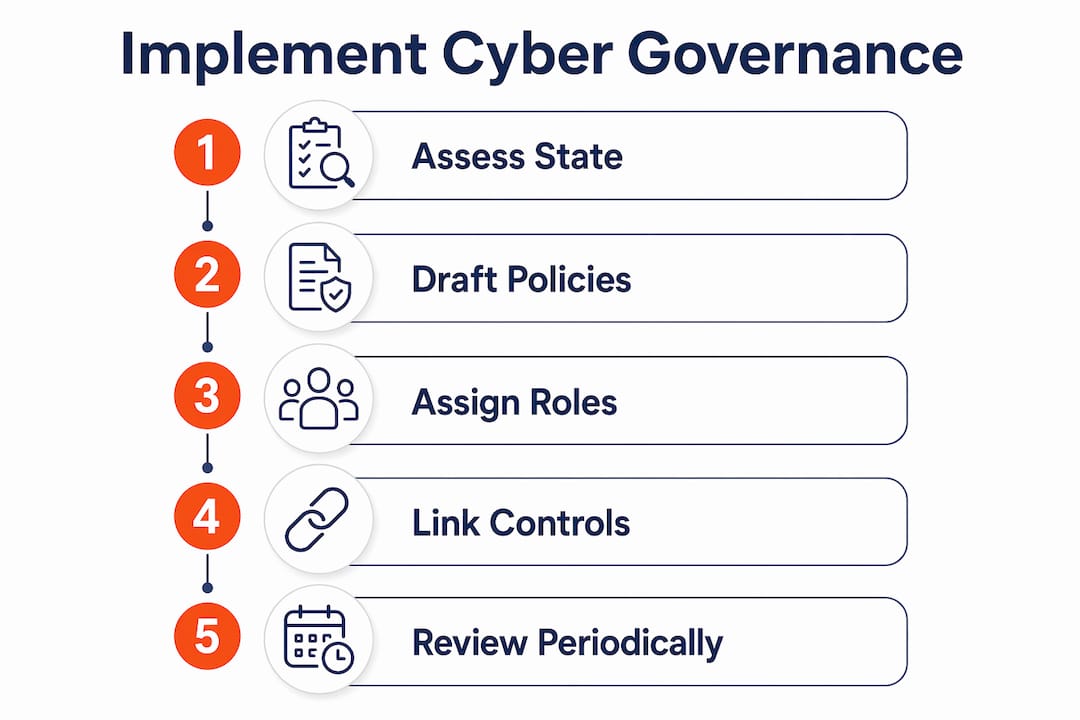
Most SMBs we work with have some policies buried in a shared drive that nobody reads. The first job is finding them, assessing whether they are current, and deciding what gaps exist. A simple spreadsheet works fine for this.
You also need to define scope. Governance for a 15-person accounting firm looks different from governance for a 50-person logistics company. Scope determines which systems, data types, and third parties fall under your policy framework.
Key prerequisites to confirm before you begin:
- Leadership buy-in. Without a director or owner visibly supporting governance, staff will not take it seriously.
- A documentation platform. SharePoint or a shared intranet works well. Transparency tools like SharePoint lists and dashboards support practical governance without creating excessive overhead.
- A governance charter. This one-page document defines scope, authority, meeting cadence, and reporting obligations. A well-structured charter also clarifies escalation paths so nobody improvises under pressure.
- Defined risk appetite. Leadership needs to agree on what level of risk is acceptable before you can write policies that reflect it.
- Realistic timelines. Building a full ISMS takes three to six months for most SMBs. Plan for it.
Pro Tip: Do not try to write all your policies at once. Start with the five most critical ones and get them approved and communicated before adding more.
How do you develop and implement the policies step by step?
A sound policy framework contains 5 to 15 foundational policies, with an information security policy as the umbrella document. For most SMBs, start with these five:
- Information security policy. The top-level document that states your commitment, scope, and principles.
- Access control policy. Defines who gets access to what, and how access is granted, reviewed, and removed.
- Incident response policy. Sets out how your business detects, reports, and responds to security incidents.
- Acceptable use policy. Covers how staff use company devices, email, and internet access.
- Data classification and handling policy. Defines what data you hold, how sensitive it is, and how it must be protected.
Once you have drafted these, assign ownership using a RACI matrix. RACI stands for Responsible, Accountable, Consulted, and Informed. It is a simple table that removes ambiguity about who does what.
| Role | Information Security Policy | Incident Response | Access Control |
|---|---|---|---|
| Business owner | Accountable | Accountable | Accountable |
| IT manager or MSP | Responsible | Responsible | Responsible |
| Department heads | Consulted | Informed | Consulted |
| All staff | Informed | Informed | Informed |
After the RACI is agreed, link each policy to the procedures and technical controls that support it. The access control policy, for example, should link directly to your Microsoft 365 conditional access settings and your MFA configuration. Policy without a matching technical control is just aspiration.
Set an oversight cadence. This means a quarterly security review with leadership, a monthly metrics report covering incidents, access reviews, and patch status, and an annual full policy review. Making governance board-ready means presenting outcomes in plain language, covering risk appetite, vendor accountability, and what decisions need to be made.
Pro Tip: Record every governance decision, exception, and review in writing. Auditors and insurers want evidence that governance is active, not just documented.
What mistakes do SMBs make when implementing governance?
Honestly, the most common mistake is treating governance as a one-time project. A business owner spends a weekend writing policies, uploads them to a shared drive, and considers the job done. Six months later, the policies are out of date and nobody has read them. Governance works as a continuous discipline with feedback loops, not a documentation sprint.
The second mistake is building too much process. We see this a lot. A business tries to replicate enterprise governance with 40-page policies, weekly committee meetings, and approval chains that slow everything down. The result is that nobody follows the process because it is too hard. Lightweight governance artifacts like a one-page annual security calendar and a clear RACI matrix are far more effective than a giant bureaucracy.
Other common pitfalls:
- No executive sponsor. Most SMBs overlook executive sponsorship and fail to communicate governance in business terms. Without a director or owner visibly championing governance, it stalls.
- No escalation path. When an incident happens, staff need to know exactly who to call and in what order. If that is not written down, people freeze or make bad decisions under pressure.
- Ignoring third parties. Your governance framework must cover vendors and suppliers who access your systems. A visible vendor register with review dates is a practical way to manage this.
- No review cycle. Policies that are never updated become liabilities. Set calendar reminders for annual reviews and trigger an unscheduled review after any significant incident or technology change.
“Security governance is not about controlling people. It is about making sure the right people have the right information to make the right calls.” This is the mindset shift that separates governance that works from governance that just looks good on paper.
How do you keep your governance policy current over time?
Governance that does not evolve becomes a liability. The goal is to embed security reviews into your normal business rhythm so they are not a separate burden.
Annual reviews are the minimum. A full policy review is recommended every year or after major events like a merger, a significant technology change, or a security incident. The review should check whether policies still reflect how the business actually operates, not just whether the document exists.
Practical ways to maintain governance maturity:
- Monthly metrics dashboard. Track incidents reported, access reviews completed, patches applied, and open exceptions. This gives leadership a real picture of security posture without requiring technical knowledge.
- Post-incident reviews. After any security event, update the relevant policy or procedure within 30 days. Do not wait for the annual cycle.
- Staff awareness checks. Test whether staff know what to do in a phishing scenario or a data breach. If they do not, the policy is not working.
- Governance maturity assessment. The NIST CSF 2.0 maturity scale runs from Partial to Adaptive. Run a gap analysis annually to see where you sit and what the next improvement looks like.
| Governance activity | Frequency | Owner |
|---|---|---|
| Policy review | Annual | Business owner or IT manager |
| Security metrics report | Monthly | IT manager or MSP |
| Post-incident policy update | Within 30 days of incident | IT manager |
| Vendor register review | Annual | IT manager or MSP |
| Staff awareness check | Bi-annual | HR or IT manager |
Integrating governance with your broader enterprise risk management approach means security decisions sit alongside financial and operational risk, not separate from them. That is when governance starts influencing real business decisions.
Key takeaways
Effective cyber security governance policy requires clear decision rights, written foundational policies, executive sponsorship, and a regular review cycle to remain useful over time.
| Point | Details |
|---|---|
| Start with five core policies | Draft an information security, access control, incident response, acceptable use, and data classification policy first. |
| Use a RACI matrix | Assign clear ownership for every policy to prevent confusion when incidents occur. |
| Make governance continuous | Schedule monthly metrics reviews and annual policy updates rather than treating governance as a one-off project. |
| Secure executive sponsorship | Leadership visibility is the single biggest factor in whether staff take governance seriously. |
| Keep artifacts lightweight | A one-page charter and a clear vendor register outperform a 40-page policy nobody reads. |
Matt’s take on governance for SMBs
Honestly, I have seen more governance failures caused by over-engineering than by under-investment. A business owner spends months building a policy library that would impress a Big Four auditor, then nobody follows it because it is too complicated for a 20-person team to manage. The policies sit in a folder, the staff do not know they exist, and the business is no more secure than before.
What actually works for SMBs is governance that fits the size of the business. Three to five clear policies, a one-page RACI, a monthly 15-minute security check-in with the owner, and a shared drive where everything lives. That is it. You can always add complexity later as the business grows.
The other thing I push back on is the idea that governance is an IT problem. It is not. It is a business problem. The IT team or your MSP can build the technical controls, but the decision about what risk is acceptable, what data matters most, and what the business will do in a crisis, those are leadership decisions. If the owner is not involved, governance will always be incomplete.
For Brisbane SMBs specifically, the cybersecurity best practices conversation has shifted a lot in the past two years. Clients are asking better questions. They want to know what their obligations are, not just whether their antivirus is up to date. That is progress. But the gap between asking the right questions and having a working governance framework is still significant for most businesses we see.
Start small, get leadership involved, and treat governance as something you maintain, not something you finish.
— Matt
How IT Start supports your governance policy
IT Start works with Brisbane SMBs to build and maintain cyber security governance frameworks that fit the size and complexity of your business. The team helps you draft foundational policies, set up a RACI structure, and establish a reporting cadence that keeps leadership informed without requiring technical expertise. IT Start holds SMB 1001 Gold certification, which means the governance approach is grounded in recognised Australian standards. Whether you need help with cybersecurity services from the ground up or want to strengthen an existing framework, IT Start provides the practical support to make governance work in the real world. For businesses moving to the cloud, cloud security solutions are built into the governance approach from day one. Reach out to IT Start for a no-obligation consultation.
FAQ
What is a cyber security governance policy?
A cyber security governance policy is a formal structure that defines who makes security decisions, what rules apply, and how the business manages and reports on security risk. It is the foundation of an Information Security Management System (ISMS).
How many policies does an SMB need to start?
An effective policy framework contains 5 to 15 foundational policies, with an information security policy as the umbrella document. Most SMBs should start with five core policies and expand from there.
How often should a cyber security governance policy be reviewed?
Policies should be reviewed annually at minimum, and immediately after a significant incident, merger, or major technology change. Monthly metrics reporting keeps leadership informed between full reviews.
What is a RACI matrix and why does it matter?
A RACI matrix assigns Responsible, Accountable, Consulted, and Informed roles for each policy or process. It removes ambiguity about who owns security decisions and prevents gaps when an incident occurs.
What framework should an SMB use for cyber governance?
The NIST CSF 2.0 Govern function is the most practical starting point for SMBs. It covers risk appetite, roles, accountability, and oversight in a format that scales to businesses of any size.