

TL;DR:
- Cyber security must be a core business priority, not just an IT concern, to prevent breaches. Most attacks exploit simple, preventable vulnerabilities like no multi-factor authentication and outdated software. Building resilience through planning, culture, and tested responses reduces long-term damage and enhances recovery.
Cyber security for a company means embedding security as a core business priority, not outsourcing the worry to your IT person and hoping for the best. 43% of businesses reported a breach or attack in the last 12 months. That is not a large-enterprise problem. Brisbane SMBs with 10 to 50 staff are in that number, often because they rely on Microsoft 365 without multi-factor authentication enabled, or they assume their cloud subscription counts as a backup. The good news is that the controls that stop most attacks are not complicated or expensive. You just need to actually implement them.
Why are small businesses prime targets for cyber attacks?
The assumption that hackers only go after big companies is the most dangerous belief we encounter. SMBs are targeted as soft entry points into larger supply chains, meaning your business may be attacked not for your data alone, but to reach a bigger client or partner you supply. That changes the risk calculation entirely.
The weaknesses attackers exploit are rarely exotic. They are boring and preventable:
- No MFA on email accounts. A stolen password is all it takes to own your Microsoft 365 tenancy.
- Shared credentials. One login used by three staff, never rotated, sometimes written on a sticky note near the monitor.
- Unmanaged personal devices. Staff checking work email on a phone with no PIN and no endpoint management.
- Outdated software. Machines running Windows 10 past end of support, or applications that have not been patched in months.
- False confidence in backups. We see this constantly. Business owners believe they are backed up because Microsoft 365 is “in the cloud.” Microsoft does not back up your data the way you think it does.
Vulnerability exploitation now accounts for 31% of all initial access vectors, overtaking credential abuse for the first time. That means unpatched systems are now the single biggest door attackers walk through.
Pro Tip: If you have not audited who has admin access to your Microsoft 365 environment in the last six months, do it today. You will almost certainly find accounts that should not be there.

What core cyber security controls should a company implement now?
The Verizon 2026 Data Breach Investigations Report is blunt: most breaches stem from foundational security failures, not sophisticated zero-day exploits. Fixing the basics delivers more protection per dollar than any premium security product. Here is what that looks like in practice for a Brisbane SMB.
-
Enable MFA on everything. Start with Microsoft 365, your accounting software, and your remote access tools. MFA blocks the overwhelming majority of credential-based attacks. Use Microsoft Authenticator, not SMS codes where possible, because SIM-swapping attacks can intercept SMS.
-
Patch and update on a schedule. Set Windows Update to automatic for workstations. For servers and network equipment, establish a monthly patching window. Unpatched systems are the number one way ransomware gets in.
-
Apply least privilege access. Staff should only have access to the systems and data they need for their role. If your receptionist has global admin rights on your server, that is a problem waiting to happen.
-
Deploy endpoint protection. Microsoft Defender is included with Microsoft 365 Business Premium and is genuinely good. Tools like Kaspersky Endpoint Security or Sophos Intercept X are solid alternatives. The key is that something is actively monitoring every device.
-
Run encrypted, tested backups. Backups must be stored separately from your primary systems, ideally with an offline or immutable copy. Test restoration quarterly. A backup you have never restored is not a backup.
-
Train your staff to spot phishing. Send simulated phishing emails using tools like KnowBe4 or Microsoft Attack Simulator. Track who clicks. Train those people. Repeat every quarter.
Pro Tip: Business email compromise is the most financially damaging attack type for SMBs. Train staff to verify any payment request or change of bank details by phone, even if the email looks legitimate.
How does the NIST Cybersecurity Framework help companies improve security?
The NIST Cybersecurity Framework (CSF) is the most widely used structure for building and measuring corporate cyber defence. Benchmarking against NIST CSF maps your security posture across six functions: Govern, Identify, Protect, Detect, Respond, and Recover. Each function gives you a clear category of work to assess and improve.
For Brisbane SMBs, the value of NIST CSF is not compliance. It is clarity. Most business owners do not know what they do not know about their security posture. The framework gives you a checklist you can actually use to find the gaps, and it gives your IT provider or MSP a common language to report against.
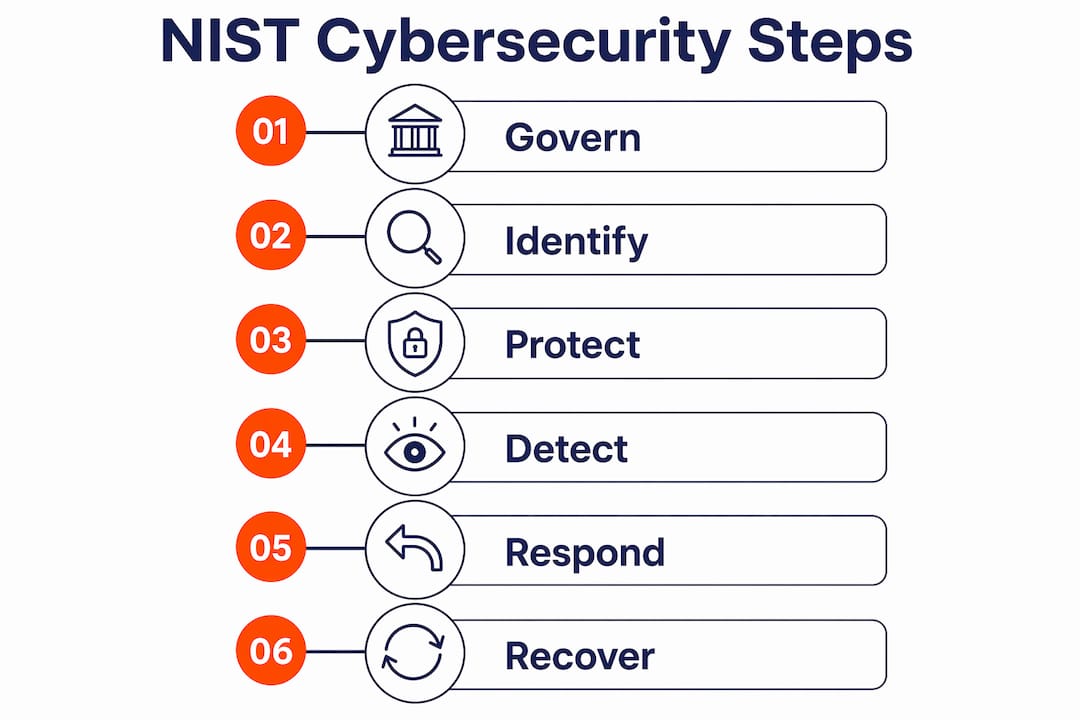
Security frameworks like NIST CSF also give non-technical leadership structured metrics and communication tools. That matters because cyber security decisions made without business context tend to be either over-engineered or completely ignored.
| NIST CSF function | What it means for your business |
|---|---|
| Govern | Who owns security decisions and what is your risk appetite? |
| Identify | What assets, data, and systems do you have and what are the risks? |
| Protect | What controls are in place to prevent or limit attacks? |
| Detect | How quickly would you know if something went wrong? |
| Respond | What is your plan when an incident occurs? |
| Recover | How do you restore operations and communicate after a breach? |
Honestly, most SMBs we work with score well on Protect (they have antivirus) and very poorly on Detect and Respond. They would not know they had been breached for days or weeks. That gap is where the real damage happens. For Queensland businesses wanting to go deeper on this, IT Start has written specifically about the NIST CSF for Queensland SMBs and how to apply it without a dedicated security team.
Why is cyber resilience more effective than prevention alone?
Prevention is necessary but not sufficient. Assuming breaches will happen and embedding resilience into business culture produces markedly better outcomes than treating security as a wall you build and forget. The businesses that recover fastest from incidents are the ones that planned for it before it happened.
Cyber resilience means a few specific things in practice:
- A written incident response plan. Not a document that lives in a drawer. A plan your team has actually read, with clear roles, contact lists, and decision trees. IT Start has a practical incident response plan example built for SMBs if you need a starting point.
- Business continuity thinking. If your server goes down at 9am on a Monday, how long until you are operational again? If the answer is “we don’t know,” that is your next project.
- Leadership involvement. Cybersecurity is a cultural issue, not just an IT issue. When the business owner treats security as a priority, staff follow. When it is treated as someone else’s problem, it becomes everyone’s problem after a breach.
- Regular testing. Run tabletop exercises. Simulate a ransomware attack in a meeting room and walk through your response. You will find gaps you never expected.
67% of executive leaders see cyber resilience as critical, yet only 24% have fully integrated the tools and processes to act on it. That gap between intention and execution is exactly where SMBs get hurt. The good news is that 55% of organisations now use managed service providers to close that gap, particularly for continuous threat monitoring.
The shift in thinking is this: stop asking “how do we prevent every attack?” and start asking “how do we detect fast and recover faster?” Mean time to detect (MTTD) and mean time to respond (MTTR) are the metrics that actually determine how much damage a breach causes. Reducing both by even a few hours can be the difference between a recoverable incident and a catastrophic one.
Key takeaways
Effective cyber security for a company requires foundational controls, a resilience mindset, and business-wide ownership, not just an antivirus subscription.
| Point | Details |
|---|---|
| MFA is non-negotiable | Enable multi-factor authentication on Microsoft 365 and all critical systems before anything else. |
| Patch on a schedule | Unpatched systems are the leading entry point for ransomware and account for 31% of initial access vectors. |
| Use NIST CSF as a guide | Map your security posture across all six NIST functions to find gaps and plan improvements clearly. |
| Plan for breach, not just prevention | Build an incident response plan and test it so your team knows what to do when, not if, something happens. |
| Culture drives outcomes | When leadership treats security as a business priority, staff behaviour follows and breach impact reduces. |
What I have learned from working with Brisbane SMBs on security
Honestly, the thing that surprises me most is not how unsophisticated the attacks are. It is how preventable the damage is. We have onboarded clients who had been running without MFA for years, with shared admin passwords, and no tested backup. They thought they were fine because nothing bad had happened yet. That is not security. That is luck.
The other thing I see constantly is the backup problem. A client will say “yes, we back up to OneDrive.” OneDrive is file sync, not backup. If ransomware encrypts your files, OneDrive syncs the encrypted versions. You need a separate, immutable backup that ransomware cannot touch. This is not a technical edge case. It is a fundamental misunderstanding that costs businesses everything.
My honest advice: stop treating cyber security as an IT project and start treating it like business continuity. You insure your building. You lock your doors. Security is the same thing for your data and systems. Start with MFA, fix your backups, and get someone to improve your security practices with a proper review. The basics done well beat any fancy product.
— Matt
How IT Start helps Brisbane businesses build real security
IT Start works with Brisbane SMBs every day on exactly these problems. We manage Microsoft 365 environments, deploy and monitor endpoint protection, set up tested backup solutions, and help businesses build incident response plans that actually work. We hold SMB 1001 Gold certification, which means our security practices are independently verified, not self-assessed. If you want to know where your business stands, start with our cyber security services page, which covers everything from security assessments to ongoing managed monitoring. For businesses also looking at cloud security and hosted environments, we can help you build a setup that is both practical and protected. No jargon, no overselling. Just honest advice from people who do this work every day in Brisbane.
FAQ
What is cyber security for a company?
Cyber security for a company is the set of controls, processes, and cultural practices that protect business systems, data, and operations from unauthorised access, theft, or disruption. It covers everything from MFA and patching to incident response planning and staff training.
Why are SMBs targeted by cyber criminals?
SMBs are targeted because they typically have weaker security controls than large enterprises but still hold valuable data and often connect to larger supply chain partners. Attackers treat them as soft entry points with lower risk and reasonable reward.
What is the most important security control for a small business?
Multi-factor authentication is the single highest-impact control for most small businesses. It blocks the majority of credential-based attacks, which remain one of the most common ways attackers gain access to business systems.
How does the NIST Cybersecurity Framework apply to small businesses?
The NIST CSF gives small businesses a structured way to assess and improve security across six functions: Govern, Identify, Protect, Detect, Respond, and Recover. It does not require a dedicated security team and works well as a planning tool for SMBs working with an MSP.
What is the difference between cyber security and cyber resilience?
Cyber security focuses on preventing attacks. Cyber resilience accepts that breaches will occur and prioritises fast detection, response, and recovery to minimise business impact. Both are necessary, but resilience thinking produces better outcomes when prevention fails.