

Selecting the right cloud solution can feel daunting for many financial services firms in Brisbane, especially with evolving compliance and cybersecurity demands. Australian Government guidance highlights cloud infrastructure as essential for secure data management, real-time access, and productivity gains. This guide explains how public, private, and hybrid cloud options can offer flexible, cost-effective technology, helping you match operational objectives with rigorous security standards and regulatory requirements.
Table of Contents
- Defining Cloud Services for Australian Businesses
- Public, Private, and Hybrid Cloud: What Suits SMEs?
- Essential Features for Security and Compliance
- Evaluating Costs and Long-Term Value
- Risks, Common Pitfalls, and Local Support Insights
Key Takeaways
| Point | Details |
|---|---|
| Cloud services enable scalability and cost-effectiveness | Australian businesses can tailor computing resources to their needs, paying only for what they consume. |
| Understanding cloud deployment models is essential | Choosing between public, private, or hybrid clouds allows SMEs to align technology with strategic goals. |
| Comprehensive security and compliance are critical | Essential security features protect sensitive information and maintain regulatory standards across industries. |
| Evaluate long-term costs for cloud investments | A thorough financial assessment considers not just initial costs but also ongoing operational efficiency and potential growth. |
Defining Cloud Services for Australian Businesses
Cloud services represent a transformative digital infrastructure enabling businesses across Australia to access flexible, scalable computing resources without massive upfront technology investments. These internet-delivered computing solutions allow organisations to consume technological capabilities on-demand, scaling resources precisely to their operational requirements.
The Australian Government’s digital strategy highlights cloud computing as a critical enabler for modern business productivity. Cloud services fundamentally differ from traditional IT infrastructure by offering several key advantages:
- Scalability: Rapidly adjust computing resources based on business needs
- Cost-effectiveness: Pay only for resources actually consumed
- Flexibility: Access services from anywhere with internet connectivity
- Security: Advanced protection mechanisms managed by specialised providers
For Brisbane SMEs, cloud services typically manifest in three primary models:
- Infrastructure as a Service (IaaS): Virtualised computing resources
- Platform as a Service (PaaS): Development and deployment environments
- Software as a Service (SaaS): Ready-to-use software applications
Cloud services represent more than technology – they’re strategic business enablers transforming how Australian enterprises operate and compete.
Deployment models further diversify cloud service options, including public, private, and hybrid cloud architectures. Each model offers distinct advantages depending on an organisation’s specific security, compliance, and operational requirements.
Pro tip: Before selecting a cloud service, conduct a comprehensive audit of your current IT infrastructure and future scalability needs to ensure optimal alignment.
Public, Private, and Hybrid Cloud: What Suits SMEs?
Australian small and medium enterprises face complex decisions when selecting cloud infrastructure, with each cloud deployment model offering unique advantages tailored to specific business requirements. Technology adoption research highlights the critical importance of understanding these models to optimise technological investments.
The three primary cloud deployment models present distinct characteristics for Brisbane SMEs:
- Public Cloud: Cost-effective, scalable, managed by third-party providers
- Private Cloud: Enhanced security, dedicated infrastructure, greater control
- Hybrid Cloud: Flexible combination of public and private cloud resources
Public cloud services provide the most economical entry point for SMEs, offering:
- Lower upfront infrastructure costs
- Rapid scalability
- Minimal maintenance requirements
- Pay-as-you-go pricing models
Choosing the right cloud model isn’t just about technology – it’s about aligning digital infrastructure with your business strategy.
Private cloud solutions offer heightened security and customisation, making them particularly attractive for businesses with stringent compliance requirements or sensitive data handling needs. Hybrid cloud architectures emerge as a sophisticated compromise, allowing organisations to balance cost-effectiveness with robust security protocols.

Here’s a concise comparison of primary cloud deployment models relevant for Brisbane SMEs:
| Model | Typical Use Case | Customisation Level | Security Protocols |
|---|---|---|---|
| Public Cloud | Startups & cost-sensitive SMEs | Limited | Provider-managed, basic |
| Private Cloud | Regulated industries | High | Tailored, advanced |
| Hybrid Cloud | Growing SMEs, mixed workloads | Moderate | Flexible, blended |
Pro tip: Conduct a comprehensive technology audit to map your specific operational needs before selecting a cloud deployment strategy.
Essential Features for Security and Compliance
Cloud security and compliance represent critical considerations for Brisbane SMEs navigating complex technological landscapes. Australian cybersecurity frameworks mandate robust protection mechanisms to safeguard sensitive business information and maintain regulatory standards.
Key security and compliance features essential for cloud services include:
- Data Encryption: Protecting information at rest and in transit
- Multi-Factor Authentication: Preventing unauthorised system access
- Regular Security Audits: Identifying and addressing potential vulnerabilities
- Compliance Tracking: Ensuring alignment with industry-specific regulations
Comprehensive cloud security requires a multifaceted approach addressing several critical domains:
- Access Control Management
- Continuous Threat Monitoring
- Incident Response Planning
- Data Backup and Recovery Protocols
Security is not a product, but a comprehensive process of continuous assessment and improvement.
For financial services and healthcare industries, additional compliance requirements demand even more stringent security protocols. Regulatory compliance involves maintaining detailed documentation, implementing strict access controls, and demonstrating ongoing commitment to data protection standards.
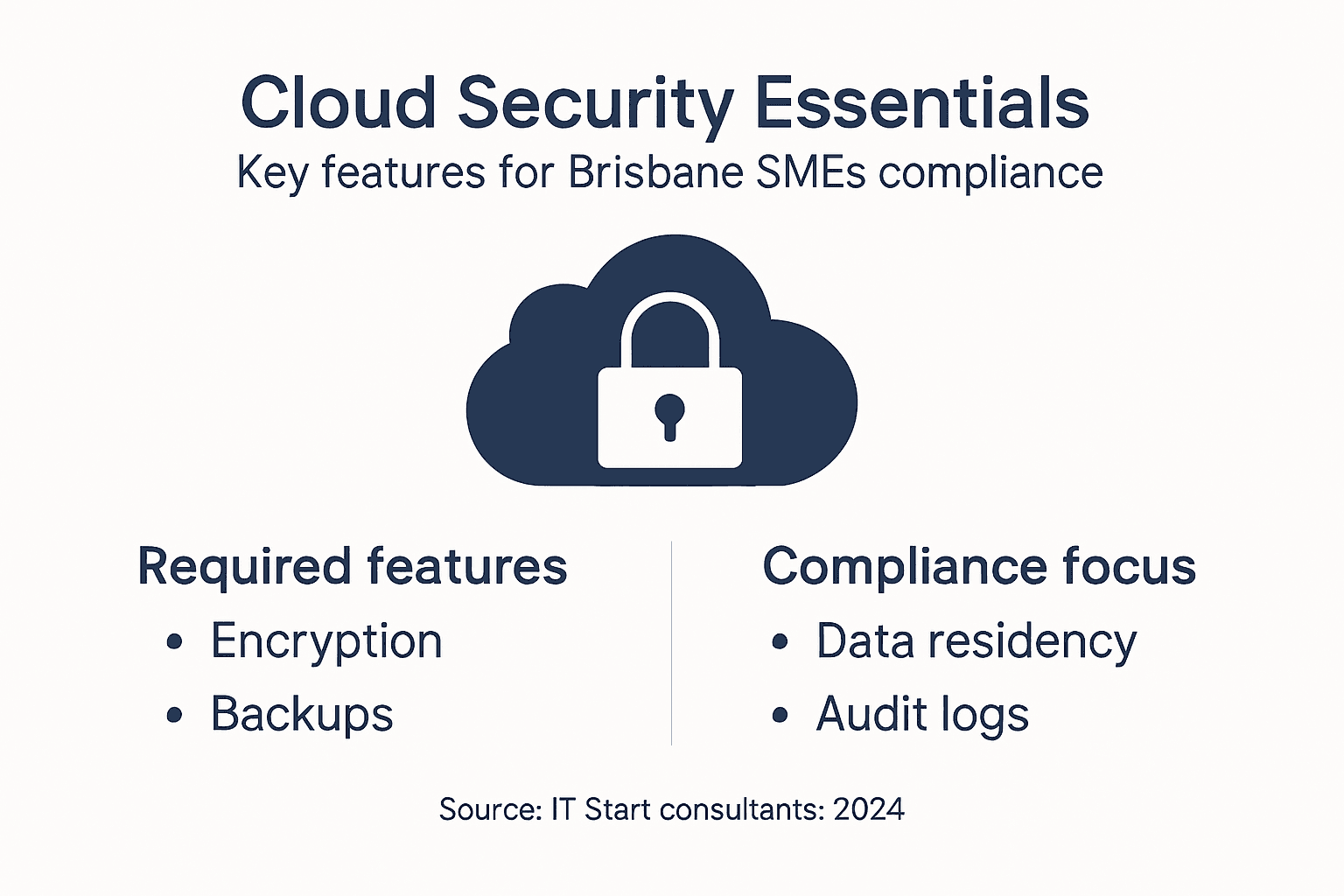
For rapid reference, here are crucial security and compliance features and their impact for Australian businesses:
| Feature | Business Impact | Compliance Relevance |
|---|---|---|
| Data Encryption | Prevents unauthorised access | Meets privacy obligations |
| Multi-Factor Authentication | Reduces internal security risk | Essential for sensitive sectors |
| Security Audits | Identifies weaknesses | Supports regulatory reporting |
| Compliance Tracking | Demonstrates standards met | Required in finance & healthcare |
Pro tip: Engage an independent cybersecurity consultant to conduct a comprehensive vulnerability assessment before finalising your cloud service strategy.
Evaluating Costs and Long-Term Value
Economic research from the Reserve Bank emphasises the critical importance of comprehensive financial evaluation for cloud service investments. Brisbane SMEs must look beyond initial pricing to understand the holistic economic impact of their technological infrastructure decisions.
Key cost considerations for cloud services include:
- Initial Implementation Expenses: Setup costs and migration investments
- Recurring Operational Costs: Monthly or annual service subscriptions
- Productivity Gains: Potential efficiency improvements
- Scalability Potential: Cost-effectiveness of future growth
A strategic financial assessment requires examining multiple economic dimensions:
- Direct technological expenditure
- Indirect operational efficiency gains
- Potential risk mitigation savings
- Long-term competitive advantage potential
Cloud investments are not expenses, but strategic financial instruments driving business transformation.
Budgeting for cloud services extends beyond simple price comparisons. Total cost of ownership encompasses infrastructure modifications, staff training, potential productivity improvements, and risk reduction strategies that contribute to overall financial performance.
Pro tip: Request detailed cost projections from potential cloud providers, including worst-case and best-case financial scenarios to inform comprehensive decision-making.
Risks, Common Pitfalls, and Local Support Insights
Digital infrastructure research reveals that Brisbane SMEs face significant challenges when adopting cloud technologies, requiring strategic understanding of potential risks and mitigation strategies. Navigating these complexities demands comprehensive awareness and proactive planning.
Common cloud service risks for local businesses include:
- Data Security Vulnerabilities: Potential breaches and unauthorised access
- Integration Complexity: Challenges connecting existing systems
- Performance Inconsistencies: Unexpected service disruptions
- Compliance Management: Meeting industry-specific regulatory requirements
Critical risk categories demand targeted strategic responses:
- Technical infrastructure limitations
- Operational workflow disruptions
- Financial investment uncertainties
- Cybersecurity exposure points
Technology adoption is not about eliminating risks, but managing them intelligently and strategically.
Local Brisbane support networks play a crucial role in mitigating these challenges. Managed service providers can offer tailored guidance, helping businesses navigate complex technological transitions with minimal operational disruption.
Pro tip: Engage multiple local IT consultants to conduct independent cloud readiness assessments before making significant technological investments.
Get the Perfect Cloud Solution for Your Brisbane SME Today
Selecting the right cloud services can feel overwhelming with so many options like public, private, and hybrid models discussed in the article. Key challenges Brisbane SMEs face include managing security risks, ensuring compliance, and controlling costs while scaling technology effectively. You need a trusted partner who understands these pain points and can tailor the ideal cloud strategy aligned to your business goals.
At IT Start, we specialise in delivering customised managed IT support and cloud solutions designed to help Brisbane businesses overcome these exact challenges. Our proactive approach focuses on security, scalability, and operational efficiency so you can confidently embrace digital transformation. With local expertise and industry-leading certifications ensuring your compliance and cybersecurity needs are met, we make complex technology simple.
Ready to take the next step in optimising your cloud infrastructure? Discover how our expert team can align your cloud deployment strategy with your business vision. Contact us now for a free consultation and assessment at IT Start Contact Us and start securing your business future today.
Explore our tailored Managed IT Support Services and learn more about our comprehensive Cloud Solutions designed specifically for Brisbane SMEs.
Frequently Asked Questions
What are the key types of cloud services for SMEs?
Cloud services for SMEs generally fall into three categories: Infrastructure as a Service (IaaS), which provides virtualised computing resources; Platform as a Service (PaaS), which offers development and deployment environments; and Software as a Service (SaaS), which includes ready-to-use software applications.
How do I choose between public, private, and hybrid cloud deployment models?
Choosing the right cloud deployment model hinges on your specific business needs: public clouds offer cost-effectiveness and scalability; private clouds provide enhanced security and control; while hybrid clouds combine the best aspects of both, allowing flexibility without compromising safety.
What are the essential security features to look for in cloud services?
When selecting cloud services, essential security features include data encryption to protect sensitive information, multi-factor authentication to prevent unauthorised access, regular security audits to identify vulnerabilities, and compliance tracking to ensure regulatory standards are met.
What economic factors should Brisbane SMEs consider before adopting cloud services?
Brisbane SMEs should evaluate various economic factors including initial implementation expenses, recurring operational costs, potential productivity gains from cloud efficiencies, and long-term scalability for future growth. A total cost of ownership approach ensures comprehensive financial understanding.