

Cyber threats cost Australian businesses over $33 billion each year. For Brisbane companies, understanding your current digital risks can mean the difference between smooth operations and major disruption. Protecting your technology and data starts with practical steps that secure every layer of your organisation. This guide walks you through a proven process to strengthen cybersecurity, from identifying weaknesses to keeping your team and systems a step ahead of potential attacks.
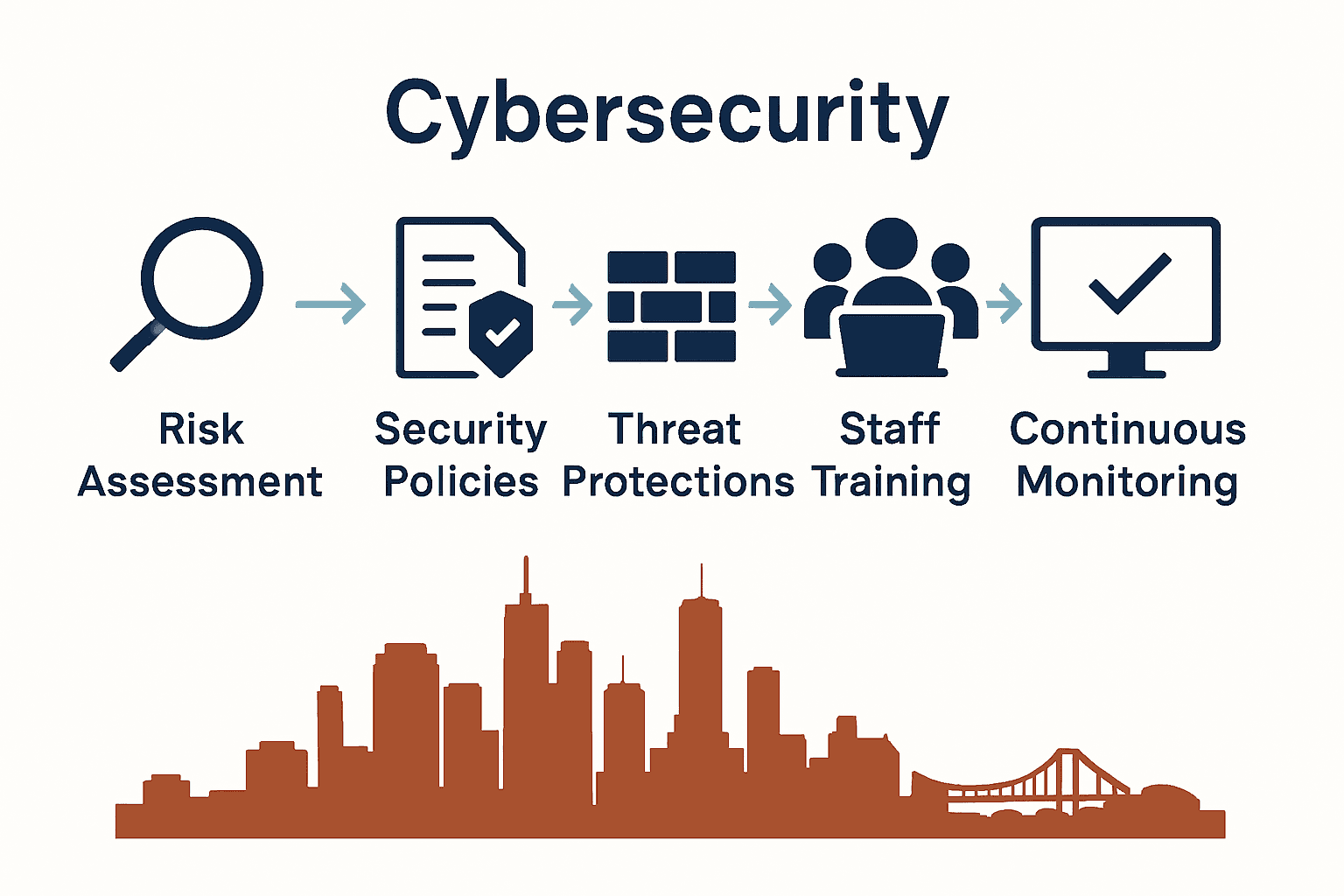
Quick Navigation: 5-Step Cybersecurity Guide for Brisbane Businesses
- Step 1: Assess Current Risks And Vulnerabilities
- Step 2: Establish Security Policies And Controls
- Step 3: Implement Advanced Threat Protections
- Step 4: Educate And Train Your Staff
- Step 5: Monitor, Audit, And Verify Compliance
Quick Summary
| Key Point | Explanation |
|---|---|
| 1. Conduct a comprehensive risk assessment | Identify and evaluate potential cybersecurity weaknesses in your business using a systematic approach and the Cyber Health Check Tool. |
| 2. Develop robust security policies | Create detailed cybersecurity policies that protect your assets and establish clear rules for employee access and data management. |
| 3. Implement advanced threat protections | Deploy layered security measures, such as multi-factor authentication and regular software updates, to defend against cyber threats. |
| 4. Educate and train staff regularly | Train employees on cybersecurity essentials like recognizing phishing attempts and safe internet practices to transform them into a defense mechanism. |
| 5. Continuously monitor and audit your systems | Establish a routine for regular security audits and vulnerability assessments to ensure ongoing alignment with best practices and compliance. |
Step 1: Assess current risks and vulnerabilities
In this crucial first step, you will systematically identify and evaluate potential cybersecurity weaknesses specific to your Brisbane business. Understanding your current security landscape allows you to develop targeted strategies that protect your critical digital assets.
Start by conducting a comprehensive vulnerability assessment using the Cyber Health Check Tool recommended by the Australian Business Government website. This tool helps you pinpoint exactly where your organisation’s cybersecurity might have gaps. Focus on key areas like network infrastructure, data storage systems, employee access controls, and current software configurations.
As noted by Cyber.gov.au, board level involvement is critical during this assessment phase. Engage your leadership team to ensure a top down approach to identifying potential risks. Consider engaging a professional cybersecurity consultant who can provide an external perspective and help you uncover vulnerabilities that internal teams might overlook.

Key areas to thoroughly examine include:
- Current network architecture
- User access management protocols
- Software patch management processes
- Endpoint device security
- Third party vendor security integrations
Remember that risk assessment is not a one time event. Establish a regular schedule for reviewing and updating your vulnerability assessment to stay ahead of emerging threats in Queensland’s dynamic business technology landscape.
Step 2: Establish security policies and controls
In this critical step, you will develop comprehensive cybersecurity policies that protect your Brisbane business from potential digital threats. Creating a robust security framework will help safeguard your organisation’s valuable technology and information assets.
According to Business.gov.au, a cybersecurity policy should outline the specific technology and information assets you need to protect, identify potential threats to those assets, and establish clear rules and controls for comprehensive protection. Start by documenting a detailed policy that covers all aspects of your digital infrastructure.
The Australian Taxation Office recommends implementing strict access controls to limit employee access to sensitive accounts, systems, programs, and files. This means creating tiered permission levels that ensure staff can only access information directly relevant to their roles.
Key components of your security policy should include:
- Detailed user authentication protocols
- Clear guidelines for password management
- Procedures for handling sensitive data
- Remote work and device usage rules
- Incident response and reporting mechanisms
Remember that a security policy is a living document. Review and update it regularly to adapt to evolving technological landscapes and emerging cybersecurity challenges specific to Brisbane businesses.

Step 3: Implement advanced threat protections
In this critical stage, you will deploy sophisticated cybersecurity measures to proactively defend your Brisbane business against evolving digital threats. Advanced threat protections create multiple layers of security that help prevent unauthorized access and potential cyber incidents.
According to Cyber.gov.au, implementing robust security controls is essential. At a minimum, ensure all business devices are locked with strong authentication methods such as passphrases, PINs, or biometric security. This simple step significantly reduces the risk of unauthorized device access.
Business.gov.au emphasizes the importance of applying software updates and patches promptly. Regular patching reduces potential vulnerability windows where cybercriminals could exploit system weaknesses. Consider implementing an automated patch management system that ensures all your business software and operating systems remain current.
Key advanced threat protection strategies include:
- Multi factor authentication
- Next generation antivirus software
- Advanced endpoint detection and response systems
- Network segmentation
- Real time threat monitoring
Pro Tip: Work with a local Brisbane IT security specialist who understands the specific cyber risk landscape for Queensland businesses.
Remember that threat protection is an ongoing process. Continuously evaluate and upgrade your security infrastructure to stay ahead of emerging cyber risks.
Step 4: Educate and train your staff
In this crucial step, you will transform your employees from potential cybersecurity vulnerabilities into your organisation’s strongest defense mechanism. Comprehensive staff training creates a human firewall that can identify and prevent potential cyber threats before they compromise your business.
According to Cyber.gov.au, restricting access to business devices is fundamental in reducing opportunities for malicious activity. This means developing clear protocols about device usage, data handling, and access permissions that every team member understands and follows.
Business.gov.au recommends taking sensible precautions like choosing strong passwords or passphrases. Develop a mandatory training program that teaches your Brisbane staff practical cybersecurity skills such as recognising phishing attempts, creating robust passwords, and understanding social engineering tactics.
Key training components should include:
- Phishing and social engineering awareness
- Password management techniques
- Safe internet and email practices
- Reporting suspicious activities
- Understanding company security policies
Pro Tip: Conduct regular simulated phishing tests to help staff recognize and respond to potential cyber threats.
Remember that cybersecurity education is not a one time event. Schedule quarterly refresher training and stay updated on the latest digital security trends specific to Queensland businesses.
Step 5: Monitor, audit, and verify compliance
In this critical final stage, you will establish a systematic approach to continuously tracking, evaluating, and ensuring your cybersecurity measures remain effective and aligned with best practices. Regular monitoring transforms your security strategy from a static defense to a dynamic, responsive protection system.
According to Cyber.gov.au, board level involvement is crucial in planning for potential cybersecurity vulnerabilities. This means creating a comprehensive audit process that provides senior leadership with clear, actionable insights into your organisation’s security performance and potential risk areas.
Business.gov.au recommends utilizing the Cyber Health Check Tool to assess your current security posture. Implement a regular audit schedule that includes:
- Quarterly comprehensive security assessments
- Monthly vulnerability scanning
- Weekly network traffic analysis
- Real time threat monitoring
- Annual penetration testing
Pro Tip: Document all audit findings and create a structured remediation plan for addressing any identified weaknesses.
Remember that compliance is an ongoing journey. Continuously adapt your monitoring strategies to address the evolving cybersecurity landscape specific to Brisbane businesses and emerging digital threats.
Strengthen Your Brisbane Business Cybersecurity with Expert Local Support
Navigating the complex challenges of cybersecurity for your Brisbane business can feel overwhelming. From identifying vulnerabilities and setting up strict access controls to implementing advanced threat protections and training your staff, each step requires careful planning and expert execution. The pressure to stay ahead of evolving cyber threats while ensuring compliance and operational efficiency is real.
At IT Start, we understand these pain points deeply. We specialise in helping Brisbane businesses like yours turn cybersecurity from a worry into a strategic advantage. Our tailored managed IT support and cybersecurity services are designed to enforce security policies, protect your digital assets, and empower your team with ongoing training and monitoring. Leveraging local expertise with a proactive and transparent approach, IT Start helps you develop a dynamic defence system that evolves with your business.
Don’t wait until a cyber incident disrupts your operations. Take the first step today by reaching out for a free consultation. Discover how our certified experts can help you confidently assess risks and deploy security measures tailored specifically for Brisbane businesses. Protect your business now with trusted local IT support at IT Start.
Frequently Asked Questions
How can I assess my current cybersecurity risks as a Brisbane business?
To assess your current cybersecurity risks, conduct a comprehensive vulnerability assessment. Focus on areas like network infrastructure and employee access controls within the next 30 days to identify any potential weaknesses.
What key components should I include in my cybersecurity policy for my Brisbane business?
Your cybersecurity policy should include user authentication protocols, password management guidelines, and incident response procedures. Start drafting your policy to cover all aspects of your digital infrastructure within two weeks.
How can I implement advanced threat protection for my business?
To implement advanced threat protection, deploy measures like multi-factor authentication and regular software updates. Aim to have these systems in place within 60 days to significantly strengthen your defenses against unauthorized access.
What are effective ways to train my staff on cybersecurity best practices?
Effective staff training should include phishing awareness, password management techniques, and safe internet practices. Schedule a mandatory training program within the next month, and include quarterly refreshers to keep your team updated on the latest threats.
How often should I monitor and audit my cybersecurity measures?
You should establish a routine of quarterly comprehensive security assessments and monthly vulnerability scanning. Begin implementing this audit schedule immediately to enhance oversight and compliance with evolving cybersecurity threats.
What steps should I take if I identify a vulnerability in my cybersecurity audit?
If you identify a vulnerability, document it and create a structured remediation plan to address the issue. Take action within 30 days to ensure timely resolution and strengthen your overall security posture.