

TL;DR:
- A data breach is a serious legal, financial, and reputational crisis that requires prompt, coordinated response. Brisbane SMBs must have a documented plan, assign clear roles, and act swiftly to contain, assess, and notify affected parties within legal timeframes. Proper preparation, including regular drills and technical controls, significantly reduces risks and recovery costs after a breach occurs.
A data breach hitting your business is not just an IT problem. It is a legal, financial, and reputational crisis that can unfold faster than most Brisbane SMB owners expect. Knowing how to respond to a data breach before one happens is the difference between a contained incident and a months-long disaster. Many local businesses freeze up, make rushed decisions, or skip critical steps entirely, and that is where the real damage starts. This guide gives you a clear, practical roadmap covering every stage: from the first moment of discovery through to recovery and prevention.
Table of Contents
- Understanding the data breach problem for Brisbane SMB owners
- Preparing your business for an effective data breach response
- Step-by-step execution: responding to a data breach
- Verifying results and preventing future breaches
- Why most Brisbane SMB data breach responses fall short (and how to fix it)
- How IT Start helps Brisbane SMB owners respond to data breaches confidently
- Frequently asked questions
Key Takeaways
| Point | Details |
|---|---|
| Immediate containment | Isolate affected systems quickly without powering them off to preserve evidence and limit damage. |
| Assessment timeline | Complete risk assessments within 30 days of breach suspicion to comply with Australian law. |
| Clear roles | Assign specific response team roles before a breach to save critical hours in incident management. |
| Notification essentials | Notify affected individuals with specific breach details and remedial advice when serious harm is likely. |
| Review and improve | Use breach incidents to strengthen policies, train staff, and prevent future data loss. |
Understanding the data breach problem for Brisbane SMB owners
A data breach is any incident where personal or sensitive business information is accessed, disclosed, or lost without authorisation. For Brisbane SMBs, the most common causes include phishing emails, weak or reused passwords, unpatched software, and insider threats. These are not exotic attack methods reserved for large corporations. They are everyday vulnerabilities that affect businesses of every size.
The escalation problem is real. A breach that goes undetected for even a few hours can result in thousands of customer records being exfiltrated. Brisbane SMBs often have outdated hardware and poor backups, which dramatically increases both the severity and the recovery cost. Without multifactor authentication (MFA) in place, a single compromised password can give an attacker access to your entire network.
Common mistakes businesses make during breach discovery include:
- Immediately powering off affected systems, destroying forensic evidence in the process
- Notifying staff via unencrypted channels, alerting the attacker that they have been detected
- Delaying the assessment, assuming it is a minor incident
- Failing to document actions taken, which creates problems during regulatory review
- Relying on verbal communication instead of written incident logs
For a deeper grounding in cybersecurity best practices for Brisbane SMBs, understanding these gaps is the first step toward closing them.
Pro Tip: When you discover a potential breach, do not power off the affected machine. Instead, isolate it from the network by unplugging the ethernet cable or disabling the Wi-Fi connection. Powering it off destroys volatile memory data that forensic investigators need to trace the attacker’s path.
Now that you understand the risks and pitfalls of data breaches, let’s look at how to prepare your business before a breach occurs.
Preparing your business for an effective data breach response
Businesses that handle data breaches well almost never improvise their way through them. They follow a documented data breach response plan that was written before anything went wrong. Assigning clear incident response roles ahead of time saves critical hours when every minute counts.
Your plan should define three core roles at minimum:
- Incident Commander: The person with authority to make decisions, authorise spending, and communicate with leadership and legal counsel
- Technical Lead: Your IT manager or managed service provider (MSP) contact, responsible for containment, investigation, and remediation
- Communications Lead: The person who manages messaging to staff, customers, media, and regulators
Beyond roles, your plan needs clear protocols. These should cover how to report a suspected breach internally, who gets notified first, how to escalate, and where all documentation is stored. The documentation process is non-negotiable. Every action, timestamp, and decision made during an incident needs to be recorded in writing.
| Plan component | Responsible role | Key action |
|---|---|---|
| Initial detection and reporting | All staff | Report suspicious activity immediately |
| Network isolation | Technical Lead | Disconnect affected systems without powering off |
| Risk assessment | Technical Lead + Incident Commander | Identify data involved and likely harm |
| Regulatory notification | Incident Commander + Communications Lead | Notify OAIC within required timeframe |
| Customer communication | Communications Lead | Draft and send clear, honest notifications |
| Forensic investigation | Technical Lead (or external expert) | Preserve and analyse evidence |
| Post-incident review | All roles | Document findings and update plan |
Protecting the data itself is equally important. Good guidance on securing your data for Brisbane businesses and ways to protect sensitive data for Brisbane SMEs will inform how your plan handles different data types.

Pro Tip: Run a tabletop exercise twice a year. Sit your team down with a fictional breach scenario and walk through every step of your plan. You will find the gaps before an attacker does.
With a solid plan and team in place, let’s dive into the actual steps to take when a data breach happens.
Step-by-step execution: responding to a data breach
When a breach occurs, speed and structure matter equally. Here is how to handle data breach situations from the first moment of detection through to remediation.
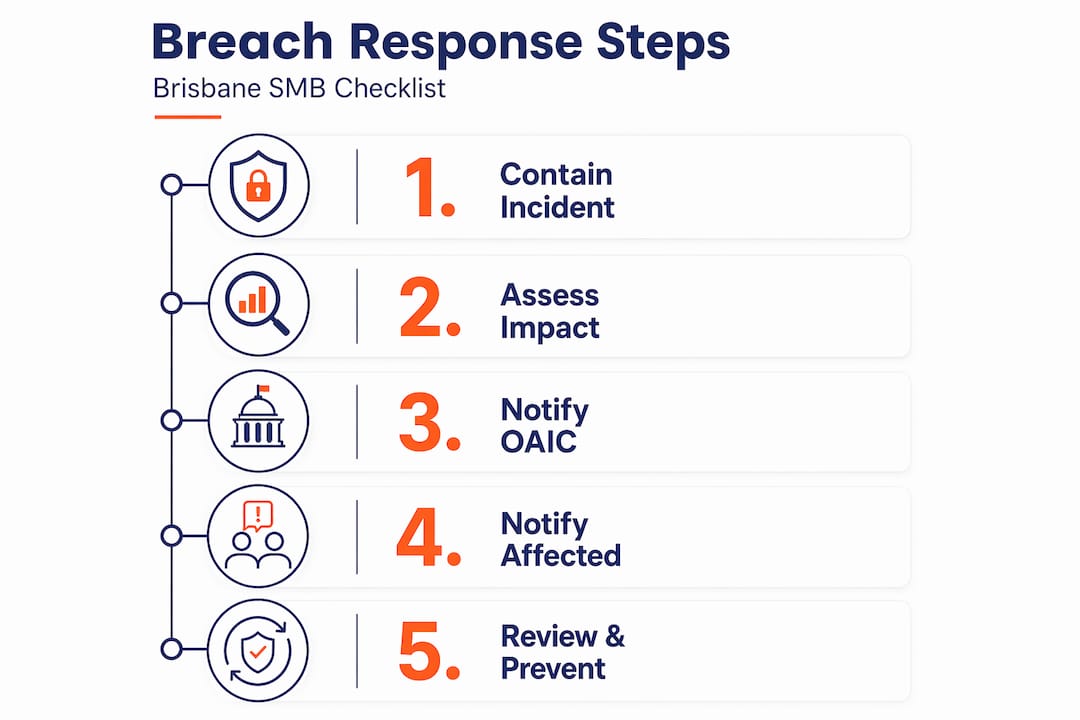
Steps after a data breach is discovered:
- Contain immediately. Isolate affected systems from the network without shutting them down. Change access credentials for compromised accounts right away.
- Assemble your response team. Notify your Incident Commander and Technical Lead. Start your incident log with the time of discovery and initial observations.
- Assess the scope. Identify which systems were affected, what data was potentially accessed or exfiltrated, and how the attacker likely gained entry.
- Determine notification obligations. Under Australia’s Notifiable Data Breaches (NDB) scheme, containing breaches and assessing risks within 30 days is mandatory once you become aware of a suspected eligible breach.
- Notify affected individuals and the OAIC. If serious harm is likely and remediation has not removed that risk, notification is required. Remedial action can avoid notification if you can demonstrate the serious harm risk has been eliminated.
- Remediate. Patch vulnerabilities, restore from clean backups, and re-enable systems only once they have been verified as secure.
- Document everything. Your incident log is your defence if regulators or affected parties challenge your response.
When it comes to the data breach notification process, you have two primary approaches:
| Notification approach | When to use | Practical consideration |
|---|---|---|
| Direct notification | Contact details are available | Email, letter, or phone call to each affected individual |
| Published notice | Impractical to contact all individuals | Prominent notice on your website and via media |
Your notification must include: the nature of the breach, the kinds of information involved, steps individuals should take to protect themselves, your contact details for enquiries, and how to make a complaint to the OAIC.
For guidance on securing business data for Brisbane SMEs and understanding data loss prevention steps for Brisbane SMEs, these resources will sharpen your response at the technical level.
Pro Tip: Engage a forensic IT expert as early as possible, ideally within the first 24 hours. Their findings not only inform your response but also provide documented evidence that reduces your legal exposure significantly.
Once you’ve handled the breach, the next step is verifying and learning to protect your business better.
Verifying results and preventing future breaches
Finishing the breach response is not the end of your obligations. The post-incident review is where preventing future data breaches actually begins. Post-breach reviews help strengthen policies, staff training, and security controls, which is why skipping this step is one of the costliest mistakes an SMB can make.
Your review should cover:
- Root cause analysis: What specific vulnerability or human error enabled the breach?
- Response timeline audit: Where did delays occur, and what caused them?
- Policy gaps: Did your existing policies fail to prevent or slow the incident?
- Technical control review: Are your current tools, patching schedules, and access controls adequate?
- Staff training assessment: Which staff behaviours contributed to the breach or the delayed response?
From there, update your data breach response plan with everything you learned. Introduce or tighten technical controls such as MFA, endpoint detection, and network segmentation. Schedule staff awareness training that reflects the actual attack vector used, not generic phishing modules.
Ongoing audits matter too. Quarterly reviews of access logs, backup integrity, and security configurations catch deterioration before it becomes a crisis. Working with a trusted IT partner for regular assessments is one of the most cost-effective data breach recovery strategies available to SMBs.
For practical guidance on how to enforce cybersecurity for Brisbane businesses on an ongoing basis, that resource is a useful complement to the work you do after an incident.
Pro Tip: Keep a detailed, timestamped record of every action taken during and after the breach. If the OAIC investigates and you can demonstrate a thorough, timely, and documented response, you are in a far stronger position to avoid penalties.
Beyond just following best practices, here’s our unique perspective on why many SMBs still struggle with data breach response.
Why most Brisbane SMB data breach responses fall short (and how to fix it)
After working with Brisbane businesses across healthcare, legal, and professional services, the pattern we see most often is not ignorance. Business owners generally know that data breaches are serious. The failure is almost always in the gap between knowing and doing.
The most damaging error is delay. Many SMBs underestimate the seriousness of breaches or delay action, turning a manageable incident into a regulatory and reputational crisis. We have seen businesses spend three days “investigating quietly” before calling anyone, only to discover the attacker was still active in their systems the entire time.
The second failure is the instinct to manage perception before managing the incident. Business owners sometimes worry more about how a breach looks than about stopping the harm. That instinct is understandable but genuinely costly. Regulators respond better to honest, timely disclosure than to delayed admissions dressed up in careful language.
The third issue is infrastructure. MFA and reliable, tested backups are not optional safeguards for larger businesses. They are the minimum viable defence for any Brisbane SMB handling customer data. Without them, a single compromised credential can result in a full network compromise with no clean restore point. The investment required is modest. The cost of not having them is not.
The businesses that fare best after a breach move immediately to contain, assess, and communicate clearly. They treat the incident log as their best legal protection. And they use the experience to build cybersecurity practices for SMBs that are genuinely more resilient, not just policy documents that sit in a folder.
How IT Start helps Brisbane SMB owners respond to data breaches confidently
Knowing the steps is one thing. Having the right team ready to execute them at 11pm on a Tuesday is another. IT Start provides Brisbane SMBs with the full support structure needed to prepare for, respond to, and recover from data breaches with confidence.
Our business IT support includes setting up documented response plans, defining team roles, and ensuring your staff know exactly what to do when something goes wrong. Our cyber security services cover proactive monitoring, rapid containment, NDB scheme compliance assistance, and forensic coordination. We also configure and manage cloud services including tested cloud backups and MFA setup, the two most effective controls for preventing the breaches we see most often. Let IT Start guide your business safely beyond the data breach.
Frequently asked questions
What is the first thing to do when you suspect a data breach?
The first step is to contain the incident by isolating affected systems without powering them off, preserving evidence for investigation while stopping further data loss. Network isolation, not shutdown, is critical for maintaining forensic evidence.
How soon must a Brisbane SMB notify the OAIC of a data breach?
Brisbane SMBs must assess suspected data breaches within 30 calendar days of awareness and notify the OAIC as soon as practicable if serious harm is likely. Under Australia’s NDB scheme, prompt and documented action is required throughout.
What should be included in a data breach notification to affected individuals?
Notifications must detail the breach nature, data involved, recommended steps for individuals, contact details for enquiries, and how to complain to the OAIC if unsatisfied. Notification must include a breach description, kinds of information involved, remedial steps, and contact details.
Can remedial actions prevent the need to notify about a data breach?
Yes, if remedial actions successfully remove the likely risk of serious harm, notification under the NDB scheme may not be necessary. Remedial action can avoid notification if you can demonstrate the serious harm risk has been genuinely eliminated.
Who should be on a data breach response team for a small business?
A team should include an Incident Commander with authority, a technical lead for IT tasks, and a communications lead to manage internal and external messaging, with backups assigned for each role. Assign clear roles in advance to ensure quick activation when an incident occurs.