

TL;DR:
- Cyber security awareness involves understanding threats and avoiding risky behaviors to protect organizations. Ongoing training and a blame-free culture are crucial for reducing human errors that cause over 82% of cyber breaches. Combining staff education with technical controls enhances overall security, especially for small and medium businesses.
Cyber security awareness is the knowledge and mindset that allows employees and business leaders to recognise cyber threats, avoid risky behaviour, and respond appropriately when something goes wrong. It is not a software product or a one-time training session. The Australian Signals Directorate confirms that building a cyber-safe culture is an ongoing organisational responsibility, not a checkbox exercise. The 2024 Australian Privacy Act reforms reinforce this, with the OAIC identifying staff education as a foundational step in meeting legal obligations. For business owners and IT managers, understanding what cyber security awareness actually means is the starting point for protecting your organisation.
What is cyber security awareness and what does it include?
Cyber security awareness, known formally as security awareness and training (SAT) in frameworks like NIST SP 800-50, covers everything your staff need to know to avoid becoming the weakest link in your defences. It includes recognising phishing emails, understanding password hygiene, knowing what to do when something looks suspicious, and understanding why the rules around data handling exist. The goal is not to turn every employee into a security expert. The goal is to make sure no one accidentally opens the door for an attacker.
Human error contributes to over 82% of successful cyber attacks in Australian SMEs. That figure tells you everything about where the real risk sits. Technical controls like firewalls and antivirus software matter, but they cannot stop a staff member who clicks a malicious link or hands over credentials to a convincing fake IT support call.
The importance of cyber security cannot be overstated for small and medium businesses. Large enterprises have dedicated security teams. SMEs typically do not, which means every employee carries more responsibility than they realise.

What are the common cyber threats that require awareness?
Your staff need to recognise specific threats, not just understand that “cyber attacks exist.” The most common threats targeting Australian businesses right now include:
- Phishing emails: Fake messages designed to steal credentials or install malware. Phishing remains the leading cause of malicious cyber attacks in Australia, exploiting user behaviour rather than technical vulnerabilities.
- Credential theft: Attackers steal usernames and passwords through phishing, data breaches, or weak password practices, then use them to access systems quietly.
- Ransomware: Malicious software that encrypts your files and demands payment. It often enters through a phishing email or an unpatched system.
- Social engineering: Attackers impersonate colleagues, suppliers, or IT support to manipulate staff into transferring money or sharing access.
- Business email compromise (BEC): A targeted attack where criminals impersonate executives or suppliers to redirect payments or extract sensitive data.
These threats share one thing in common. They exploit human behaviour, not just technical gaps. An attacker does not need to break through your firewall if they can convince your accounts payable staff to change a bank account number over email. The operational consequences of a breach include financial loss, regulatory penalties under the Privacy Act, and reputational damage that takes years to repair.
Pro Tip: Train staff to pause before acting on any urgent request involving money, credentials, or access. Urgency is a manipulation tactic, not a reason to skip verification.
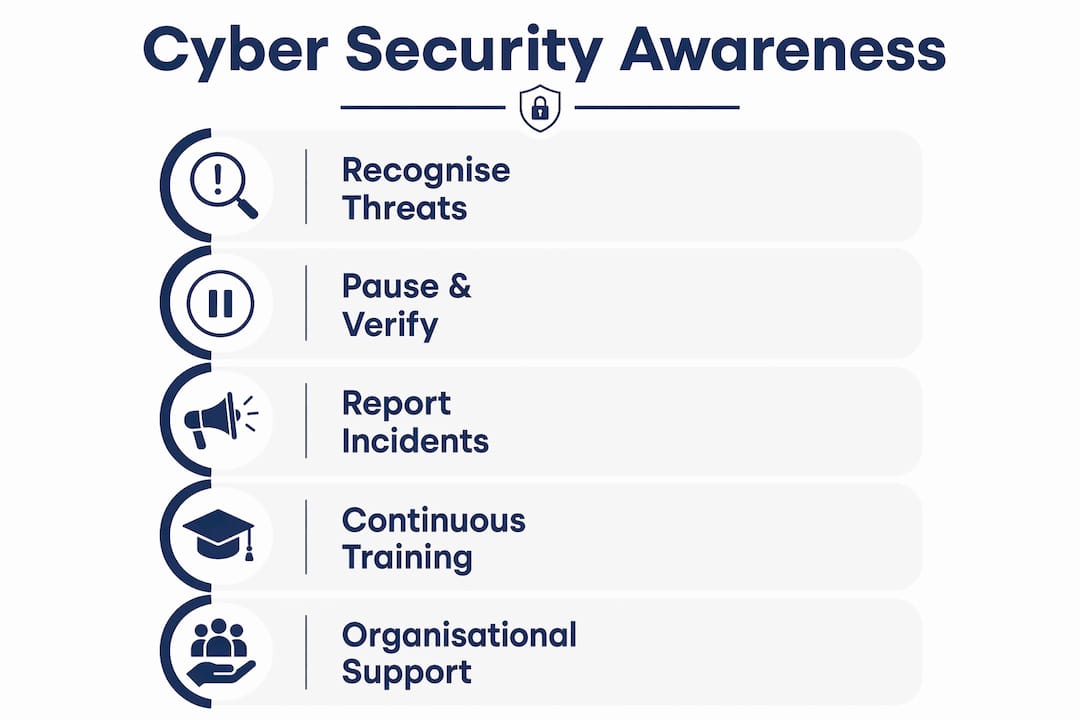
How does cyber security awareness training work to reduce business risks?
Effective cyber security training programmes do not look like a 45-minute video watched once a year. That approach produces compliance records, not behaviour change. The benefits of cyber awareness training only show up when training is ongoing, practical, and connected to real scenarios your staff actually face.
Here is what effective training looks like in practice:
- Quarterly microlearning sessions: Short, focused modules covering one topic at a time. Staff retain more from a 10-minute session on phishing than from a two-hour annual lecture covering everything.
- Simulated phishing campaigns: Send fake phishing emails to your own staff and track who clicks. Use the results as a teaching moment, not a punishment exercise. Training that includes incident-based feedback achieves better retention and real behaviour change.
- Gamification: Leaderboards, quizzes, and scenario-based challenges increase engagement. Staff who enjoy the training pay attention to it.
- Incident-based learning: When a real incident occurs, debrief the team. Explain what happened, what the warning signs were, and what to do differently. This is the most memorable training you can deliver.
- Role-specific content: A finance team member faces different threats than a receptionist. Tailor content to the actual risks each role encounters.
The concept of the “human firewall” captures this well. Your employees are the last line of defence when technical controls fail. Building that human layer requires consistent investment, not a once-a-year tick.
A blame-free reporting culture is non-negotiable. Employees hide errors when they fear punishment, which means incidents go unreported and breaches escalate. Staff need to know they can raise a concern without consequences. That psychological safety is what gets you early warning before a small mistake becomes a major incident.
Pro Tip: Appoint a security champion within each team. This is someone who is not in IT but takes an active interest in security. They become the go-to person for questions and help normalise security conversations in daily work.
What organisational practices support cyber security awareness beyond training?
Training alone is not enough. The practices around it determine whether awareness actually sticks. The Australian Signals Directorate’s Information Security Manual (ISM) recommends pairing user awareness with controlled access and separation of duties as core personnel security controls.
| Practice | What it does | Why it matters |
|---|---|---|
| Multi-factor authentication (MFA) | Requires a second verification step beyond a password | Stops credential theft from becoming a full account compromise |
| Least-privilege access | Staff only access the systems and data their role requires | Limits the damage if an account is compromised |
| Role-based access control | Access permissions are tied to job function, not individual requests | Reduces accidental or malicious data exposure |
| Regular permission reviews | Periodic audits of who has access to what | Catches outdated access from role changes or departures |
| Incident response planning | A documented process for responding to a breach | Reduces chaos and speeds up containment when something goes wrong |
These controls work because they reduce the blast radius of human error. If a staff member clicks a phishing link but only has access to their own files, the attacker cannot reach your client database. Awareness training teaches people to avoid mistakes. Access controls limit the consequences when mistakes still happen.
Regular training combined with clear incident escalation plans enables faster containment and recovery. We see this constantly with clients. The ones who have a documented process recover in hours. The ones who are figuring it out on the fly lose days.
What are the biggest mistakes businesses make with cyber security awareness?
Honestly, most businesses get this wrong in predictable ways. The mistakes are not exotic. They are the same ones we see across Brisbane SMEs every week.
- Treating training as a compliance exercise. Completing a training register does not mean your staff are prepared. It means they watched a video. Engagement and behaviour change are what count.
- Running one session and considering it done. Threats evolve constantly. Training from two years ago does not cover current phishing techniques or AI-generated fake emails. Cyber security education requires regular updates.
- Blaming staff when incidents occur. This kills your reporting culture immediately. If people fear being singled out, they will not tell you when they click something suspicious. You will find out later, when the damage is done.
- Ignoring the human element entirely. Some businesses invest heavily in technical controls and nothing in people. That is like installing a deadlock on your front door and leaving the window open.
- No clear reporting process. Staff who notice something suspicious need to know exactly who to call and what to do. If that process does not exist, the moment passes and the incident goes unreported.
Pro Tip: Build a culture where reporting a mistake is seen as responsible behaviour, not a failure. Recognise staff who raise concerns. That recognition costs nothing and changes everything.
How to implement a cyber security awareness programme for your business
Getting a programme off the ground does not require a large budget or a dedicated security team. It requires a plan and consistent follow-through. Here is a practical starting point for Australian SMEs:
- Assess your current risk. Identify what data you hold, who has access to it, and where your biggest human vulnerabilities are. A cyber security risk assessment gives you a baseline to work from.
- Customise your training content. Generic training is better than nothing, but role-specific content is far more effective. Finance staff need training on BEC and payment fraud. Customer-facing staff need training on social engineering.
- Schedule regular sessions. Quarterly microlearning is a practical minimum. Monthly is better. Build it into the calendar so it does not get skipped when things get busy.
- Run simulated phishing tests. These reveal your actual risk exposure, not your perceived risk. Use the results to target follow-up training where it is needed most.
- Assign a security champion. Give someone outside IT the responsibility of promoting security awareness within their team. This person does not need technical expertise. They need credibility with their colleagues.
- Measure and adapt. Track click rates on phishing simulations, training completion, and incident reports over time. If the numbers are not improving, the programme needs adjustment.
For a detailed walkthrough on how to train staff on cybersecurity, the approach matters as much as the content. Consistency beats intensity every time.
Key takeaways
Cyber security awareness is the single most cost-effective defence available to Australian SMEs, because human error drives the majority of breaches and training directly addresses that risk.
| Point | Details |
|---|---|
| Human error is the primary risk | Over 82% of breaches involve human error, making staff awareness the highest-priority control. |
| Training must be ongoing | One-off sessions do not change behaviour. Quarterly microlearning and simulated phishing produce lasting results. |
| Blame-free culture is non-negotiable | Staff who fear punishment hide mistakes, turning small incidents into major breaches. |
| Technical controls amplify awareness | MFA, least-privilege access, and incident response plans reduce the damage when human errors still occur. |
| Privacy Act compliance requires it | The 2024 Australian Privacy Act reforms identify staff education as a reasonable step businesses must take. |
What I have learned from watching SMEs get this wrong
The businesses I see struggle most with cyber security awareness are not the ones with no budget. They are the ones who spent money on the wrong things. A $500 annual training subscription that nobody engages with is not a security investment. It is a receipt.
What actually works is making security feel relevant to the person sitting in front of the screen. When a finance manager understands that the fake invoice email they almost paid last year is the same technique attackers use every day, the training clicks. When a receptionist realises that the “IT support” caller asking for their password is a social engineering attempt, they hang up. That moment of recognition is worth more than any technical control you can buy.
The other thing I have seen consistently is that businesses underestimate how much a blame-free culture matters. We had a client whose staff member clicked a phishing link and then spent three days saying nothing because they were terrified of being fired. By the time it surfaced, the attacker had been inside the network for 72 hours. A safe reporting environment would have contained that incident in hours.
Cyber security education is not a cost centre. It is the thing that keeps your business running when everything else fails. The importance of cyber security awareness for SMEs is not theoretical. It shows up in real incidents, real costs, and real reputational damage that I have watched businesses absorb.
— Matt
How IT Start supports cyber security awareness for Brisbane businesses
IT Start works with Brisbane SMEs to build cyber security programmes that go beyond compliance paperwork. That means structured awareness training, simulated phishing campaigns, MFA implementation, and access control reviews, all designed to fit businesses with 10 to 50 staff who do not have a dedicated security team. The approach combines technical protections with staff education so that both layers are working together. If you want to understand where your business actually stands, IT Start offers a cyber security assessment that gives you a clear picture of your risks and a practical plan to address them. Contact IT Start to get started.
FAQ
What is cyber security awareness in simple terms?
Cyber security awareness is the knowledge and habits that help employees recognise and avoid cyber threats like phishing, credential theft, and social engineering. It is the human side of your organisation’s security defences.
How often should cyber security training happen?
Quarterly microlearning sessions are a practical minimum for most SMEs. More frequent short sessions produce better retention than a single annual training event.
Does cyber security awareness training reduce breaches?
Yes. Human error is present in over 82% of breaches, and targeted awareness training directly reduces the behaviours that attackers exploit, including clicking phishing links and sharing credentials.
What does the Australian Privacy Act require for staff training?
The 2024 Australian Privacy Act reforms require businesses to take reasonable steps to protect personal data. The OAIC identifies staff education as a foundational element of meeting that obligation.
What is the difference between cyber awareness and technical security controls?
Cyber awareness addresses human behaviour, while technical controls like MFA and firewalls address system vulnerabilities. Both are necessary. Awareness reduces the likelihood of human error; technical controls limit the damage when errors still occur.