

The minimum combination that gets you hired as a cyber security analyst is prior IT experience, one recognised entry-level certification such as CompTIA Security+ or the ISC2 Certified in Cybersecurity, core technical skills, and some hands-on proof like a home lab, a CTF result, or SOC exposure. Hiring managers tend to value experience and certifications more than a degree on its own, and most new recruits take between four and nine months to handle routine tasks independently.
TL;DR:
- Start with help desk, administration, or volunteer IT work, then earn one entry level certification and publish a lab or CTF project demonstrating your process.
- Learn networking, Windows and Linux administration, basic scripting, and SIEM tools; cloud identity and logging matter too, especially in Microsoft 365 and Azure environments.
- 51% of hiring managers prioritize reporting and documentation as automation replaces routine monitoring; new analysts typically need four to nine months to work independently.
- Skip CISSP and CISA until you meet their experience requirements; choose Security+ or ISC2 Certified in Cybersecurity first, then demonstrate learning with a practical project.
Table of Contents
- Education and formal pathways: degrees, diplomas and short courses
- Technical skills employers actually expect
- Certifications that actually help you get hired
- Practical experience: labs, projects, internships and SOC exposure
- What hiring managers actually look for beyond the technical checklist
- What your first 6 to 12 months will actually look like
- How to get started and make yourself hireable
- What we see most early-career candidates get wrong
- Legal, regulatory and compliance frameworks you need to understand
- Tools and technologies you will actually use day to day
- Career progression beyond the entry level
- The Australian cybersecurity job market right now
- The honest take on breaking into this field
- How we can help you see real analyst work in practice
- FAQ
Education and formal pathways: degrees, diplomas and short courses
We get asked this constantly by career changers: do you need a degree? Honestly, no. A degree proves you can study theory and come out the other end with a broad understanding of networking, systems and some security fundamentals. That counts for something, but it is not the only door in.
TAFE diplomas, university microcredentials, bootcamps and vendor training (Microsoft, Cisco, CompTIA) get you job-ready faster, often in months rather than years. Employers in our experience care about a degree mostly for graduate programmes at larger organisations or government roles with formal entry requirements. For everyone else, practical skills and certifications close the gap quickly.
If speed matters more than prestige, pair a short vocational course with real projects straight away:
- A TAFE or RTO certificate in networking or systems administration.
- A university microcredential in security fundamentals if you want a recognised institution on your résumé.
- A short bootcamp focused on SOC analyst skills.
- Vendor-run training (Microsoft, CompTIA, Cisco) that doubles as certification prep.
What we see work best is combining one of these with a home lab or volunteer IT role at the same time, not sequentially.
Technical skills employers actually expect
This is where a lot of candidates fall over at interview. They can define a VLAN but cannot explain why one would be misconfigured, or they know what a SIEM is but have never opened one.
You need solid networking fundamentals: TCP/IP, how firewalls filter traffic, how VLANs segment a network, and how to read a packet capture without panicking. You need comfort in both Windows and Linux, because real environments are mixed, and you need to be able to read logs and spot what is normal versus what is not. Basic scripting in Python or PowerShell matters too, not to build software, but to automate repetitive triage and pull data out of systems faster than clicking through a GUI.
- Networking basics: TCP/IP, firewall rules, VLAN segmentation, DNS.
- Operating systems: Windows and Linux administration, log locations, permissions.
- Scripting: Python or PowerShell for automation and basic triage.
- Tooling: SIEM platforms, IDS/IPS, endpoint protection, vulnerability scanners.
- Cloud basics: identity management, shared responsibility model, cloud logging.
Cloud security knowledge is becoming non-negotiable. Most SMBs we work with run Microsoft 365 and some Azure workloads, and an analyst who cannot explain conditional access or cloud logging is going to struggle from day one.
Pro Tip: Spin up a free-tier cloud account and break something on purpose, then fix it. That one exercise teaches more than a week of slides.
Certifications that actually help you get hired
Certifications work as a filter, not a guarantee. Hiring managers use them to sort candidates who have proven baseline knowledge from those who have not, before they even get to the experience conversation.
Start with CompTIA Security+ or the ISC2 Certified in Cybersecurity. Both are built for entry-level candidates, cover the fundamentals employers expect, and do not require years of prior experience to sit. Cisco CyberOps Associate is a solid alternative if you are leaning towards SOC and network-focused roles specifically.
Save CISSP and CISA for later. Both require years of verified experience before you can even claim the full certification, so chasing them early wastes study time you could spend on practical skills instead.
- CompTIA Security+: broad security fundamentals, widely recognised by employers.
- ISC2 Certified in Cybersecurity: free or low-cost entry point backed by a major industry body.
- Cisco CyberOps Associate: useful if you want a SOC or network security focus.
- CISSP and CISA: valuable later, but they require years of experience to claim.
ISC2 research on hiring managers backs this up: many prioritise hands-on IT experience over a degree, and treat an entry cert as evidence you have put in real effort, not just theory. Pick one entry cert, pass it, then show the learning through a project. That sequence matters more than collecting three certificates with nothing to back them up.
Practical experience: labs, projects, internships and SOC exposure
Certifications tell an employer you studied. A lab, a CTF placement, or real SOC exposure tells them you can actually do the job. That distinction can matter in entry-level interviews.
- Build a home lab using a spare machine or a cheap VPS: practise log parsing, run simulated phishing or malware scenarios, and do basic vulnerability scans with a tool like Nessus Essentials or OpenVAS.
- Enter a few Capture The Flag competitions through platforms like TryHackMe or Hack The Box, and keep notes on what you solved and how.
- Publish your work somewhere visible, even a basic GitHub repo with scripts or writeups, so an employer can see the thinking, not just the certificate.
- Take an internship, volunteer IT role, or junior helpdesk job that touches ticketing, user access or basic system administration, since these map directly onto SOC tasks.
Pro Tip: Screenshots do not impress anyone reviewing applications. The ACSC’s assessment guidance on evidence quality applies here too: scripts and test results that show what you actually did outrank a static image every time.
What hiring managers actually look for beyond the technical checklist
We have seen junior analysts who were technically sharp but could not write an incident report anyone else could follow. That is a bigger problem than it sounds, because most of the job is documentation, alert triage and communicating what happened, not just finding the problem.
ISC2 research on hiring trends found that 51% of hiring managers now rate human-centric skills like documentation and reporting as more important, as automation takes over routine monitoring work. Teamwork and plain written communication often outweigh raw technical depth at entry level.
- Documentation and clear written reporting, since alerts mean nothing if nobody can act on your notes.
- Alert triage: deciding what is urgent, what can wait, and what is noise.
- Physical access control awareness, badge systems, visitor logs, and why they matter.
- Problem solving under pressure, explained with a specific example in interviews, not a general claim.
Expect four to nine months before you are handling these tasks independently. That is a hiring manager’s own estimate, not a worst case.
What your first 6 to 12 months will actually look like
Nobody hands you a keyboard and a live incident on day one. Expect a ramp-up that looks something like this.
- Onboarding, shadowing, and learning the organisation’s specific tools and asset inventory.
- Documentation work, basic alert handling under supervision, and learning the escalation process.
- Handling routine alerts independently, contributing to reports, and starting to spot patterns.
- Participating in incident response, owning small projects, and mentoring the next new hire.
Honestly, a lot of workplaces underprepare for new analysts. We see this constantly with SMB clients: messy documentation, no clear runbooks, and systems nobody has fully mapped. Ask for concrete runbooks and measurable goals early. It speeds up your progress and flags whether the employer actually has its own basics sorted.
How to get started and make yourself hireable
You do not need a perfect résumé to start applying. You need evidence that stacks up.
- Get basic IT experience first, through a helpdesk role, IT admin work, or volunteering for a local organisation’s systems.
- Choose one entry-level certification, pass it, and write a short summary of what you learned and how you’d apply it.
- Build a small home lab, enter a couple of CTFs, and publish one portfolio piece showing your process.
- Apply for internships and junior SOC roles with applications tailored to each listing, backed by the specific evidence above rather than a generic cover letter.
Pro Tip: Tailor each application to the actual job description. A generic “I’m passionate about cybersecurity” line gets skipped. A line referencing the specific duties listed in the job ad gets read.
What we see most early-career candidates get wrong
In interviews, the gap is often not knowledge. It is application. Someone can explain what a brute force attack is in theory but freezes when asked to actually check a login log for one.
Most small businesses we support have no MFA properly enforced, backups nobody has tested, and asset lists that are years out of date. If your only lab experience is a clean, perfect simulated environment, you will be unprepared for the real mess. Frame your small-business or volunteer IT experience honestly: “fixed backup failures” or “enforced MFA rollout” reads better than vague claims about “supporting IT operations”.
— Matt
Legal, regulatory and compliance frameworks you need to understand
You will not need to be a lawyer, but you do need working knowledge of the frameworks that shape day-to-day decisions. The Essential Eight from the Australian Signals Directorate sets out eight mitigation strategies, including patching, multi-factor authentication, restricting admin privileges and regular backups, plus a maturity model used to measure how well an organisation applies them. Most SMB employers expect analysts to understand this model even if a formal assessment is not currently in place.
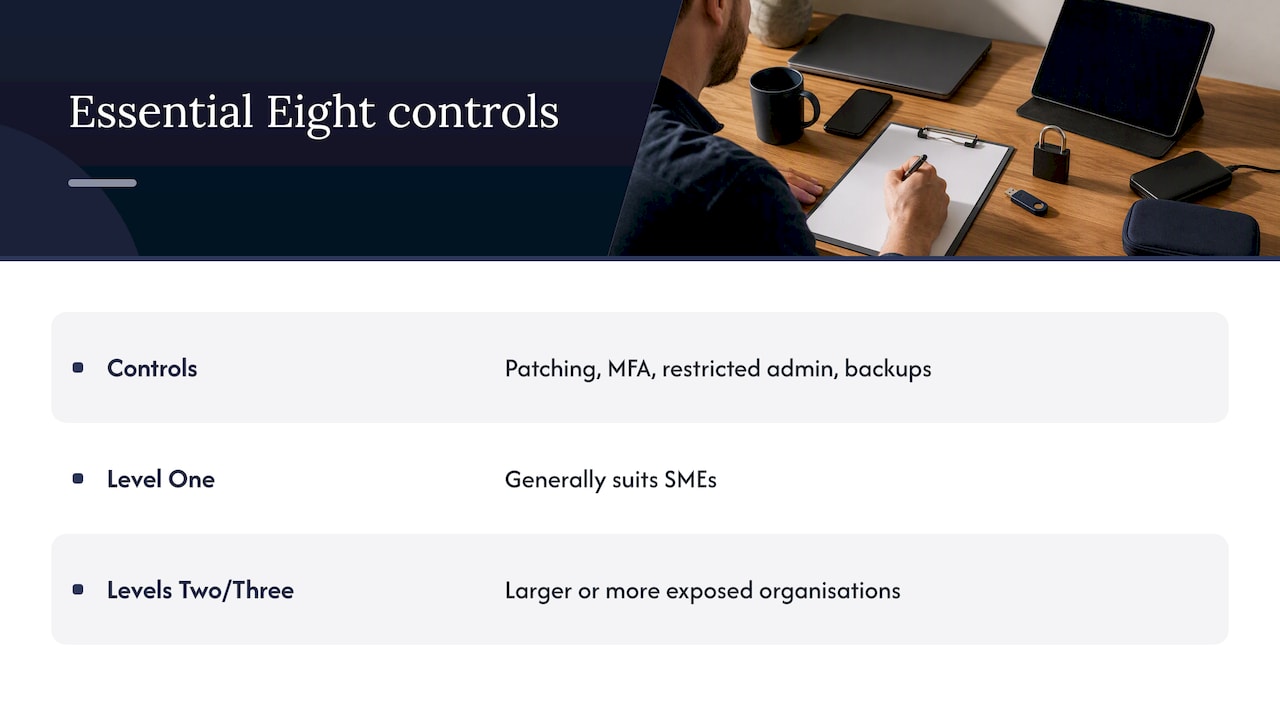
The Essential Eight maturity model FAQ notes that Maturity Level One generally suits small and medium enterprises, while Levels Two and Three are aimed at larger or more exposed organisations. Knowing which level applies to a given business shapes what controls actually matter there.
Beyond Essential Eight, expect to touch privacy obligations, industry-specific compliance (finance, health, legal sectors all have their own expectations), and incident notification responsibilities depending on sector. You do not need to memorise legislation. You need to know when to flag something to a compliance lead rather than quietly fixing it and moving on.
Tools and technologies you will actually use day to day
The toolset for an entry-level analyst is fairly consistent across SMB environments, even if vendor names differ. You will spend real time in a SIEM platform pulling and correlating logs, and in an IDS or IPS reviewing flagged traffic. Endpoint protection consoles (Microsoft Defender, CrowdStrike, Sophos, depending on the employer) are where a lot of daily triage happens.
Vulnerability scanners like Nessus or OpenVAS come up regularly for identifying unpatched systems, and ticketing systems for tracking and documenting incidents are unavoidable, since documentation is most of the job. Cloud environments add identity and access tools, particularly around Microsoft 365 and Azure, given how common these platforms are in Australian SMBs.
If you are considering sensitive data handling early in your career, tools like secure data rooms come up in specific contexts such as due diligence or M&A work. This practical guide to secure data rooms is a reasonable primer if that is a direction you end up working in.
Career progression beyond the entry level
Entry-level analyst work is a stepping stone, not the destination. After a year or two of SOC or helpdesk-adjacent security work, most people specialise.
Common paths include incident response, where you move from triage into leading investigations, or threat intelligence, which shifts focus from reactive alerts to proactive research. Penetration testing and vulnerability management are another route, usually requiring deeper technical certification. Governance, risk and compliance roles suit people who gravitated towards the reporting and policy side more than hands-on technical work.
The ASD Cyber Skills Framework maps these progressions against proficiency levels and links them to broader frameworks like SFIA, which is useful if you want a structured view of what skills each step actually requires rather than guessing from job titles alone.
The Australian cybersecurity job market right now
Demand has been climbing steadily, and the numbers back that up rather than just anecdotal chatter from recruiters. As of August 2025, around 70,900 people worked as Database and Systems Administrators and ICT Security Specialists in Australia, up by 3,300 on the year before, with projected growth of 14.2% between May 2024 and 2029.
Brisbane’s market mirrors this trend, particularly in sectors with compliance pressure like financial services, healthcare and legal firms, where SMBs increasingly need in-house or outsourced security support rather than treating it as an afterthought. We see this shift firsthand: businesses that ignored security two years ago are now actively asking for risk assessments and better monitoring, often because a client or insurer started asking questions they could not answer.
The honest take on breaking into this field
Here is where I think most advice gets it backwards. Everyone tells beginners to collect certifications first and experience will follow. In practice, the candidates who get hired fastest flip that order: they get scrappy IT experience early, even unpaid or informal, and layer one solid certification on top once they have something real to talk about in an interview.
The conventional wisdom also oversells the degree. A long commitment is a lot to ask someone to make before they even know if they like the work. Start with a cert and a lab instead, and treat the degree as optional, not foundational.
What the data and our own hiring experience both point to is this: prioritise provable troubleshooting ability over theoretical breadth. An employer can teach you a specific tool in a week. They cannot quickly teach someone who panics the first time a system behaves unexpectedly.
How we can help you see real analyst work in practice
If you are trying to break into this field, one of the fastest ways to learn is watching how a managed security team actually handles the daily grind: alert triage, patching cycles, access reviews, and the kind of messy legacy setups most businesses have sitting in the background. We manage exactly this for small and medium Brisbane businesses every day through our cyber security services, covering endpoint protection, firewall management, and risk assessments.
If you want a short conversation about what the work actually looks like, get in touch with our team and we will see what makes sense.
FAQ
What to learn to become a cyber security analyst?
Focus on networking fundamentals, Windows and Linux administration, basic scripting in Python or PowerShell, and familiarity with SIEM and vulnerability scanning tools. Pair that with one entry-level certification like CompTIA Security+ or the ISC2 Certified in Cybersecurity and hands-on practice through a lab or CTF.
Can you make $500,000 a year in cyber security?
That figure is not supported by any entry-level or even typical senior analyst salary data referenced in this article, and it would be misleading to suggest it as a realistic target. Most cybersecurity careers progress gradually through analyst, specialist and leadership roles, with pay rising alongside experience and specialisation rather than reaching extreme figures early.
What are the best cybersecurity certifications in Australia?
CompTIA Security+ and the ISC2 Certified in Cybersecurity are widely recognised entry points for the Australian market. Experience-gated certifications like CISSP and CISA matter more later in your career once you have the required years of verified work behind you.
Can you work remotely in cybersecurity?
Many SOC and analyst roles do offer remote or hybrid arrangements, particularly once you move past the entry level and employers trust your independent judgement. Early in your career, in-office or hybrid roles are more common, since mentoring and supervised triage work tend to happen more effectively in person.