

A cyber security degree teaches you the technical and organisational skills to find, stop and manage cyber threats, and it prepares you for roles such as security analyst, incident responder and security architect. It suits career changers, IT staff looking to specialise, and school leavers aiming straight at a security career. Whether it’s the right move depends on your starting point and how fast you want to get hired.
TL;DR:
- Choose courses with realistic scenario assignments, hands on labs, placements, and a capstone; request a sample brief and check whether online labs provide practical work.
- Australia’s median earnings for cyber security professionals working full time were $2,284 weekly in October 2025, versus $1,697 across occupations; neither predicts graduate starting pay.
- If you already work in IT, a postgraduate certificate plus targeted certifications may reach the same hiring outcome faster and cheaper than another full degree.
- Employers favor documented labs, placements, or relevant certifications over grades alone; government and defence posts may also require Australian citizenship and security clearance.
Table of Contents
- What a cyber security degree covers: curriculum, labs and delivery
- Degree levels explained: diploma, bachelor and postgraduate study
- Skills a cyber security degree should actually teach you
- Career outcomes: roles, sectors and what the pay data shows
- How employers actually assess candidates: degrees, experience and clearances
- How to choose a degree programme: a practical shortlist checklist
- What we see when graduates walk into SME security roles
- Typical entry requirements for cyber security degree programs in Australia
- Studying cyber security in Brisbane and across Queensland
- Specialisations within a cyber security degree
- Why practical experience matters more than coursework alone
- Where cyber security curricula are heading next
- Is a cyber security degree actually worth it?
- Where IT Start fits if you’re building a security career or team
- FAQ
- Sources
What a cyber security degree covers: curriculum, labs and delivery
Most cyber security degrees in Australia are built around a core set of modules that show up again and again, regardless of which university runs the course. You’ll typically study networking fundamentals, cryptography, secure software development, incident response and risk management. Some courses add governance and law units, because a lot of real security work is about policy and process, not just firewalls.
What separates a decent course from a weak one is how much of that content is actually practised rather than lectured. A module on incident response means very little if you never touch a simulated breach. Capstone projects and placements are where this gets tested properly: you’re handed a scenario, a vulnerable system, or an actual business problem, and asked to work through it the way you would on the job.
Delivery models vary:
- On-campus courses give you physical lab access and more face-to-face mentoring, useful for hands-on topics like network defence.
- Online and blended courses suit people working full time, though you need to check whether labs are virtual or require occasional on-site attendance.
- Some universities run accredited pathways that map directly to industry frameworks, which matters more than people expect when you’re job hunting later.
Accreditation and industry recognition aren’t just marketing lines on a course brochure. A degree that explicitly aligns its units to real-world capability frameworks gives you a clearer story to tell in an interview, and it gives hiring managers a faster way to understand what you can actually do. We’ll come back to why that mapping matters when we talk about how employers assess candidates.
Degree levels explained: diploma, bachelor and postgraduate study
Cyber security study isn’t one fixed qualification. The level you choose should match where you’re starting from and what role you’re aiming at.
- Associate degree or diploma: Usually one to two years, focused on foundational networking, systems administration and basic security concepts. These suit people moving into entry-level roles like help desk or junior security support, often as a stepping stone into a bachelor degree later.
- Bachelor degree: The standard three to four year pathway, covering the full spread of technical and governance modules. Graduates typically move into roles like security analyst, SOC analyst or junior penetration tester, depending on electives and placement experience.
- Honours year: Adds a research component on top of a bachelor degree, useful if you’re considering further study or a role that leans on applied research, such as threat intelligence.
- Master’s degree: Suited to people who already have an IT background and want to specialise fast, or who are aiming at leadership and architecture roles rather than hands-on analyst work. Course length and entry requirements vary a lot depending on your undergraduate background.
- Postgraduate certificate: A short, focused option, often six months to a year, useful if you already work in IT or a related field and want formal recognition of security knowledge without committing to a full master’s.
The honest truth is that a lot of employers care less about the exact level and more about what you can demonstrate. A bachelor graduate with a solid placement often beats a master’s graduate with no practical exposure.
Skills a cyber security degree should actually teach you
A good course produces graduates who can do things, not just pass exams about things. The technical skill set that matters most includes network security fundamentals, Linux and Windows hardening, basic scripting (Python or PowerShell), digital forensics basics and an introduction to penetration testing methodology. If a degree skips scripting entirely, that’s a gap worth asking about before you enrol.
The business side matters just as much, and it’s the part a lot of technically minded students underrate:
- Risk assessment: understanding how to prioritise threats against business impact, not just technical severity.
- Communication: writing an incident report a non-technical manager can actually act on.
- Governance and compliance literacy: knowing how frameworks like the Information Security Manual.pdf) structure security decisions around governing, identifying, protecting, detecting and responding.
- Basic leadership: even junior analysts end up explaining risk to people above them in the org chart.
Assessment design tells you a lot about course quality. Look for courses where assignments are scenario-based: write an incident response playbook, run a simulated penetration test and document it, or present a risk assessment to a mock stakeholder panel. Multiple-choice exams on definitions don’t build the muscle you’ll need on day one of a real job.
Pro Tip: Ask any course you’re considering for a sample capstone brief before enrolling. If it reads like a real workplace task, that’s a good sign.
Career outcomes: roles, sectors and what the pay data shows
Graduates land in a wider spread of roles than most people expect going in. Common titles include security analyst, SOC analyst, incident responder, penetration tester, security engineer and, with more experience, security architect or risk and compliance consultant. Day to day, this ranges from monitoring alerts and triaging incidents through to running audits, hardening systems and advising on new projects before they go live.
Demand isn’t evenly spread. Government and defence, financial services, healthcare and professional services are consistently the sectors hiring hardest for security skills, largely because they carry the heaviest regulatory and risk exposure.
Median full-time non-managerial earnings for cyber security professionals in Australia were $2,284 per week as of October 2025, compared with $1,697 per week across all occupations, according to Jobs and Skills Australia. That gap reflects both genuine skill scarcity and the fact that security roles tend to carry more responsibility earlier in a career than equivalent general IT positions.
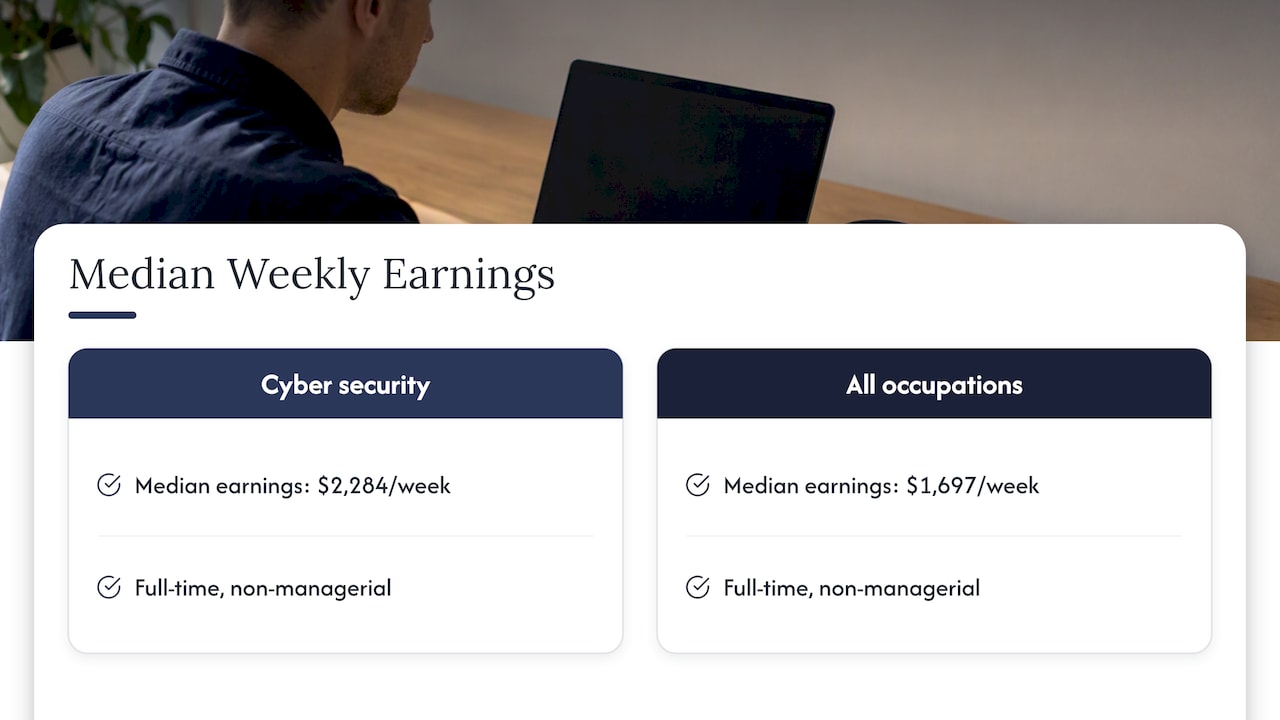
We’d treat that figure as a sign of healthy demand rather than a promise about any individual’s first-year salary. Where you land on that scale depends heavily on your specialisation, location and how much practical evidence you bring to the interview, which is the next thing worth getting right.
How employers actually assess candidates: degrees, experience and clearances
Honestly, this is where a lot of graduates get a rude shock. A degree opens the door to an interview. It rarely wins you the job on its own.
- Employers weigh practical evidence heavily: a documented home lab, a placement project, or a certification earned alongside study often carries more weight than grades.
- Certifications that regularly show up in job ads include CompTIA Security+, CEH and, for more experienced candidates, OSCP or CISSP. These aren’t a replacement for a degree, but they’re frequently used as a filter.
- The ASD Cyber Skills Framework maps nine defined cyber roles, including penetration tester, incident responder and malware analyst, to specific capabilities. Courses and candidates who can speak to that framework directly tend to communicate their value more clearly to employers.
- Government and defence roles often require Australian citizenship and a security clearance, sometimes at Baseline level or higher, which the AFP’s own recruitment pages confirm is a minimum for certain positions. No degree substitutes for meeting that requirement.
- Specialist assessor roles go further still. IRAP training and assessment guidance expects candidates to show at least five years of prior hands-on information security implementation or assessment experience. A degree is a base, not a substitute.
If government or defence work is the goal, check clearance and citizenship requirements early, before you’ve sunk years into a course that assumes you’ll qualify.
How to choose a degree programme: a practical shortlist checklist
Picking a course on reputation alone is a mistake we see a lot, even among people who are otherwise careful researchers. Reputation doesn’t tell you whether the curriculum maps to a real job.
- Check whether modules and the capstone project align with the specific role you’re targeting, not just “cyber security” as a broad label.
- Ask about work placement availability, industry partnerships and what percentage of graduates land security-relevant roles within a year of finishing.
- Confirm whether labs are physical, virtual or a mix, and whether assessment is scenario-based or exam-heavy.
- Compare part-time and online options if you’re studying alongside work, but check that the practical components aren’t watered down in the online version.
- Factor in total cost and duration against your target salary band, and check whether the course gives credit or a clear pathway toward certifications like Security+ or CISSP later.
A course that can show you where its last three cohorts ended up working is telling you something a prospectus never will. For a deeper look at how this plays out for Brisbane employers specifically, our piece on degree relevance for Brisbane businesses covers how local hiring expectations shape that decision.
What we see when graduates walk into SME security roles
We work with small and medium businesses on security, and we interview or work alongside a fair number of recent cyber security graduates. The pattern is consistent: strong theory, thin practical exposure.
The most common gap is log analysis. Graduates can explain what a SIEM does in an exam answer but have never actually triaged a real alert queue with the noise and false positives that come with it. A close second is documentation. We see this a lot: someone can run a scan but can’t write up findings in a way a business owner with no technical background can act on.
What SMEs actually look for on day one is simpler than a CV suggests: can you troubleshoot calmly, explain a risk in plain English, and do you understand why MFA and tested backups aren’t optional extras. Too many businesses think they’re backed up until a restore test proves otherwise.
- Build a small home lab and document an attack-and-defence scenario end to end.
- Take on a placement or volunteer project where you handle a real, messy system.
- Pair your degree with one solid certification relevant to your target role.
Pro Tip: A documented incident-response playbook from a placement, even a small one, is more convincing to an SME hiring manager than a transcript full of high distinctions.
Typical entry requirements for cyber security degree programs in Australia
Entry requirements depend on the level of study and the university, but a few patterns are consistent nationwide. Bachelor degree entry usually requires completion of senior secondary school with a relevant ATAR, and mathematics is often recommended, sometimes required, given the amount of logic and statistics underpinning cryptography and risk modules.
Mature-age and career-changer pathways are common. Many universities accept relevant work experience, a diploma, or a bridging course in place of a formal ATAR, which matters if you’re moving across from general IT or another field entirely.
Postgraduate entry, including master’s and postgraduate certificate programs, typically requires a completed bachelor degree, not necessarily in IT, though some universities ask for evidence of basic programming or networking knowledge before you start. A handful of courses run bridging units in the first term specifically to bring non-IT graduates up to speed.
English language requirements apply for international students, and some universities run their own aptitude or interview screening for competitive intakes, particularly where places are capped by lab capacity. If you’re weighing up levels of study against your current background, it’s worth reading that against the broader picture in our explainer on what a cyber security professional actually does, which breaks down the skills and certifications that matter once you’re working.
Studying cyber security in Brisbane and across Queensland
Brisbane and the wider Queensland region have a growing number of degree options at both bachelor and postgraduate level, reflecting the state’s expanding demand for security-literate IT staff across government, health and financial services. Queensland universities commonly offer cyber security as either a standalone bachelor degree or a major within a broader IT or computer science degree, alongside postgraduate options for IT professionals looking to specialise.
What we’d flag to anyone shortlisting a Queensland course is the same thing we’d flag anywhere: check for local industry links. A course with placement partnerships into Brisbane businesses, government agencies or professional services firms gives you a much shorter path from graduation to employment than one that teaches the same content with no local placement network at all.
If you’re already working in IT in Brisbane and weighing up whether formal study is worth the time against building experience on the job, that’s exactly the trade-off we unpack in our guide to degree pathways for Brisbane businesses, including how local employers tend to weigh qualifications against hands-on runtime experience.
Specialisations within a cyber security degree
Most bachelor and master’s programs let you specialise in the later years, and the choice matters because it shapes which jobs you’re realistically ready for at graduation.
Network security concentrates on defending infrastructure: firewalls, segmentation, intrusion detection and the kind of work that feeds directly into SOC analyst and network security engineer roles. Ethical hacking and penetration testing electives teach offensive techniques under controlled conditions, aimed at people wanting to move into penetration testing or red team work, though most employers still expect a certification like OSCP on top of the degree before hiring for that role specifically.
Digital forensics focuses on evidence handling, chain of custody and investigation techniques, relevant to incident response and to law enforcement or legal-adjacent security roles. Governance, risk and compliance electives lean into the non-technical side, mapped closely to the governance functions described in the Information Security Manual, and suit people aiming at risk analyst or compliance consultant roles rather than hands-on technical work.
Cloud security has become common as its own specialisation rather than a side topic, given how much infrastructure now sits in platforms like Azure or AWS. Picking a specialisation early helps you choose electives and placement opportunities that actually build toward it.
Why practical experience matters more than coursework alone
Internships, lab access and industry-linked projects are the part of a degree that turns theory into something an employer will actually believe. A module on incident response is one thing; being handed a simulated breach with real time pressure and a non-technical stakeholder expecting a plain-English update is another.
The strongest programs build this in deliberately rather than leaving it optional. That means dedicated lab environments with vulnerable systems you’re allowed to break and fix, capstone units built around real or realistic business scenarios, and formal placement programs with local employers rather than a vague “work experience encouraged” line in the handbook.
University sector guidance on counter-foreign interference and security governance recommends embedding security practice, including governance and risk thinking, across whole organisations rather than treating it as a bolt-on technical function, and the same logic applies to how a degree should teach it: integrated into real projects, not isolated in one unit. Our own experience backs this up. The graduates who come into SME roles and perform well from week one are almost always the ones who had a placement that put them in front of a messy, real system, not just a clean lab exercise built for a textbook outcome.
Where cyber security curricula are heading next
Course content is shifting to keep pace with where the actual threats and infrastructure are moving, and a few trends show up consistently in newer curricula. Cloud security has moved from an elective to a core expectation in a lot of programs, given how much business infrastructure now runs on Azure, AWS or Google Cloud rather than on-premises servers.
AI is showing up in two distinct ways: as a tool security teams use for faster log analysis and anomaly detection, and as a new attack surface in its own right, with courses adding units on securing machine learning systems and detecting AI-assisted attacks. Zero trust architecture concepts are increasingly taught as a default design principle rather than an advanced topic, reflecting how government and enterprise networks are being rebuilt.
Supply chain security has also earned more curriculum time, driven by high-profile incidents showing how a single vulnerable vendor can compromise dozens of downstream organisations. A partner analysis of 2026 cyber security trends covers this shift toward strategic, organisation-wide defence thinking in more depth, if you want the wider context behind why curricula are changing this way. None of this replaces the fundamentals covered earlier. It sits on top of them, which is exactly why a course that skips the basics to chase trends is usually a weaker choice.
Is a cyber security degree actually worth it?
Here’s our honest take: a degree is the fastest route in if you’re starting from scratch with no IT background, because it gives you structured fundamentals you’d otherwise have to piece together yourself. If you’re already working in IT, a shorter postgraduate certificate plus a couple of well-chosen certifications often gets you to the same hiring outcome faster and cheaper.
We’ve seen both work. A career changer with zero technical background who did a full bachelor degree with a solid placement walked straight into a SOC analyst role. We’ve also seen an experienced sysadmin skip the degree entirely, pick up Security+ and a home lab, and land a security engineer role within a year.
If you’re a school leaver, go for the full degree. If you’re mid-career in IT, prioritise certifications and a documented project over another three years of study. Either way, chase practical evidence relentlessly: it matters more than the letters after your name.
— Matt
Where IT Start fits if you’re building a security career or team
We provide managed security services including endpoint protection, risk assessments, firewall management and backup testing to small and medium businesses. If you’re a graduate looking for the kind of real-world project experience this article keeps pointing back to, or a business owner wondering whether your current setup would survive a serious incident, we’re happy to talk it through.
Our cyber security services page covers what a proper risk assessment and ongoing protection look like in practice, and we offer a free consultation if you want a second opinion on where your current security stands.
FAQ
What do you do with a degree in cybersecurity?
A cyber security degree typically leads to roles like security analyst, SOC analyst, incident responder, penetration tester or security engineer, depending on your electives and placement experience. Many graduates start in analyst or support-level roles and move into specialist or leadership positions with a few years of practical experience.
Can I make $200,000 a year in cyber security?
Senior and specialist roles in cyber security can reach high salaries, but the published median for Australian cyber security professionals sits at $2,284 per week, well below that figure annually. Reaching very high earnings typically requires years of specialist experience, senior leadership responsibility or in-demand niche skills rather than a degree alone.
Is cybersecurity a hard degree?
Cyber security degrees are demanding because they combine technical subjects like networking and cryptography with analytical and communication skills, but they’re not harder than comparable IT or engineering degrees. Students with some mathematics or logic background often find the technical modules more manageable from the start.
Is cybersecurity a high paying job?
Cyber security roles generally pay above the national median, with Australian cyber security professionals earning a median of $2,284 per week compared to $1,697 across all occupations. Actual pay varies a lot by role, specialisation and experience level.