

More than 45 percent of australian small businesses have faced cyber incidents in the past year. For IT managers at Brisbane financial service firms, the stakes are higher with sensitive client data and strict compliance requirements at risk. This guide brings together the latest australian standards, actionable steps, and practical insights to help your business build a data safety strategy that protects assets and aligns with evolving cybersecurity laws.
Table of Contents
- Defining Data Safety For SMEs
- Common Types Of Business Data At Risk
- Key Threats To Data Safety In 2026
- Australian Privacy Laws And Obligations
- Risk Management Duties For IT Managers
- Mistakes That Cause Data Breaches
Brisbane SME Data Safety: Quick Guide to Key Topics
| Point | Details |
|---|---|
| Data Safety Is Continuous | Small and medium enterprises must view data protection as an ongoing commitment rather than a one-off task, involving regular audits and updates to security practices. |
| Understand Your Data Types | Businesses should categorise sensitive information based on risk levels to implement tailored protection mechanisms that safeguard critical assets. |
| Proactive Cybersecurity Training | Continuous education and training for employees are essential to raise awareness about emerging threats and strengthen the overall cybersecurity posture. |
| Legal Compliance Is Critical | Adhering to Australian privacy laws and regulations is vital for SMEs to avoid penalties and maintain customer trust, necessitating regular compliance assessments. |
Defining Data Safety For SMEs
Data safety represents the comprehensive strategy Brisbane small and medium enterprises (SMEs) use to protect their critical business information from digital threats and potential breaches. In the rapidly evolving cybersecurity landscape, understanding what constitutes robust data protection goes beyond simple password management.
The Australian Cyber Security Centre provides clear guidance through Essential Eight mitigation strategies, which outline a foundational framework for technological defence. These strategies help businesses create multilayered protection mechanisms that prevent unauthorized access, detect potential vulnerabilities, and respond quickly to emerging cyber risks.
For SMEs in Brisbane, data safety encompasses several key dimensions: technological infrastructure, employee training, risk assessment, and ongoing monitoring. This means implementing secure network configurations, using encrypted communication channels, establishing strict access controls, and developing comprehensive incident response plans. Businesses must also recognise that data protection is not a one time event, but a continuous process of adaptation and improvement.
Pro tip: Conduct a quarterly internal cybersecurity audit to identify and address potential vulnerabilities before they become critical security risks.
Common Types Of Business Data At Risk
Brisbane small and medium enterprises handle multiple categories of sensitive data that require comprehensive protection strategies. Understanding these data types is crucial for implementing targeted security measures that safeguard an organisation’s most valuable digital assets.
According to research from the University of Technology Sydney, SMEs typically manage several critical data categories, including customer data and transactional records. These digital assets encompass personal customer information, purchase histories, contact details, financial transactions, and behavioural analytics that drive business decision making. Each data type presents unique vulnerabilities that cybercriminals might exploit.
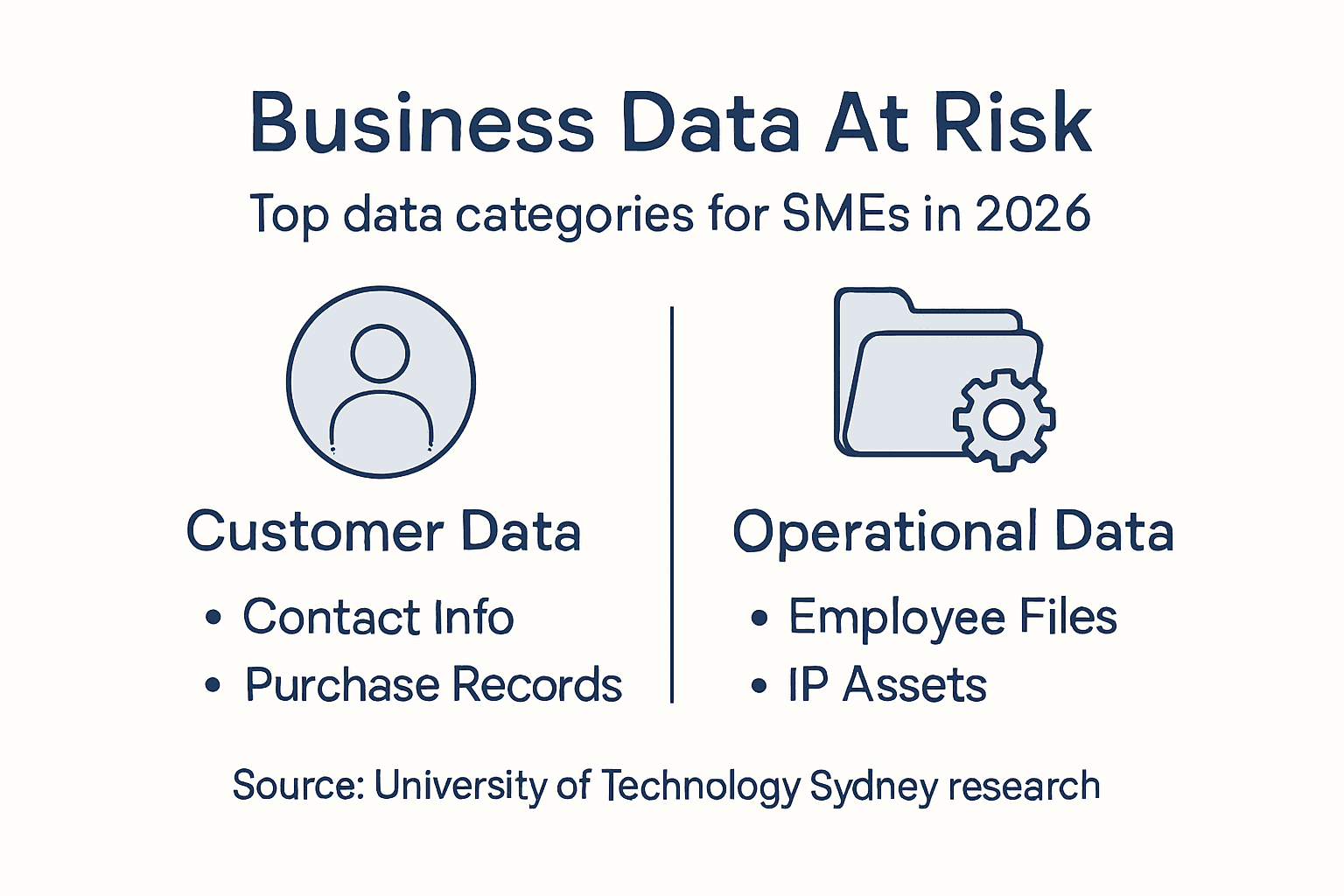
Beyond customer information, businesses also manage sensitive operational data such as employee records, proprietary business intelligence, strategic planning documents, financial statements, and intellectual property. Confidential business data includes internal communications, contract negotiations, pricing strategies, and research development materials. Many organisations underestimate the potential damage that could result from unauthorized access or data breaches involving these critical information repositories.
Businesses must categorise their data based on sensitivity levels, implementing graduated protection mechanisms that reflect the potential risk and value of each information type. This approach allows for more nuanced and effective cybersecurity strategies tailored to specific organisational needs.
The following table summarises common categories of sensitive business data and their associated protection needs for Brisbane SMEs:
| Data Type | Typical Business Use | Primary Risks | Recommended Protection |
|---|---|---|---|
| Customer Information | Personal details, communications | Identity theft, privacy breach | Encryption, restricted access |
| Transactional Records | Purchase history, payments | Financial fraud, data loss | Secure backups, controlled access |
| Employee Records | HR management, payroll | Unauthorised exposure, identity theft | Multi-factor authentication, audit trails |
| Intellectual Property | Proprietary research, innovation | Industrial espionage, competitive theft | Segmentation, legal safeguards |
| Strategic Documents | Planning, contracts, pricing | Competitive disadvantage, data leaks | Confidentiality agreements, secure storage |
Pro tip: Create a comprehensive data inventory that maps all sensitive information, classifying each data type according to its confidentiality and potential business impact.
Key Threats To Data Safety In 2026
As technology evolves, Brisbane small and medium enterprises face increasingly sophisticated cyber threats that demand proactive and comprehensive defence strategies. Understanding these emerging risks is crucial for maintaining robust data protection in an increasingly complex digital landscape.

The Australian Signals Directorate warns of sophisticated cyber attack vectors that target business infrastructure with unprecedented complexity. In 2026, these threats will likely include advanced ransomware techniques, artificial intelligence-powered phishing attempts, and highly targeted social engineering attacks designed to exploit human and technological vulnerabilities.
Artificial intelligence and machine learning technologies are creating new threat landscapes for businesses. Cybercriminals are now leveraging AI to develop more intelligent malware, automate attack strategies, and identify subtle network vulnerabilities that traditional security systems might overlook. Emerging digital threats now include deepfake technologies that can impersonate company executives, sophisticated data manipulation techniques, and attacks targeting interconnected Internet of Things (IoT) devices within business networks.
The most concerning aspects of future cyber threats involve their potential to cause systemic disruption. Attacks are no longer just about stealing data but can potentially paralyse entire business operations, compromise critical infrastructure, and cause long-term reputational and financial damage. Small businesses remain particularly vulnerable due to limited cybersecurity resources and less comprehensive defence mechanisms.
Pro tip: Invest in continuous cybersecurity training that keeps your team updated on the latest threat evolution and defence strategies.
Australian Privacy Laws And Obligations
Brisbane small and medium enterprises operate within a complex legal framework designed to protect individual privacy and ensure responsible data management. Understanding these legislative requirements is crucial for maintaining legal compliance and building trust with customers and stakeholders.
The Privacy Act 1988 and its Australian Privacy Principles establish comprehensive guidelines for how organisations collect, handle, and protect personal information. These principles require businesses to implement transparent data practices, obtain explicit consent for data collection, and maintain rigorous security protocols that prevent unauthorized access or potential breaches.
Beyond traditional privacy regulations, digital safety laws are rapidly evolving to address emerging technological challenges. The Online Safety Act 2021 introduces additional layers of protection, empowering businesses to proactively manage digital risks and respond effectively to potential online safety incidents. This legislation requires SMEs to develop robust incident response plans, maintain comprehensive data management strategies, and understand their legal obligations in protecting both personal and organisational digital assets.
For Brisbane businesses, compliance is not merely about avoiding legal penalties but about demonstrating ethical data stewardship. This means implementing clear privacy policies, conducting regular privacy impact assessments, and training staff on the nuanced requirements of Australian privacy legislation. Small businesses must recognize that data protection is an ongoing commitment that requires continuous education and adaptive strategies.
For quick reference, this table outlines key Australian privacy and digital safety regulations impacting Brisbane SMEs:
| Regulation | Main Focus | SME Obligation | Consequence of Non-Compliance |
|---|---|---|---|
| Privacy Act 1988 | Personal data handling | Obtain consent, secure information | Fines, reputation damage |
| Australian Privacy Principles | Data collection and use rules | Transparent policies, staff training | Legal action, customer distrust |
| Online Safety Act 2021 | Online risk management | Incident response planning | Penalties, operational disruption |
Pro tip: Conduct an annual privacy compliance audit to ensure your business remains aligned with the latest legislative requirements and best practice standards.
Risk Management Duties For IT Managers
In the rapidly evolving cybersecurity landscape, IT managers in Brisbane small and medium enterprises bear critical responsibilities for protecting organisational digital assets and mitigating potential risks. Their role extends far beyond traditional technical maintenance, requiring a strategic and comprehensive approach to technology governance.
The Digital Transformation Agency emphasises the importance of comprehensive risk management frameworks that demand proactive identification, assessment, and mitigation of potential technological vulnerabilities. IT managers must develop sophisticated strategies that anticipate emerging threats, implement robust security protocols, and create adaptive defence mechanisms that can respond quickly to dynamic cyber risks.
Professional cybersecurity education highlights that risk management responsibilities encompass multiple critical domains. These include conducting regular security audits, maintaining up-to-date technological infrastructure, implementing multi-layered authentication systems, developing comprehensive incident response plans, and ensuring continuous staff training on emerging cyber threats. IT managers must also maintain detailed documentation of security processes, regularly update risk assessment matrices, and establish clear communication channels for reporting potential security incidents.
Moreover, IT managers are increasingly expected to serve as strategic advisors, translating complex technological risks into clear business language for executive leadership. This requires not just technical expertise, but also strong communication skills, strategic thinking, and the ability to align cybersecurity measures with broader organisational objectives and risk tolerance levels.
Pro tip: Develop a quarterly risk assessment scorecard that quantifies and tracks potential cybersecurity vulnerabilities across your organisation.
Mistakes That Cause Data Breaches
Data breaches represent catastrophic risks for Brisbane small and medium enterprises, often emerging from seemingly minor organisational oversights. Understanding these potential vulnerabilities is crucial for developing comprehensive cybersecurity strategies that protect sensitive business information.
The Australian Cyber Security Centre highlights critical cybersecurity framework failures that frequently lead to significant data compromise. These mistakes include neglecting software patch management, implementing weak access controls, and maintaining inadequate system logging practices. Organisations that fail to update critical software leave themselves exposed to known vulnerabilities that sophisticated cybercriminals can readily exploit.
Systemic security lapses extend beyond technical configurations and deeply into organisational culture. Human error remains the most significant risk factor, with employees inadvertently creating security vulnerabilities through practices like using weak passwords, sharing sensitive credentials, falling for phishing attempts, and failing to recognise social engineering tactics. Many businesses underestimate how a single compromised user account can provide attackers with extensive network access, potentially exposing entire organisational data repositories.
Moreover, many SMEs mistakenly believe they are too small to be targeted, which creates a dangerous complacency. Cybercriminals actively seek out organisations with minimal security infrastructure, viewing them as attractive, low-risk targets. This misconception leads businesses to invest minimally in cybersecurity training, infrastructure, and proactive monitoring systems, ultimately increasing their vulnerability to potentially devastating digital attacks.
Pro tip: Implement mandatory quarterly cybersecurity awareness training that simulates real-world threat scenarios to continuously educate and test your team’s response capabilities.
Safeguard Your Brisbane SME’s Data with IT Start
The challenge of protecting sensitive business information in 2026 is complex and ever-changing. Brisbane SMEs face critical risks such as sophisticated cyber attacks, data breaches caused by human error, and evolving privacy obligations. With key concerns like AI-powered threats, ransomware, and compliance with Australian Privacy Laws, it is essential to have a proactive and robust data safety strategy in place that covers technological infrastructure, staff training, and risk management.
At IT Start, we understand these challenges and tailor our managed IT support, cybersecurity services, and cloud solutions specifically for Brisbane small and medium enterprises. We help you build multilayered defence mechanisms to secure customer information, transactional records, intellectual property, and strategic documents. Our local expertise and commitment to high standards such as SMB 1001 Gold certification ensure your business stays compliant and resilient against emerging digital threats.
Ready to strengthen your data protection and reduce business risks? Discover how IT Start can partner with you to enhance operational efficiency while safeguarding your critical assets. Book a free consultation today and take the first step towards comprehensive cybersecurity and peace of mind. Reach out to us now via Contact IT Start or learn more about our managed IT support and cybersecurity services designed for Brisbane SMEs.
Frequently Asked Questions
How can SMEs protect their data against emerging cyber threats in 2026?
Implementing multi-layered cybersecurity strategies, such as the Essential Eight mitigation strategies, employee training, and regular risk assessments, can help SMEs safeguard against sophisticated cyber threats.
What types of sensitive data should Brisbane SMEs prioritise in their cybersecurity efforts?
SMEs should focus on protecting customer information, transactional records, employee data, intellectual property, and strategic documents, as these types of data are most vulnerable to breaches.
What are the main privacy laws that SMEs need to comply with when managing data?
Brisbane SMEs must comply with the Privacy Act 1988, the Australian Privacy Principles, and the Online Safety Act 2021, which mandate proper data handling, consent for data collection, and incident response planning.
What common mistakes can lead to data breaches in SMEs?
Common mistakes include neglecting software updates, weak access controls, inadequate system logging, and underestimating the risks posed by human error, such as falling for phishing attacks.
Recommended
- 7 Essential Data Protection Tips for Brisbane Businesses – IT Start
- Data Privacy Explained: Protecting Your Brisbane Business – IT Start
- Why Is Cybersecurity Important? Complete Guide for SMEs – IT Start
- How to Secure Business Data for Brisbane SMEs – IT Start
- Artificial Intelligence Archives – Kadima