

Consulting is when an organisation pays an outside expert to diagnose a specific problem, recommend a fix, and often help put that fix into practice. Businesses, teams and leaders hire consultants when they lack the internal expertise, time or objectivity to solve something themselves. Engagements usually take one of three shapes: a fixed project, an ongoing retainer, or short-term advisory support.
TL;DR:
- Effective consulting requires thorough diagnosis, actionable recommendations, and ongoing support to ensure implementation, not just delivering a report.
- Different consulting types target specific issues, with management, IT, HR, change, operations, and compliance each producing distinct deliverables and requiring tailored expertise.
- A consulting project duration varies from a few weeks for small fixes to several months for large-scale transformations, with retention agreements being continuous rather than project-based.
- A successful engagement provides objectivity, specialized expertise, and extra bandwidth, helping internal teams overcome biases, pattern problems, and resource constraints.
- High pay in consulting generally reflects seniority and specialization, but most roles are demanding with tight deadlines and high expectations, especially at the senior level.
Table of Contents
- What consultants actually do: diagnostic work and deliverables
- Types of consulting and which one fits your problem
- Consulting versus coaching versus mentoring
- Skills and qualities that separate a good consultant from a bad one
- Is consulting high paying, and is it a hard job?
- A practical checklist before you hire a consultant
- How a consulting engagement is actually structured
- How long a consulting engagement actually runs
- The real benefits a client gets from a good engagement
- Frameworks and methods consultants actually use
- What we see when businesses bring in consultants
- If you want help putting a recommendation into practice
- FAQ
- Sources
What consultants actually do: diagnostic work and deliverables
A consultant’s job starts with finding out what is actually wrong, not what people assume is wrong. That means interviews with staff, pulling data from your systems, watching how work actually gets done, and comparing what they find against how things should run. We see this a lot in IT: a business thinks its network is slow because of the internet connection, and the real cause turns out to be an overloaded server nobody has touched in three years.
From that diagnostic work, a consultant produces deliverables you can act on:
- A written report setting out what they found and why it matters
- A set of recommendations, ranked by impact or urgency
- A roadmap or implementation plan with timeframes
- A business case if the fix needs budget approval
- Ongoing advisory support if you choose a retainer model
Engagement models vary. A fixed project suits a one off problem with a clear start and end. A retainer works when you need ongoing access to expertise, similar to how many businesses use a managed IT support arrangement instead of hiring full time staff. Interim management puts a consultant directly into a leadership role for a defined period.
Here is the part most businesses miss: a report sitting in someone’s inbox does not fix anything. The value only shows up when recommendations get implemented, which is why the best engagements include support through delivery, not just advice on paper.
Pro Tip: Before signing a consulting contract, ask explicitly whether implementation support is included or billed separately. Plenty of firms stop at the report.
Types of consulting and which one fits your problem
Consulting is not one job. It is a cluster of specialisations, and picking the wrong one wastes money and time.
- Management and strategy consulting looks at how your business is structured and whether its systems support its goals, as the ABS occupation definitions describe it: analysing organisational structures and recommending changes to improve efficiency.
- IT consulting focuses on technology decisions, infrastructure and digital risk, which our own breakdown of IT consulting covers in more detail.
- HR and people consulting deals with workforce structure, culture and policy.
- Change management consulting helps a business move through a transition, like a merger or a system rollout, without losing staff along the way.
- Operations consulting targets process efficiency on the floor or in the back office.
- Compliance consulting addresses regulatory obligations, risk frameworks and audit readiness.
Deliverables and methods differ by type. A compliance engagement produces audit evidence and gap assessments. A change management engagement produces a transition plan and communication schedule. Bigger problems often need more than one specialist working together, for example an IT consultant and a change manager on the same project when a new system is rolled out.
Consulting versus coaching versus mentoring
These three get mixed up constantly, and the confusion costs people money when they hire the wrong one.
- Consulting means an expert diagnoses your problem and tells you what to do about it. You hire a consultant when you do not have the answer yourself.
- Coaching is a collaborative process where the professional assumes you already have the answers and helps you find them, as the International Coaching Federation defines the distinction.
- Mentoring is experience sharing from someone who has walked a similar path, usually informal and relationship based rather than deliverable based.
Hire a consultant when you need an external diagnosis and a concrete plan. Hire a coach when your team has the capability but needs help unlocking it. Find a mentor when you want perspective from someone who has been there before, without a formal scope or fee.
During major change projects, consulting and coaching often run side by side. Change professionals handle the structural transition while coaching supports how leaders and teams behave through it, a pairing the ICF’s own guidance on change describes as complementary rather than competing.
Skills and qualities that separate a good consultant from a bad one
The best consultants combine structured problem solving with the ability to manage people who do not want to hear what they are about to hear.
- Structured analysis: breaking a messy problem into testable pieces
- Stakeholder management: getting buy in from people whose job the recommendation affects
- Change facilitation: helping a business actually adopt the fix, not just approve it
- Healthy scepticism: they test assumptions instead of accepting the official story
- Clear communication: findings written so a non technical owner can act on them
- A practical delivery focus: they want to see the fix working, not just signed off
Look for evidence, not polish. Case studies, measurable outcomes, references you can actually call, and relevant certifications matter far more than a slick pitch deck. Most businesses skip the reference check entirely and only find out the consultant has never delivered a similar project after the invoice lands.
Pro Tip: Ask a prospective consultant for one example where their recommendation did not work and what they changed. The answer tells you more than any case study.
Is consulting high paying, and is it a hard job?
Pay in consulting skews high, but it is not universal. Management and organisation analysts, the occupation group that includes management consultants, had a median full time weekly salary of $2,444 in 2025 according to Jobs and Skills Australia, well above the all occupations median at a median hourly rate of $63 versus $47.
That premium reflects seniority, specialisation and billable rate structures, not an entry level guarantee.
- Senior and niche specialists command the highest rates
- Generalist or junior roles sit much closer to average professional salaries
- Workload is genuinely demanding: SEEK’s career advice notes the role is varied and rewarding but routinely involves tight deadlines and high client expectations
- The pressure comes from client visibility, not just hours worked
A practical checklist before you hire a consultant
Before you sign anything, do this groundwork yourself.
- Write down the specific problem and what success looks like in measurable terms.
- Ask for a scope document covering timeline, deliverables and who does what.
- Request examples of similar work and at least two references you can actually ring.
- Watch for vague outputs, no measurable outcomes, or a consultant who goes quiet on implementation.
- Agree milestones upfront, including a point where they transfer knowledge back to your team.
Pro Tip: If a proposal cannot tell you what “done” looks like, do not sign it. Vague scope is the single biggest driver of blown consulting budgets we see clients deal with.
How a consulting engagement is actually structured
Every legitimate consulting engagement follows roughly the same arc: diagnosis, then recommendation, then implementation support. Skip any one of those steps and you have paid for a guess.
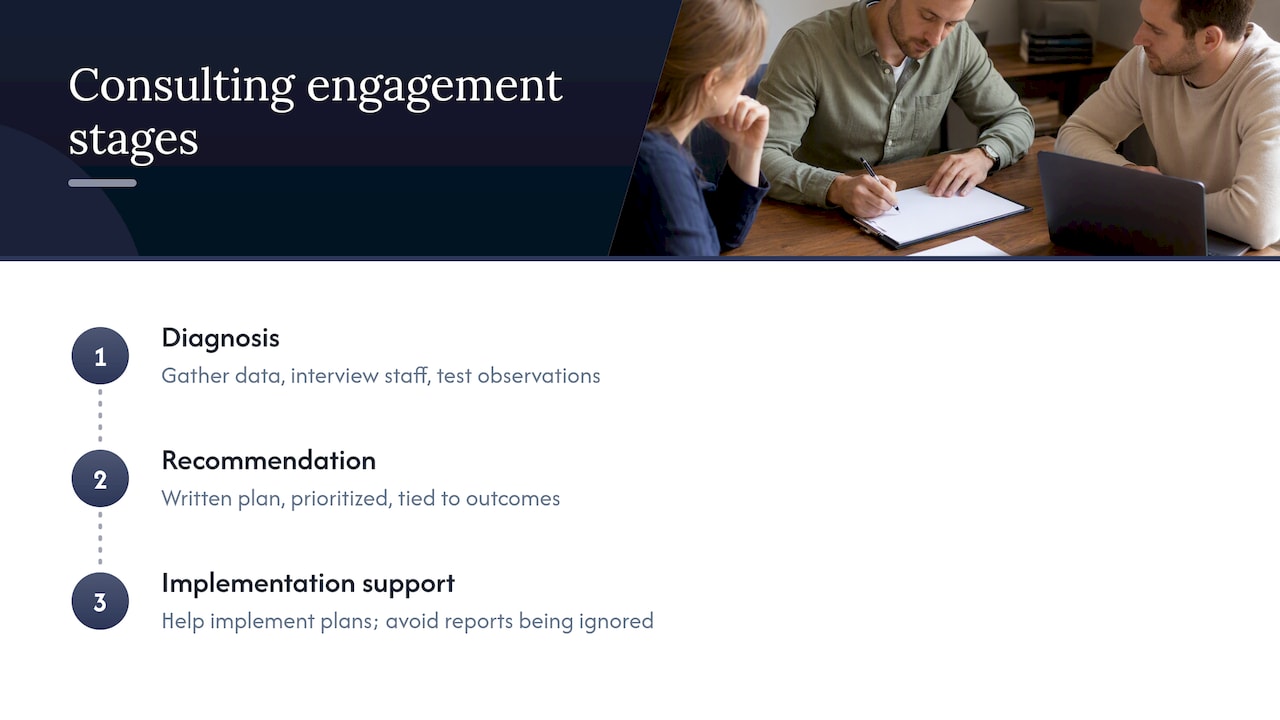
Diagnosis comes first and takes the longest if it is done properly. The consultant gathers data, talks to the people doing the work, and tests what they are told against what they observe. We see businesses rush this stage constantly, wanting the “fix” on day one, and it almost always produces a weaker recommendation because the real cause never got found.
Recommendation is the written output: a specific plan, ranked by priority, tied to a business outcome rather than a technical nicety. A good recommendation names who does what and by when. A weak one just lists “best practices” with no connection to your actual constraints.
Implementation support is where most engagements quietly fall apart. The ABS draft occupation standard for management consultants lists supporting implementation as a core task, not an optional extra, and that matches what we see on the ground. A report with no implementation partner behind it tends to sit untouched because the internal team that was already stretched thin before the consultant arrived is still stretched thin after they leave.
How long a consulting engagement actually runs
There is no single standard length, because the duration depends entirely on the problem’s size and how deep the diagnostic phase needs to go.
Short, focused engagements, like a single process review or a compliance gap assessment, often wrap inside four to eight weeks: a couple of weeks diagnosing, a week or two drafting recommendations, and a short handover. Larger engagements, such as a full organisational restructure or a multi site IT overhaul, run for several months and move through distinct phases: discovery, analysis, recommendation, pilot, then full rollout.
Retainer style advisory arrangements do not have a fixed end date at all. A business keeps a consultant on tap for a set number of hours each month, which suits situations where the problem is ongoing rather than a one off event, similar to how a business keeps ongoing IT strategy and consulting support rather than booking a single visit. The mistake we see most often is a business expecting a retainer to behave like a project, with a defined finish line. It will not, and that mismatch causes more disputes than almost anything else in consulting contracts.
The real benefits a client gets from a good engagement
Done properly, consulting buys you three things you cannot easily get internally: objectivity, specialised expertise and bandwidth.
Objectivity matters because internal staff are often too close to a problem to see its structural cause, something Jobs and Skills Australia’s occupation profile points to directly: internal teams can end up treating symptoms instead of root causes. An outsider has no political stake in protecting a particular department or decision.
Specialised expertise means you are not paying to train a generalist on a problem they have never seen before. A consultant who has fixed the same issue at ten other businesses brings pattern recognition your internal team simply has not had the chance to build.
Bandwidth is the quiet benefit nobody mentions enough. A business running lean cannot pull three staff off their day jobs for six weeks to fix a structural problem. A consulting engagement absorbs that workload temporarily, without permanently growing headcount.
Frameworks and methods consultants actually use
Most consulting work leans on a handful of recognisable frameworks, adapted to the specific engagement rather than applied rigidly.
Gap analysis compares current state against a target state and defines the distance between them. Root cause analysis, often using simple tools like the “five whys”, pushes past the obvious symptom to find what is actually driving it. Process mapping lays out how work currently flows step by step, which is usually the fastest way to spot where time and money leak out. Change management frameworks, used heavily in IT and organisational transitions, structure how a business moves people through a shift rather than just technology or policy. For compliance specific work, structured standards like ISO 27001 give a defined checklist to work against, and businesses weighing up that kind of project can get a sense of scope and cost through tools like the ISO 27001 implementation calculator.
None of these frameworks replace judgement. They give structure to a diagnostic process that still depends heavily on the skill of the person running it.
What we see when businesses bring in consultants
Honestly, most of the IT consulting calls we get start the same way: a business thinks it is backed up, and it is not. Or there is no MFA on anywhere near enough accounts. Or the network has grown so messy over the years that nobody can say with confidence what is actually connected to what.
Good consulting ties that mess back to a business outcome: fewer outages, less compliance risk, lower cost over time. That is the gap between advice and value, and it is why our IT consulting breakdown focuses as much on implementation as diagnosis.
— Matt
If you want help putting a recommendation into practice
Once a diagnosis points to outdated hardware, patchy backups, no MFA or a network nobody fully understands, the harder part is fixing it without disrupting the business. We provide IT support, cloud migration, cybersecurity remediation and ongoing implementation assistance for small to medium businesses dealing with these problems.
- Managed IT support and help desk backup for day to day issues
- Cybersecurity fixes including MFA rollout and risk assessment and compliance work
- Cloud migration and Azure strategy support for businesses modernising infrastructure
If you have a consultant’s recommendations sitting on your desk and need someone to actually build them, get in touch with our team to talk through what implementation looks like for your business.
FAQ
What does a consultant do?
A consultant diagnoses a specific business problem, then delivers a written recommendation and often supports putting that recommendation into action. The work typically spans interviews, data analysis and process review before any advice is given.
Is consulting a high paying job?
Pay can be well above average, particularly for senior or specialised roles. Management and organisation analysts had a median full time weekly salary of $2,444 in 2025, though junior and generalist roles sit much closer to typical professional salaries.
What are the top 5 consulting skills?
Structured problem solving, stakeholder management, change facilitation, clear communication and practical delivery focus are the core skills clients should expect. Scepticism toward assumptions is just as valuable, since it stops a consultant accepting the official story at face value.
Is consulting a difficult job?
It can be demanding, with tight deadlines and high client expectations noted across industry career resources like SEEK’s role overview. The difficulty varies by specialisation and client, but pressure to deliver visible results is a constant feature of the work.
Sources
- Jobs and Skills Australia
- International Coaching Federation – Guide to experiencing coaching for individuals
- Australian Bureau of Statistics – Unit Group 2234 Management and Organisation Analysts