

What is internet risk, and why does it matter for your family?

Internet risk is the chance of experiencing harm or negative consequences while using the internet. That includes threats like cyberbullying, scams, exposure to violent or sexual content, and contact with people who intend harm. For Australian families with children and teens, understanding these risks is not optional. It is the starting point for keeping young people safe.
The eSafety Commissioner organises online risks into four categories: content, contact, conduct, and contract. These four categories cover almost every type of harm a person can encounter online, from stumbling across disturbing material to being manipulated into sharing personal information. Knowing the categories helps you spot problems early, before they escalate.
The scale of the problem is real. According to eSafety research from the Keeping Kids Safe Online survey, conducted december 2024 to february 2025:
- 74% of children aged 10–15 had seen or heard content associated with harm online
- 53% had experienced cyberbullying
- A majority had seen or heard online hate
- A significant minority had personally experienced online hate
- Some had experienced non-consensual tracking, monitoring, or harassment
Online abuse can cause lasting psychological harm, including anxiety, depression, social withdrawal, and loss of trust in others, according to eSafety’s community risk guidance. The digital world is not going away. Managing internet risk is a shared responsibility across families, schools, and communities.
Common types of internet risks you need to know about
Online threats fall into recognisable patterns. Understanding each type helps you respond to the right risk at the right time.
Content risks occur when someone is exposed to distressing or harmful material, including violent, gory, extremist, or age-inappropriate sexual content. Low-quality “sticky” games and apps that use psychological techniques to keep children engaged also fall into this category, according to eSafety’s risk framework.
Contact risks involve harmful interactions with adults or strangers online. This includes grooming, cyberflashing, cyberstalking, identity theft, and recruitment to extremist groups. Research from eSafety’s Mind the Gap report found that 55% of children had communicated with someone they first met online, yet many parents were unaware of this contact.
Conduct risks cover harmful behaviour such as cyberbullying, trolling, sexual harassment, and participation in dangerous online trends. These risks often come from peers, sometimes where a power imbalance exists.
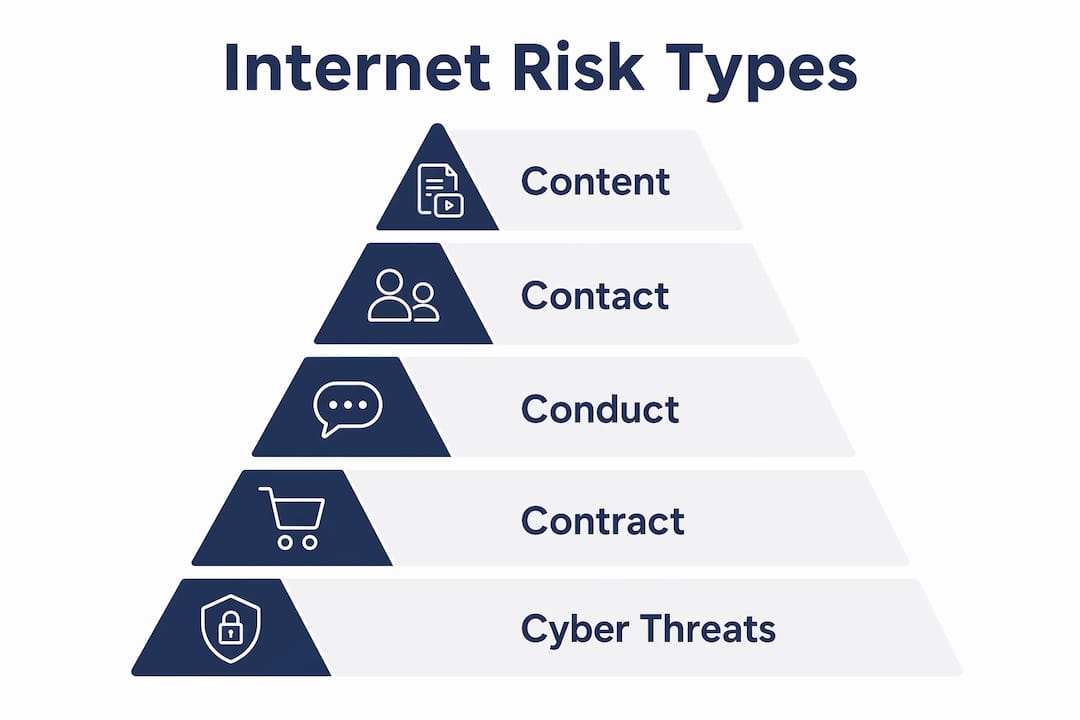
Contract risks involve exploitation through scams, gambling, or age-inappropriate marketing. This category also covers illegal trading, such as the distribution of child sexual abuse material.
Beyond these four categories, common cyber threats include malware, hacking, phishing, identity theft, and sextortion. These affect adults and children alike.
| Risk type | Description | Example |
|---|---|---|
| Content | Exposure to harmful or inappropriate material | Violent videos, extremist content, adult sites |
| Contact | Harmful interaction with strangers or adults | Grooming, cyberflashing, cyberstalking |
| Conduct | Harmful behaviour from or toward others | Cyberbullying, trolling, dangerous challenges |
| Contract | Exploitation through commercial or legal means | Scams, gambling, deceptive in-app purchases |
| Malware/hacking | Device or account compromise | Phishing emails, ransomware, stolen passwords |
| Sextortion | Blackmail using sexual images | Coerced image sharing, threats to expose |
Internet risks specific to children and teenagers in Australia
Young people face a different version of these risks than adults do. Teens have more independence online, less experience recognising manipulation, and a stronger drive to fit in socially. That combination creates real vulnerability.
53% of Australian children aged 10–15 have experienced cyberbullying, and 74% have encountered harmful content online. (eSafety Commissioner, Keeping Kids Safe Online, 2024–2025)
The eSafety data also shows that teens and trans or gender-diverse children face higher rates of online harm than other groups. Risk is not evenly distributed. A one-size-fits-all approach to online safety will miss the young people who need the most support.
Specific concerns for children and teenagers include:
- Cyberbullying and peer harassment, which can follow a child from school into their home via messaging apps and gaming platforms
- Sextortion, where perpetrators coerce young people into sharing sexual images and then threaten to distribute them. The Australian Centre to Counter Child Exploitation (ACCCE) has reported a significant increase in this crime against young people
- Grooming by adults, with research indicating it is a significant issue among girls under 18
- Exposure to self-harm or eating disorder content, which is particularly prevalent among girls aged 14–17
- Online reputation damage, where posts, images, or videos shared impulsively can affect a young person’s social standing or future opportunities
- Scams targeting teens, including fake offers in gaming environments and phishing through social media
From December 2025, Australian law requires social media platforms to take reasonable steps to prevent Australians under 16 from creating or keeping accounts. That is a meaningful step. But as eSafety notes, no online platform or service is risk-free, and children will still access content without logging in. Legal protections help, but they do not replace active parenting and open conversation.
Practical strategies for managing online risks at home
Technology alone will not protect your family. We see this constantly in our work: parents install parental controls and assume the job is done. It is not. Parental controls are not foolproof, and children who are motivated can find ways around them. The real protection comes from combining tools with communication and consistent supervision.
Here are strategies that actually work:
- Create a family tech agreement. Set clear rules about when, where, and how devices are used. eSafety has downloadable templates, and ThinkUKnow Australia offers a Family Online Safety Contract for older children. Getting your child’s input makes them more likely to follow the rules.
- Set up parental controls on every device. This includes phones, tablets, laptops, gaming consoles, and smart TVs. Microsoft Family Safety, Apple Screen Time, and Google Family Link each offer content filtering, screen time limits, and activity reports. Apply controls to the home Wi-Fi router as well for broader coverage.
- Review privacy settings regularly. Default settings on gaming and social media platforms often allow anyone to contact your child. Check and tighten these settings, especially after app updates.
- Keep devices in shared spaces. For younger children especially, having devices in visible areas of the home reduces the risk of unsupervised contact and exposure to harmful content.
- Talk openly and often. Ask your child who they are talking to online, what they are watching, and whether anything has made them uncomfortable. Reassure them they will not lose device access if they come to you with a problem. Children who fear punishment stay silent.
- Report incidents to the right authorities. Cyberbullying of children can be reported to the eSafety Commissioner. Suspected child sexual abuse or exploitation should go to the ACCCE. Scams can be reported to Scamwatch. For immediate danger, call Triple Zero (000).
Pro Tip: Fading controls gradually as your child matures builds trust and independence. Strict lockdowns on teenagers often create secrecy cycles, where young people hide their online activity rather than discuss problems. The goal is to stay informed, not to monitor every click.
For a broader look at securing your internet connection at home, including device settings and network security, IT Start has a practical guide covering the key steps.
What IT Start sees families getting wrong about digital risk
Honestly, the biggest gap we see is not a lack of tools. It is a mismatch between what families think they have set up and what is actually working.
- Assuming one device is covered means all devices are covered. Parental controls set on a home computer do nothing on a sibling’s phone or a school-issued tablet. Every connected device needs its own settings.
- Treating parental controls as a set-and-forget solution. Apps update. Settings reset. Children find workarounds. Controls need regular review, not a one-time setup.
- Underestimating gaming platforms as a contact risk. Parents often focus on social media and miss that gaming environments, including open-world multiplayer games, expose children to strangers with no age verification. Review privacy settings on gaming consoles and apps specifically.
- Not having MFA on family accounts. Multi-factor authentication (MFA) is one of the most effective ways to stop account takeovers. If your child’s email or gaming account does not have MFA enabled, it is far easier for a cybercriminal to access it. The Australian Cyber Security Centre recommends MFA as a baseline protection.
- Sharing passwords between family members. Children sharing passwords with friends is common and genuinely risky. A shared password means a shared account, and that exposes personal data, payment details, and private messages.
- Skipping the conversation because it feels awkward. This is the one we see most. Parents install filters and avoid the hard discussions about grooming, sextortion, and online relationships. Those conversations are uncomfortable, but they are the most effective protection available.
The layered approach works: combine cyber security tools with clear household rules, regular check-ins, and age-appropriate conversations. No single measure covers everything. The families who manage internet risk well are the ones doing all three consistently, not perfectly.
Key takeaways
Australian children face real and measurable online risks, and managing them requires combining technology, communication, and consistent supervision.
| Point | Details |
|---|---|
| Four risk categories | Content, contact, conduct, and contract cover the full range of online harms children face. |
| Scale of harm | 74% of Australian children aged 10–15 have seen harmful content online; 53% have experienced cyberbullying. |
| Vulnerable groups | Teens and trans or gender-diverse children face higher rates of online harm and need tailored safety approaches. |
| Controls have limits | Parental controls must be paired with open communication; children can bypass tools but cannot bypass trust. |
| Reporting matters | Cyberbullying goes to eSafety; exploitation goes to the ACCCE; scams go to Scamwatch; immediate danger means Triple Zero (000). |
FAQ
What is internet risk?
Internet risk is the likelihood of experiencing harm or negative consequences while using the internet, including threats such as cyberbullying, scams, malware, and exposure to harmful content. The eSafety Commissioner groups these risks into four categories: content, contact, conduct, and contract.
What are the four online risks for children?
The four categories are content risks (exposure to harmful material), contact risks (harmful interactions with strangers or adults), conduct risks (cyberbullying and harmful behaviour), and contract risks (scams, gambling, and exploitative marketing), as defined by researchers Livingstone and Stoilova and adopted by the eSafety Commissioner.
What are five practical rules for internet safety?
Use strong, unique passwords with MFA on every account; keep devices in shared family spaces; set parental controls on all connected devices; talk regularly with your child about who they are communicating with online; and report harmful content or contact to eSafety or the ACCCE immediately.
What risks can you find on the internet?
Common online risks include malware, phishing, hacking, identity theft, cyberbullying, sextortion, grooming, exposure to violent or sexual content, and scams. Children and teenagers face additional risks from contact with strangers in gaming environments and social media platforms.