

TL;DR:
- A cyber security incident response plan is a documented set of procedures that guides your team during a breach, ransomware attack, or data theft. It should be customized, concise, regularly tested, and include pre-authorized decision-making, clear roles, and communication templates. Proper planning and execution can significantly reduce legal, financial, and operational impacts during cyber incidents.
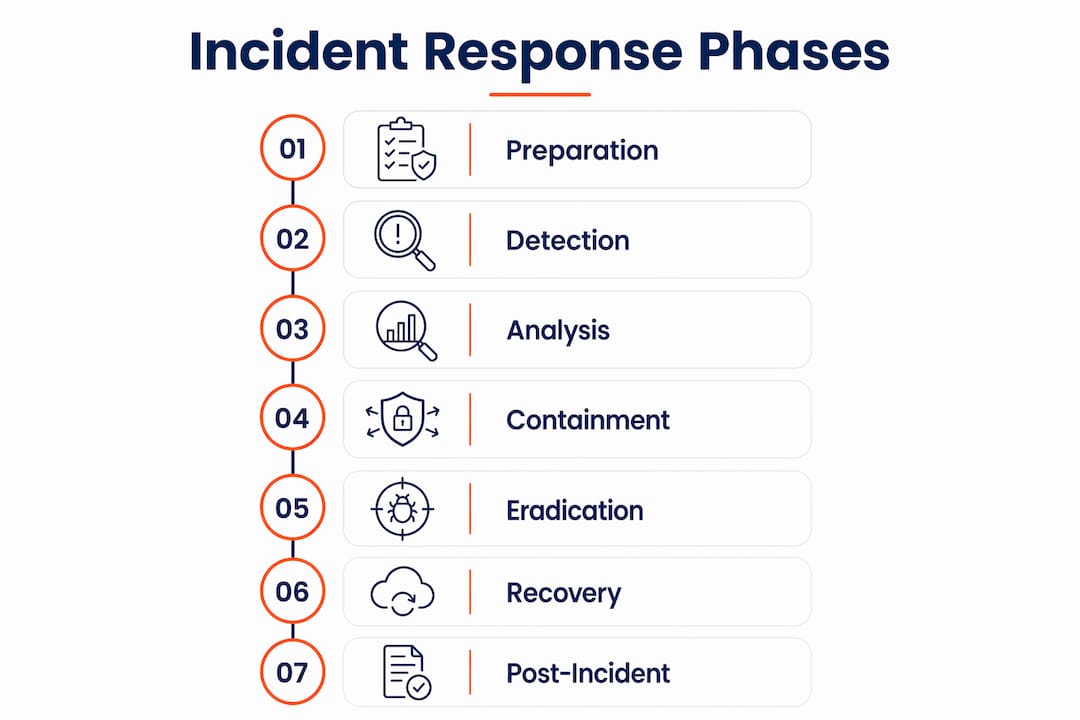
A cyber security incident response plan (IRP) is a documented, pre-approved set of procedures that tells your team exactly what to do when a breach, ransomware attack, or data theft occurs. The industry standard for structuring one is NIST SP 800-61, which breaks response into six phases: Preparation, Detection and Analysis, Containment, Eradication, Recovery, and Post-Incident Activity. For Australian SMBs, having a concrete cyber security incident response plan example to work from is not optional. Regulators are watching, attackers are not waiting, and the gap between businesses with a tested plan and those without one shows up clearly when something goes wrong.
What are the core components of a cyber security incident response plan?
A solid IRP is not a vague policy document. It is a working reference your team can act on under pressure. Every effective cyber security incident response plan example includes the following sections.
Purpose and scope defines what the plan covers, which systems it applies to, and what types of incidents trigger it. Without this, teams waste time debating whether an event qualifies as an incident while the attacker moves laterally through your network.
Incident response team roles and contact information must be current and specific. List names, mobile numbers, and backup contacts. Include your IT provider, legal counsel, cyber insurer, and any forensic firm you have pre-contracted. Stale contact lists are one of the most common failures we see in SMB plans.
Escalation matrix maps incident severity levels (typically P1 through P4) to specific response actions and decision-makers. A P1 ransomware event triggers your CEO and legal team immediately. A P4 phishing attempt goes to your IT manager. The matrix removes ambiguity when people are stressed.

Phase-by-phase procedures follow the NIST SP 800-61 lifecycle. Each phase needs numbered steps, not paragraphs of prose.
Communication templates cover internal staff notifications, customer breach notices, and media statements. Pre-writing these saves hours during a real incident.
Regulatory reporting obligations must be explicit. The SEC’s 4-day disclosure window for material incidents applies to listed entities, and Australia’s Notifiable Data Breaches scheme under the Privacy Act requires reporting to the OAIC within 30 days of becoming aware of an eligible breach. Missing these deadlines adds legal exposure on top of the breach itself.
Evidence handling procedures document how logs, screenshots, and affected devices are preserved for forensic investigation and insurance claims.
Here is a quick reference for the core IRP sections and their primary purpose:
| IRP Section | Primary Purpose |
|---|---|
| Purpose and scope | Defines what triggers the plan and what it covers |
| Team roles and contacts | Assigns clear ownership and provides current contact details |
| Escalation matrix | Maps severity levels to decision-makers and response actions |
| Phase procedures (NIST) | Provides step-by-step actions for each response phase |
| Communication templates | Pre-written notices for staff, customers, and regulators |
| Regulatory obligations | Documents reporting deadlines and responsible parties |
| Evidence handling | Preserves data for forensics, legal, and insurance purposes |
How do you customise an IRP example for your business?
A template is a skeleton. Effectiveness depends on customising it to your specific technology stack, risk profile, and regulatory environment. Here is how to do that practically.
-
Map your risk profile first. List the three to five incidents most likely to hit your business. For most Queensland SMBs in professional services, that means ransomware, business email compromise, and credential theft. Your plan should prioritise those scenarios above all others.
-
Identify your critical assets. What data, if stolen or encrypted, would cause the most damage? Client files, financial records, and Microsoft 365 accounts are the usual answers. Your plan needs to name these assets explicitly so responders know what to protect first.
-
Assign decision authority clearly. The IRP must pre-authorise who can approve isolating a server, engaging external forensics, or notifying customers. If your team has to chase down the owner for every decision during a live incident, you will lose hours you cannot afford.
-
Incorporate your actual tools. If you use Microsoft Defender, Acronis for backups, and Microsoft 365 for communication, name them in the procedures. Generic steps like “isolate the affected system” are useless without specifying how to do that in your environment.
-
Write specific playbooks for high-impact scenarios. Numbered action sequences work far better than flowcharts for ransomware, data exfiltration, business email compromise, and insider threats. Each playbook should fit on one page. The first five steps should be executable by any team member without IT expertise.
-
Treat the plan as a living document. Schedule a review every six months and after every significant incident or infrastructure change. A plan written in 2023 that has never been updated is not a plan. It is a liability.
Pro Tip: Store a printed copy and a copy on a USB drive off-network. If ransomware encrypts your file server, you still need to access your IRP. We have seen businesses locked out of their own response plan during an attack.
What tools do smbs need to implement an incident response plan?
Having a written plan is one thing. Having the tools to execute it is another. Most SMBs we work with are missing at least two of the following.
- SIEM and EDR platforms. AI-assisted detection tools like Microsoft Sentinel (SIEM) and Microsoft Defender for Endpoint (EDR) detect threats faster than any manual process. They also generate the logs your forensic team will need later. Without them, you are flying blind.
- Pre-contracted external support. Engage a cyber forensics firm and a cyber-specialist lawyer before you need them. Negotiating contracts during an active breach is expensive and slow. Your cyber insurer may have preferred providers, so check your policy now.
- Centralised logging infrastructure. Your plan is only as good as the evidence it can draw on. Centralised logging through a tool like Microsoft Sentinel or a managed SOC service means you have an audit trail when something goes wrong.
- Communication platforms with redundancy. If your primary email is compromised, how do you communicate internally? Many SMBs have no answer to this. A secondary channel like Microsoft Teams on mobile or a Signal group for leadership is worth setting up in advance.
- Tabletop exercises. Run a simulated incident with your team at least once a year. Walk through a ransomware scenario step by step. You will find gaps in your plan that no amount of document review would surface. This is also how you build proactive monitoring habits across your team.
Pro Tip: Your cyber insurer will often ask whether you have a tested IRP before quoting. A documented, exercised plan can reduce your premium and improve your coverage terms.
Here is a comparison of detection tool options relevant to SMBs:
| Tool Type | Example | Best For |
|---|---|---|
| EDR | Microsoft Defender for Endpoint | Endpoint threat detection and isolation |
| SIEM | Microsoft Sentinel | Log aggregation and threat correlation |
| Backup and recovery | Acronis Cyber Protect | Ransomware recovery and data restoration |
| Communication backup | Microsoft Teams (mobile) | Internal comms if email is compromised |
What are the most common mistakes in incident response plans?
We see the same mistakes repeatedly. Knowing them in advance saves you from learning them the hard way.
- Overcomplicating the document. No one reads a 40-page binder during a crisis. Effective plans fit on a few pages with quick-access contact info and numbered checklists. If your plan requires a calm afternoon to navigate, it will fail under pressure.
- Failing to pre-authorise decisions. This is the single most costly mistake. Lack of pre-authorised decision-making causes delays that turn a contained incident into a catastrophic loss. Your plan must name who can approve each critical action without needing further sign-off.
- Ignoring regulatory deadlines. Australia’s Notifiable Data Breaches scheme and the SEC’s 4-day disclosure rule are not suggestions. Build these deadlines into your escalation matrix with named owners responsible for each notification.
- Not updating the plan. Plans must be tested and updated annually at minimum. Staff leave, systems change, and new attack vectors emerge. A plan with outdated contacts or references to decommissioned systems is worse than no plan because it creates false confidence.
- Missing specific playbooks. A generic “respond to cyber incident” procedure does not help your team when ransomware is spreading across your network at 2am. You need a specific playbook for ransomware, one for business email compromise, one for data exfiltration, and one for insider threats. Each should be a numbered list of the first ten actions to take.
“An IRP is as much about governance and decision authority as it is about technical response steps. The businesses that recover fastest are the ones that already know who is in charge.” — Canadian Centre for Cyber Security
Honestly, the gap between a good plan and a bad one is rarely technical. It is almost always about clarity of ownership and willingness to make hard decisions in advance.
Key takeaways
A cyber security incident response plan works only when it is specific, pre-authorised, regularly tested, and short enough to use under pressure.
| Point | Details |
|---|---|
| Use NIST SP 800-61 as your structure | Build your plan around the six-phase lifecycle: Preparation through Post-Incident Activity. |
| Pre-authorise every critical decision | Name who can approve isolation, forensics, and customer notification before an incident occurs. |
| Write specific playbooks | Create numbered action lists for ransomware, BEC, data exfiltration, and insider threats. |
| Store a copy off-network | Keep a printed or USB copy so ransomware cannot lock you out of your own plan. |
| Test and update annually | Review after every major change and run a tabletop exercise at least once per year. |
What i have learned running irps for queensland smbs
Honestly, the plans that fail are not the ones with technical gaps. They are the ones where nobody agreed in advance who is actually in charge.
We worked with a professional services firm in Brisbane that had a decent-looking IRP. Twelve pages, NIST-aligned, covered all the right phases. When they had a business email compromise incident, the plan fell apart within the first hour because three people thought they were the decision-maker and nobody had authority to isolate the compromised account without the owner’s approval. The owner was overseas. They lost six hours.
The fix was not technical. We rewrote the escalation matrix to pre-authorise the IT manager to isolate accounts and engage forensics without waiting for owner sign-off. That one change made the plan usable.
The other thing I push hard on is simplicity. I have seen plans that are genuinely impressive documents. Detailed, thorough, well-researched. And completely useless at 2am when your receptionist is the only one in the office and ransomware is spreading. Your incident response strategy needs to be executable by a non-technical person following a numbered list. If it requires interpretation, it will not get used.
Test your plan. Run a tabletop exercise. You will find the gaps faster than any review process. And check where you are storing the plan itself. We have seen businesses whose only copy was on the file server that got encrypted. That is not a plan. That is a document.
— Matt
Get expert help building your incident response plan
IT Start works with Brisbane SMBs across professional services, healthcare, and finance to build, test, and maintain cyber security incident response plans that actually work under pressure. We do not hand you a generic template and walk away. We map your specific risk profile, assign decision authority, write your playbooks, and run tabletop exercises with your team. If you want a plan your staff can execute at 2am without calling anyone, our cyber security services are built for exactly that. Reach out for a free assessment and we will tell you honestly where your current plan stands and what needs to change.
FAQ
What is a cyber security incident response plan?
A cyber security incident response plan is a documented set of procedures that tells your team how to detect, contain, and recover from a cyber attack. It assigns roles, pre-authorises decisions, and includes communication templates and regulatory reporting obligations.
How long should an incident response plan be?
An effective plan fits on a few pages with numbered checklists and quick-access contact information. Lengthy documents are not read during a crisis, so brevity and clarity are more valuable than comprehensiveness.
What is the NIST SP 800-61 framework?
NIST SP 800-61 is the most widely used structure for incident response plans, covering six phases: Preparation, Detection and Analysis, Containment, Eradication, Recovery, and Post-Incident Activity. Most Australian and international IRP templates are built around this lifecycle.
How often should you update your incident response plan?
Plans must be tested and updated at least annually and after every significant infrastructure change or real incident. Stale plans with outdated contacts or irrelevant procedures create false confidence and fail when needed most.
Do australian smbs have legal reporting obligations after a breach?
Yes. Australia’s Notifiable Data Breaches scheme requires eligible businesses to report qualifying breaches to the OAIC within 30 days of becoming aware of them. Your IRP should name the person responsible for this notification and include the reporting deadline explicitly.