
TL;DR:
- Cybersecurity involves protecting systems, data, and networks through layered controls guided by the CIA triad. Most SMBs focus on confidentiality but must also prioritize integrity and availability to prevent disruptions. Implementing MFA, tested backups, and proper processes significantly reduces cybersecurity risks and enhances business resilience.
Cybersecurity is the practice of protecting your business’s systems, networks, and data from unauthorised access, damage, or disruption through coordinated people, processes, and technology. The US Cybersecurity and Infrastructure Security Agency, cited by CompTIA, defines it as protecting networks, devices, and data to preserve confidentiality, integrity, and availability of information. That three-part definition matters because most small and medium-sized businesses think cybersecurity means “keeping hackers out.” It means far more than that. It covers how your data is stored, who can access it, whether your systems stay operational under attack, and how quickly you recover when something goes wrong. The NIST Cybersecurity Framework and Sophos both describe this as a lifecycle, not a product you buy once and forget.
What does cyber security protect? The CIA triad explained
The CIA triad is the foundational mental model for understanding what cybersecurity actually protects. The three goals are confidentiality, integrity, and availability. Each one maps to a real business risk.
Confidentiality means only authorised people can access your data. Think client records, financial files, employee details. A breach here means that information ends up somewhere it should not be, whether that is a competitor, a criminal, or a random server in Eastern Europe.

Integrity means your data has not been tampered with. This one catches a lot of SMB owners off guard. Ransomware does not just lock your files. It can silently corrupt data for weeks before you notice. If your accounting records, contracts, or client databases have been altered, you may not realise until the damage is done.
Availability means your systems are up and accessible when you need them. A distributed denial-of-service attack, a failed server, or a misconfigured update can take your business offline. For a medical practice or legal firm, even a few hours of downtime has real financial and reputational consequences.
Most SMBs focus almost entirely on confidentiality, which is understandable. Data theft gets the headlines. But integrity and availability failures cause just as much disruption, and they are often harder to detect. We see this a lot: a business has antivirus installed and thinks they are covered, but they have no tested backups and no idea what they would do if their file server went down on a Monday morning.
- Confidentiality controls: access permissions, encryption, multi-factor authentication (MFA)
- Integrity controls: audit logs, version control, checksums, change management
- Availability controls: redundant systems, tested backups, disaster recovery plans
Pro Tip: Map every security control you have to one of the three CIA goals. If you cannot identify which goal a control serves, it is either misconfigured or unnecessary. This exercise alone reveals gaps most businesses did not know they had.
How does cyber security work? Layered defence for small businesses
Cybersecurity works through multiple protection domains working together, not a single product. Sophos describes this as a layered lifecycle approach that limits attacker entry, restricts access if they get in, and speeds up recovery when something breaks through. No single tool covers all of this.
Here are the core protection domains every SMB should have in place:
- Email filtering and anti-phishing. Over 90% of attacks start with email. Microsoft 365 Defender and tools like Proofpoint filter malicious links, attachments, and spoofed senders before they reach your staff.
- Endpoint security. Every laptop, desktop, and mobile device is a potential entry point. Endpoint detection and response (EDR) tools like Microsoft Defender for Business or Sophos Intercept X go beyond basic antivirus to detect behavioural anomalies.
- Identity and access management. MFA on every account is non-negotiable. We still find businesses running Microsoft 365 with no MFA on admin accounts. That is an open door.
- Network controls. Firewalls, network segmentation, and DNS filtering stop attackers from moving laterally once inside. A flat network where every device can talk to every other device is a liability.
- Encryption. Data at rest and in transit should be encrypted. BitLocker on Windows devices and TLS on web traffic are baseline requirements.
- Monitoring and alerting. You cannot respond to what you cannot see. Security information and event management (SIEM) tools or a managed detection and response (MDR) service give you visibility.
- Incident response. Having a documented incident response plan before something goes wrong is the difference between a contained incident and a catastrophic one.
Technology alone is not enough. Cybersecurity failures in SMBs most often come from process and people gaps, not missing software. Staff clicking phishing links, sharing passwords, or ignoring update prompts cause more breaches than unpatched zero-days.
Pro Tip: When something goes wrong, your first priority is containment, not investigation. Isolate the affected device or account immediately. Speed of containment directly limits how far an attacker can move through your network.
What framework should SMBs follow for cyber security?
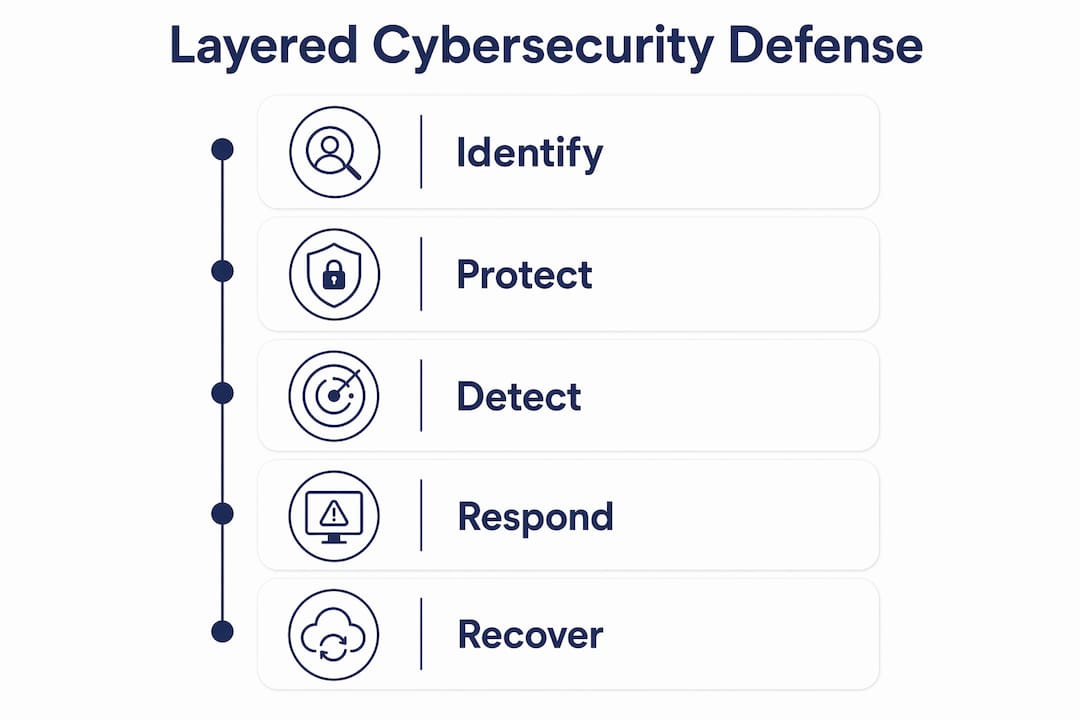
The NIST Cybersecurity Framework 2.0 gives SMBs a structured way to manage cyber risk across six core functions. It is designed to work for organisations of any size, including businesses with no dedicated IT staff. The value of a framework is that it shifts cybersecurity from a series of one-off purchases to an ongoing risk management programme.
| NIST CSF 2.0 function | What it means for your business |
|---|---|
| Govern | Define who is responsible for security decisions and what your risk appetite is |
| Identify | Know what assets, data, and systems you have and what risks they carry |
| Protect | Put controls in place: MFA, patching, backups, access restrictions |
| Detect | Monitor for unusual activity and set up alerts for potential incidents |
| Respond | Have a documented plan for what to do when an incident occurs |
| Recover | Restore systems and data quickly, and learn from what happened |
Most SMBs we work with are strong on Protect (they have antivirus and a firewall) and weak on everything else. They have no asset register, no monitoring, no written response plan, and no tested recovery process. The NIST framework is useful precisely because it forces you to look at all six areas, not just the ones that feel familiar.
Adopting this framework does not mean hiring a full-time security team. It means working through each function systematically, even if your answers are simple at first. A one-page asset list is better than none. A basic response checklist is better than improvising under pressure.
What are the biggest cyber security mistakes SMBs make?
Honestly, the list is depressingly consistent. We see the same gaps across industries, from accounting firms to medical practices to construction companies. The problems are rarely exotic. They are basic.
- No MFA on critical accounts. Microsoft 365, banking portals, accounting software. Passwords alone are not sufficient. Credential theft is the most common attack vector, and MFA blocks the vast majority of it.
- Backups that have never been tested. We see this constantly. A business thinks they are backed up because a backup job runs nightly. But the restore has never been tested, the backup destination is on the same network as the primary data, or the retention period is too short to recover from a slow-moving ransomware infection.
- Outdated hardware and software. End-of-life operating systems like Windows 10 (support ends October 2025) receive no security patches. Running them is the equivalent of leaving a door unlocked.
- No documented processes. What happens when a staff member leaves? Are their accounts disabled immediately? Is there a checklist? We find active accounts for people who left months ago.
- One product, no strategy. Buying antivirus and calling it done. Effective cybersecurity treats controls as repeatable processes, not a single product purchase.
Pro Tip: Compliance frameworks like the Australian Government’s Essential Eight are a useful starting point, but ticking boxes without testing your controls gives false confidence. Run a simulated phishing test on your staff. Attempt a restore from your backup. The results are usually sobering.
For a practical breakdown of what tools actually cover these gaps, the cybersecurity solutions comparison from IT Start covers the options available to SMBs in 2025 and 2026.
How to apply cyber security principles to your SMB today
Getting started does not require a large budget or a dedicated security team. It requires prioritising the right things in the right order.
- Audit your access. List every system your business uses and who has access to it. Remove accounts that should not exist. Enable MFA on everything, starting with email and financial systems.
- Fix your backups. Confirm your backups are running, stored offsite or in the cloud, and test a restore. Do this before anything else. A working backup is your most important recovery tool.
- Patch everything. Enable automatic updates on all devices and software. Unpatched systems are the most common entry point for attackers after phishing.
- Train your staff. One phishing awareness session per year is not enough. Regular, short training and simulated phishing tests build the habit of scepticism that stops most attacks.
- Write a basic response plan. Document what you will do if you suspect a breach. Who do you call? What do you isolate? Who notifies clients? Having this written down before an incident saves hours of confusion when it matters most.
Reducing attacker entry paths and improving your speed of containment and recovery gives SMBs the fastest measurable reduction in risk. You do not need to solve everything at once. Start with MFA, backups, and patching. Those three controls alone close the majority of attack vectors we see exploited in practice.
Use the CIA triad as a mental checklist. For every control you implement, ask: does this protect confidentiality, integrity, or availability? If you cannot answer that question, you may be spending money on the wrong thing.
Key takeaways
Cybersecurity protects SMBs through layered controls across people, processes, and technology, guided by the CIA triad and structured frameworks like NIST CSF 2.0.
| Point | Details |
|---|---|
| CIA triad is the foundation | Every security control should map to confidentiality, integrity, or availability to avoid gaps. |
| Layered defence beats single tools | Email filtering, MFA, endpoint security, backups, and monitoring must work together. |
| NIST CSF 2.0 structures your approach | The six functions (Govern through Recover) give SMBs a repeatable risk management lifecycle. |
| Backups and MFA are the fastest wins | These two controls close the majority of attack vectors seen in SMB environments. |
| Process gaps cause most breaches | Technology without documented processes and trained staff leaves critical vulnerabilities open. |
What I have learned managing security for SMBs
The thing that surprises most business owners is how rarely the problem is technical. We get called in after an incident and almost every time, the root cause is something simple. No MFA. A backup that was not actually running. A staff member who clicked a link because nobody ever told them not to.
I have stopped trying to sell cybersecurity as a product. It is a practice. The businesses that handle incidents well are the ones that have thought about it beforehand, not the ones with the most expensive software. A 20-person accounting firm with a written response plan, tested backups, and MFA on every account is genuinely more secure than a 200-person firm with a sophisticated firewall and no process behind it.
The NIST framework is worth adopting not because it is a compliance requirement, but because it forces you to think about all six areas. Most SMBs I work with have never considered what “Govern” means for their business. Who actually owns the security decisions? Often nobody does, which means nothing gets done until something breaks.
Start simple. Stay consistent. Treat it as ongoing risk management, not a one-time fix.
— Matt
How IT Start can help protect your Brisbane business
IT Start works with small and medium-sized businesses across Brisbane to build practical, layered cybersecurity programmes that actually get implemented. That means MFA, tested backups, endpoint protection, monitoring, and a written response plan, not just a product licence and a handshake. IT Start holds SMB 1001 Gold certification and specialises in industries where data protection and compliance matter most, including financial services, healthcare, and legal. If you are not sure where your gaps are, start with a free security assessment or explore IT Start’s managed cloud services to see how cloud-based controls integrate with your security posture. The team is local, direct, and will tell you what you actually need rather than what sounds impressive.
FAQ
What is cyber security in simple words?
Cybersecurity is the practice of protecting your business’s computers, networks, and data from theft, damage, or disruption. It combines technology, processes, and people to prevent attacks and recover quickly when something goes wrong.
What does cyber security protect?
Cybersecurity protects the confidentiality, integrity, and availability of your information and systems. That includes client data, financial records, email accounts, and the operational systems your business depends on every day.
What is involved in cyber security for a small business?
Effective cybersecurity for a small business involves MFA on all accounts, tested backups, endpoint security, email filtering, staff training, network controls, and a documented incident response plan. No single tool covers all of these areas.
What is the role of cybersecurity in business continuity?
Cybersecurity directly supports business continuity by reducing the likelihood of incidents and shortening recovery time when they occur. Businesses with tested backups and a written response plan recover significantly faster than those without.
What is meant by a layered cyber security approach?
A layered approach means using multiple overlapping controls rather than relying on one product. If an attacker bypasses your email filter, endpoint security should catch the malware. If that fails, network monitoring should detect unusual behaviour before damage spreads.