

TL;DR:
- Most Queensland SMEs assume a perimeter firewall alone provides sufficient security, but internal threats persist without segmentation.
- Network segmentation divides networks into isolated zones, limiting lateral movement of attackers and reducing breach impact.
Most Queensland business owners assume a strong perimeter firewall is enough protection. It isn’t. Once an attacker gets past your outer defences, a flat network (one with no internal boundaries) lets them move freely across every system, file, and database you own. That’s why network segmentation has become one of the most consequential security decisions an SME can make. This article explains what it is, what it costs you to skip it, and how to apply it practically in a Queensland business context.
Table of Contents
- What is network segmentation and why does it matter?
- How network segmentation reduces breach costs and speeds recovery
- Network segmentation and compliance: easing audit burdens for Queensland businesses
- Common pitfalls in segmentation projects and how to avoid them
- Applying segmentation strategically: best practices for Queensland SMEs
- The uncomfortable truth about segmentation that most vendors won’t tell you
- How IT Start helps Queensland businesses implement segmentation that actually works
- Frequently asked questions
What is network segmentation and why does it matter?
Network segmentation means dividing your business network into smaller, isolated zones, each governed by its own access rules and controls. Think of it like compartments in a ship. If one compartment floods, the others stay dry. Without segmentation, a single compromised laptop on your staff Wi-Fi can give an attacker a direct path to your financial records, client data, and critical servers.
As CISA’s Cybersecurity Performance Goals confirm, network segmentation limits breach impact by creating boundaries that contain malicious occurrences to separate segments. This containment is what security professionals call “limiting lateral movement.” An attacker can’t simply pivot from your guest Wi-Fi to your accounting system if those two networks are properly isolated.
Beyond security, segmentation also improves day-to-day network performance. Broadcast traffic (the background chatter between devices) stays confined to its own segment rather than flooding the whole network. For businesses running VoIP phones, point-of-sale terminals, and cloud applications simultaneously, this matters.
Key reasons why network segmentation is essential for Queensland SMEs:
- Stops attackers from moving freely once inside your network
- Limits damage to one zone rather than exposing every system
- Protects sensitive data like payroll or client records in their own isolated area
- Reduces network congestion and improves application performance
- Makes it far easier to detect unusual activity in a specific zone
Building a solid understanding of network security basics first helps you make better decisions about where to draw those internal boundaries.
How network segmentation reduces breach costs and speeds recovery

Understanding segmentation’s basics is important, but seeing its financial and operational impact illustrates why it’s essential for any business serious about continuity.
The numbers are stark. Average data breach costs have reached $4.44 million globally in 2025, and organisations that deploy network segmentation experience significantly reduced breach costs and faster containment. For a Queensland SME, even a fraction of that figure is catastrophic. Legal fees, regulatory fines, client notification, reputational damage and downtime all compound quickly.
By the numbers: Full macro and micro-segmentation reduces breach recovery time by 31%, cutting the average recovery window from 29 days down to 20 days.
Nine days may not sound dramatic until you calculate what nine fewer days of downtime actually costs your business in lost revenue, staff productivity, and client trust. For a professional services firm in Brisbane billing at $2,000 per day, that’s an $18,000 difference before you count the security response costs.
Segmentation buys your team something money can’t easily replace: time. When an attacker is confined to a single segment, they can’t quietly move through your systems undetected for weeks. Detecting unusual activity in a small, well-monitored zone is far simpler than hunting a threat actor who has had free run of your entire environment.
Operational benefits of segmentation during a breach:
- Incident responders can isolate and shut down the affected segment without taking the whole network offline
- Forensic investigation scope narrows considerably, reducing cost and time
- Business operations in unaffected segments continue while the breach is contained
- Customers and partners experience less disruption, protecting your reputation
Exploring the managed network security benefits available to Brisbane businesses shows how these outcomes translate into real, measurable protection for your operations.
Network segmentation and compliance: easing audit burdens for Queensland businesses
Beyond security and costs, segmentation offers compliance benefits that bring practical relief during audits, particularly for businesses that handle payment card data or sensitive personal information.
The most concrete example is PCI DSS (Payment Card Industry Data Security Standard). Any business that processes, stores, or transmits card payments must comply. Without segmentation, every device on your network potentially falls within the audit scope. That means hundreds of systems may need to be assessed, hardened, and documented. Segmenting your cardholder data environment (CDE) into its own isolated zone changes that picture entirely. PCI DSS compliance scope can be reduced by up to 80% through network segmentation, dramatically lowering audit costs and ongoing compliance effort.
How segmentation simplifies compliance across multiple frameworks:
| Regulation | How segmentation helps |
|---|---|
| PCI DSS | Isolates cardholder data environment, shrinks audit scope by up to 80% |
| HIPAA | Separates patient health records from general business systems |
| Privacy Act (Australia) | Limits exposure of personal information to only authorised systems |
| ISO 27001 | Supports access control and information classification requirements |
| GDPR (if applicable) | Restricts personal data flow to defined, controlled segments |
For Queensland businesses in healthcare, legal, or financial services, this is not a theoretical benefit. Audit preparation is expensive. Staff time, consultant fees, and the risk of non-compliance penalties all weigh on operations. Segmentation lets you draw a firm line around what actually needs scrutiny.
Keeping up with data protection compliance requirements is already demanding enough without an unnecessarily broad audit scope making it worse.
Common pitfalls in segmentation projects and how to avoid them
With the benefits clear, it’s vital to understand the mistakes that derail segmentation efforts and turn a good idea into an expensive frustration.
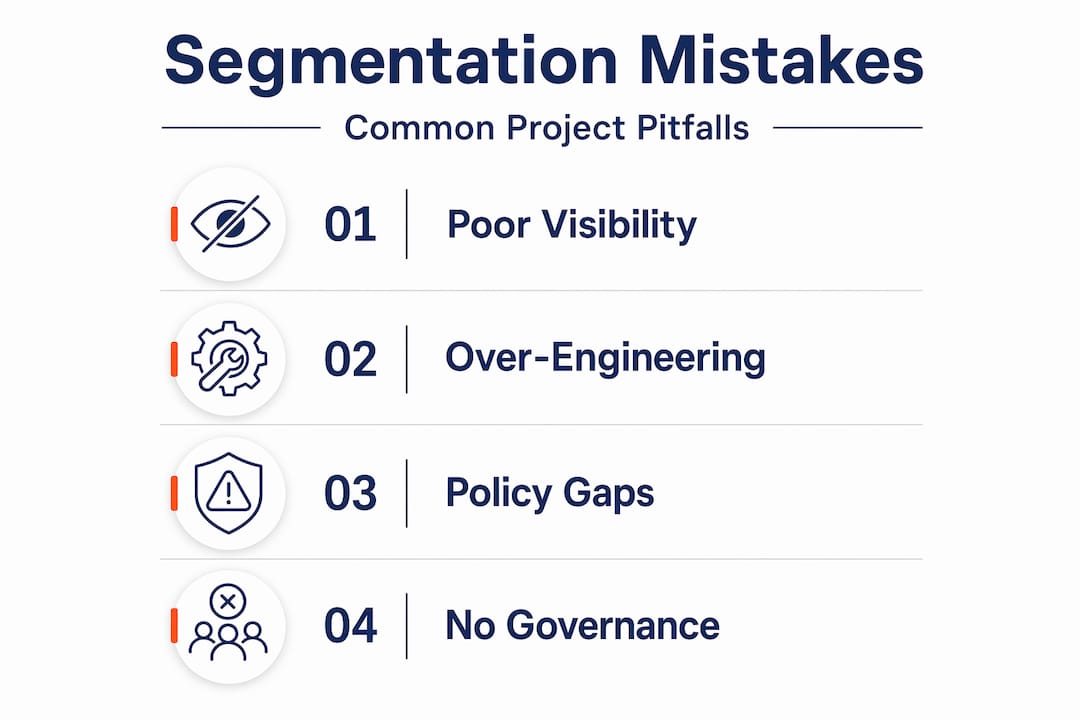
The most common failure point is poor asset visibility. You cannot segment what you haven’t mapped. Segmentation projects stall due to incomplete asset visibility and unrecognised legitimate traffic flows, which leads to overly permissive policies that provide little real protection. If your team doesn’t know that the warehouse printer communicates with the accounts server for automated invoicing, they may block that flow during segmentation, causing operational disruption.
A second major blind spot is operational technology (OT). Factories, medical clinics, and building management systems often rely on older equipment that was never designed with cybersecurity in mind. IT segmentation strategies do not always translate to OT environments, which may require physical isolation methods like data diodes rather than software-only controls. Treating OT the same as office IT is a mistake with potentially serious consequences.
Common segmentation mistakes and how to fix them:
- Skipping traffic analysis before designing segments (run passive monitoring for two to four weeks first)
- Applying the same access policies to every segment regardless of sensitivity
- Neglecting IoT devices like printers, cameras, and smart building systems
- Failing to document segment boundaries and update them as the business changes
- Setting and forgetting segmentation policies without periodic reviews
Pro Tip: Before you draw a single boundary, spend at least two weeks analysing your actual network traffic. Free tools like Wireshark, or logs from your existing firewall, will reveal legitimate communication flows you had no idea existed. Map those flows first, then design your segments around them.
Reviewing common network security pitfalls specific to Brisbane businesses can help you spot gaps before they become problems during implementation.
Applying segmentation strategically: best practices for Queensland SMEs
Knowing what not to do helps, but here’s a clear path to make segmentation work well in your business.
A practical implementation framework for Queensland SMEs:
- Inventory every asset on your network, including IoT devices, printers, and any OT equipment. You cannot protect what you haven’t identified.
- Map your traffic flows over two to four weeks using firewall logs or a network monitoring tool. Identify which systems communicate, how often, and why.
- Define your segments based on function and sensitivity. Common starting zones include: corporate devices, guest Wi-Fi, servers, point-of-sale, IoT, and management systems.
- Implement macro-segmentation first, separating broad functional areas by department or system type using VLANs (virtual local area networks) or dedicated subnets.
- Layer in micro-segmentation for your highest-value systems. Administrative functions, finance databases, and executive devices should have their own tightly controlled zones.
- Apply least-privilege access at every boundary. No device or user should have more access than their role requires. CISA and Cisco insights confirm that segmentation following least-privilege principles and Zero Trust models delivers the most granular and reliable security outcomes.
- Review and adapt regularly. Staff changes, new software, and business growth all affect your network. Quarterly reviews keep your segmentation aligned with reality.
Macro vs micro-segmentation: when to use each
| Approach | Best for | Complexity | Protection level |
|---|---|---|---|
| Macro-segmentation | Department or function separation | Low to medium | Good baseline isolation |
| Micro-segmentation | Individual workloads, admin systems | Medium to high | Granular, fine-grained control |
| Physical isolation | OT, critical infrastructure | High | Maximum for legacy systems |
Pro Tip: Don’t try to segment everything at once. Start with your highest-risk assets, typically anything that handles payments, personal data, or gives remote admin access. Get those right first, then expand outward over time.
For more guidance on improving network security in your specific environment, it’s worth reviewing frameworks that match the size and complexity of your business.
The uncomfortable truth about segmentation that most vendors won’t tell you
Here’s what fifteen years of working with Queensland businesses has taught us: most SMEs that invest in segmentation still get it wrong. Not because the technology is too hard. Because they treat it as a one-time project rather than an ongoing discipline.
A network you segment today will drift. Staff onboard new tools. Cloud services get connected. IoT devices multiply. Within 18 months of a segmentation project, many businesses have quietly created new gaps that undo half their work, because nobody reviewed the policies as the environment changed.
The conventional wisdom is that segmentation is a configuration task. We’d argue it’s actually a governance task. The firewall rules and VLANs are the easy part. The hard part is the process that keeps them current, the person accountable for reviewing them, and the discipline to enforce access boundaries even when it’s inconvenient.
We’ve also seen businesses over-engineer their first segmentation attempt, trying to achieve micro-segmentation across 200 devices in one go. The result is weeks of disruption, frustrated staff, and a project that gets abandoned halfway through. Starting with three to five clearly defined macro-segments, done properly, delivers more real security than an ambitious micro-segmentation project that never reaches completion.
The impact of network segmentation on security is only as strong as the process that maintains it. Build the governance first. The technology follows naturally.
How IT Start helps Queensland businesses implement segmentation that actually works
If you’re a business owner in Queensland weighing up whether network segmentation is worth the investment, the answer is almost certainly yes. But the execution matters enormously. At IT Start, we work with Brisbane SMEs across healthcare, legal, financial services, and professional services to design, implement, and maintain segmentation strategies that fit how your business actually operates. We start with a thorough network assessment, map your real traffic flows, and build a staged plan that minimises disruption. Our SMB 1001 Gold certification reflects the standards we hold ourselves to on every engagement. Get in touch with us for a free consultation and find out where your current network leaves you exposed.
Frequently asked questions
What is network segmentation in simple terms?
Network segmentation is dividing your business network into smaller, separated zones that control access between them, limiting how far an attacker can move if they breach one area.
How does network segmentation limit the damage from a cyberattack?
Segmentation confines attackers to the zone they first compromised, stopping them from reaching sensitive data or systems in other parts of your network. As CISA confirms, these boundaries contain malicious activity to separate segments, preventing network-wide compromise.
Can network segmentation reduce my business’s compliance audit scope?
Yes. Isolating your cardholder data environment is a prime example: PCI DSS audit scope can shrink by up to 80% through segmentation, making compliance significantly less time-consuming and costly.
What are common mistakes when implementing segmentation?
The biggest mistake is starting without a complete picture of your network assets and traffic flows, which leads to policies that either block legitimate operations or leave real gaps. Research confirms that incomplete asset visibility causes overly permissive segmented policies that provide false confidence.
Is network segmentation compatible with Zero Trust security?
Absolutely. Segmentation is a core building block of Zero Trust, enforcing the principle that no device or user is trusted by default at every internal boundary, making it much harder for attackers to exploit stolen credentials or compromised endpoints.