

Protecting sensitive client information feels more complex each year for Brisbane financial services firms. The rise of cloud platforms delivers clear business benefits, yet it also brings fresh challenges that cannot be ignored. As cyber threats grow more sophisticated and regulatory pressure mounts, understanding how to implement shared responsibility cloud security is now essential if you want to keep your client trust intact and stay ahead of compliance demands.
Table of Contents
- Cloud Data Security In Financial Services
- Key Cloud Security Types And Controls
- How Cloud Security Works For Finance
- Australian Regulations And Compliance Standards
- Risks, Costs, And Common Cloud Pitfalls
Table of Contents: Cloud Data Security for Financial Services
| Point | Details |
|---|---|
| Shared Responsibility | Financial firms must actively manage cloud security alongside their providers, ensuring robust encryption and access controls. |
| Regulatory Compliance | Understanding and adhering to Australian regulations is essential for maintaining data protection and avoiding penalties. |
| Multilayered Security Approach | Implementing multiple security controls—encryption, access management, and monitoring—is crucial for safeguarding financial data. |
| Continuous Improvement | Regular audits and staff training are necessary to adapt to evolving cyber threats and ensure security measures remain effective. |
Cloud data security in financial services
Financial firms in Brisbane operate in an environment where trust hinges entirely on data protection. Your clients hand over sensitive information—bank account details, investment portfolios, personal identification numbers—expecting that information stays secure. The reality is that your firm faces constant pressure from cyber attackers who view financial data as high-value targets. Cloud adoption has become necessary for efficiency and scalability, but it introduces new security risks that traditional on-premises systems didn’t present. Understanding how to secure data in the cloud isn’t optional anymore; it’s foundational to your business continuity.
The stakes are genuinely high. Australia’s banking sector has demonstrated that cyber threats pose serious risks to financial stability, and attacks targeting financial institutions have become increasingly sophisticated and targeted. These threats extend beyond the major banks to smaller firms like yours. When your firm moves financial data to the cloud, you’re relying on third-party infrastructure, managed services providers, and interconnected systems that expand your potential attack surface. A single vulnerability in your cloud environment, or in a vendor’s security controls, could expose client data that took years to build trust around. The costs of a breach include regulatory fines, reputational damage, client attrition, and remediation expenses that can destabilise a small to medium-sized firm.
What distinguishes effective cloud data security in financial services is a shared responsibility approach. You cannot simply transfer security responsibility to your cloud provider and assume you’re protected. Your provider secures the infrastructure, but you must secure your data, manage user access, configure encryption properly, and monitor for suspicious activity. This means establishing clear policies around who can access what data, implementing encryption both in transit and at rest, conducting regular security audits, and maintaining detailed logs of data access. For Brisbane financial firms, this also means understanding Australian regulatory requirements around data residency and compliance frameworks that apply to your specific services. The approach works best when you combine strong technical controls with staff training that helps your team recognise phishing attempts and follow security protocols consistently.
Pro tip: Start by conducting a cloud security assessment with your IT provider to identify which of your financial data assets are most sensitive and vulnerable, then implement encryption and access controls for those assets first rather than attempting a complete overhaul at once.
Key cloud security types and controls
When you’re securing financial data in the cloud, you’re not working with a single solution. Rather, you need multiple layers of protection working together to defend against different types of attacks. Think of it like layering security at a bank branch: you have door locks, surveillance cameras, alarm systems, and trained staff all playing distinct roles. Cloud security works the same way. Essential cloud security controls include identity and access management, encryption, and threat detection systems that each address specific vulnerabilities. Understanding which controls address which risks helps you build a coherent security strategy instead of implementing random tools.
The most critical controls for Brisbane financial firms centre on three foundational techniques. First, encryption protects your data by rendering it unreadable to anyone without authorisation, both when data sits in storage and when it travels across networks. Second, access control determines who can view, modify, or delete financial information, ensuring that only authorised staff members reach sensitive datasets. Third, data loss prevention systems monitor and restrict unauthorised data transfers that could send client information outside your organisation. Beyond these core controls, cloud data storage security also employs techniques such as data redundancy and continuous monitoring to ensure your information remains both protected and available when your firm needs it. Different financial firms prioritise these tools differently depending on their size, client base, and regulatory obligations, but all three form the foundation of any solid cloud security programme.

Implementing these controls requires thinking about your cloud architecture holistically. You cannot simply enable encryption on a database and assume protection is complete. Your approach must include regular security audits to verify that access controls actually work as intended, staff training so employees understand why these protections matter, and incident response planning that outlines how your team reacts if something goes wrong. Many Brisbane firms struggle because they implement controls in isolation without considering how data flows through multiple cloud services and third-party systems. Your financial data might travel through email systems, payment processors, backup services, and analytics platforms, and each transition point introduces risk. A comprehensive control strategy addresses security at every one of those handoff points.
Here’s a summary of core cloud security controls and their impact for Brisbane financial firms:
| Security Control | Primary Function | Business Impact |
|---|---|---|
| Encryption | Protects data by making it unreadable to attackers | Minimises risk of data breaches |
| Access Control | Restricts who can view or modify sensitive data | Ensures only authorised staff access |
| Data Loss Prevention | Monitors and blocks unauthorised data transfers | Safeguards client information integrity |
| Continuous Monitoring | Detects real-time threats and suspicious activity | Allows prompt response to cyber threats |
| Security Audits | Verifies effectiveness of security measures | Supports compliance and regulatory needs |
Pro tip: Work with your cloud provider to document exactly where your financial data sits, how it moves between systems, and which controls protect it at each stage, then map this information against your compliance requirements to identify any gaps before a regulator does.
How cloud security works for finance
Cloud security for financial firms operates differently than security in other industries because the stakes involve real money, regulatory oversight, and client trust. Your cloud environment doesn’t sit in isolation. Instead, it connects to payment systems, banking networks, compliance databases, and third-party service providers that all depend on your security architecture. When you implement cloud security correctly, you’re creating a system where data stays protected at every stage of its journey. This means building defences that work simultaneously across multiple layers: detecting threats in real time, controlling who accesses what information, encrypting sensitive data, and maintaining audit trails that regulators can examine.
The practical reality for Brisbane financial firms is that cloud security operates through continuous adaptation to emerging threats using advanced detection systems and regular security assessments. You cannot set security controls once and forget about them. Threats evolve weekly. New attack vectors emerge constantly. Your team must implement multi-factor authentication to prevent unauthorised login attempts, maintain encryption protocols that protect data both at rest and in transit, and conduct regular audits to verify that controls actually work. Additionally, your firm must establish clear procedures for how staff members access cloud systems, what they can do once they’re logged in, and how the system logs and monitors those activities. Financial regulators in Australia expect to see documented evidence that you’ve thought through these details. The security approach that works combines technological controls (like firewalls and encryption) with human processes (like staff training and incident response plans) working together seamlessly.
What distinguishes effective cloud security in finance is understanding that you share responsibility with your cloud provider. Financial institutions work collaboratively with government agencies and cybersecurity professionals to strengthen their overall resilience against attacks. Your provider controls the underlying infrastructure, but you control how data flows through that infrastructure, who can access it, and what happens when suspicious activity occurs. This shared responsibility model means your firm must actively manage your portion of security rather than assuming the cloud provider handles everything. You need incident response plans that outline how your team reacts when something goes wrong, employee awareness programmes that help staff recognise phishing attempts, and regular communication with your provider about security updates and vulnerabilities. The firms that excel at cloud security treat it as an ongoing operation, not a one-time project.
Pro tip: Schedule quarterly security reviews with your cloud provider and IT team to discuss any new threats, update your access controls, and verify that your incident response plans still reflect your current systems and staff responsibilities.
Australian regulations and compliance standards
Financial firms operating in Brisbane don’t get to choose their own security standards. Australian regulators have established a framework of requirements that apply to how you handle client data in the cloud. These aren’t suggestions or best practices. They’re mandatory obligations backed by enforcement powers, financial penalties, and reputational consequences. Understanding which regulations apply to your specific business is the first step toward building compliant cloud security. The regulatory landscape covers data protection, privacy, operational resilience, and incident reporting, all of which directly affect how you implement cloud security controls. If you’re handling client funds, investment data, or payment information, regulators expect you to know exactly what rules apply to your firm.
Australia’s financial sector operates under stringent regulatory frameworks mandating robust data protection and incident reporting requirements. Your firm must comply with privacy legislation that restricts how you collect, store, and use client information. You must implement security controls that meet Australian standards for operational resilience, which means your systems need to function reliably even during cyber attacks. Additionally, regulators require you to report significant security incidents to authorities within specific timeframes. These aren’t vague requirements. Regulators expect documented evidence that you’ve implemented security measures, trained staff, tested your systems, and prepared response plans. Brisbane financial firms often underestimate the depth of compliance obligations because they assume regulations only apply to large banks. The reality is that smaller firms handling client data face the same fundamental regulatory expectations, though the scale of implementation may differ. A breach at a small firm receives the same regulatory scrutiny as a breach at a major institution.
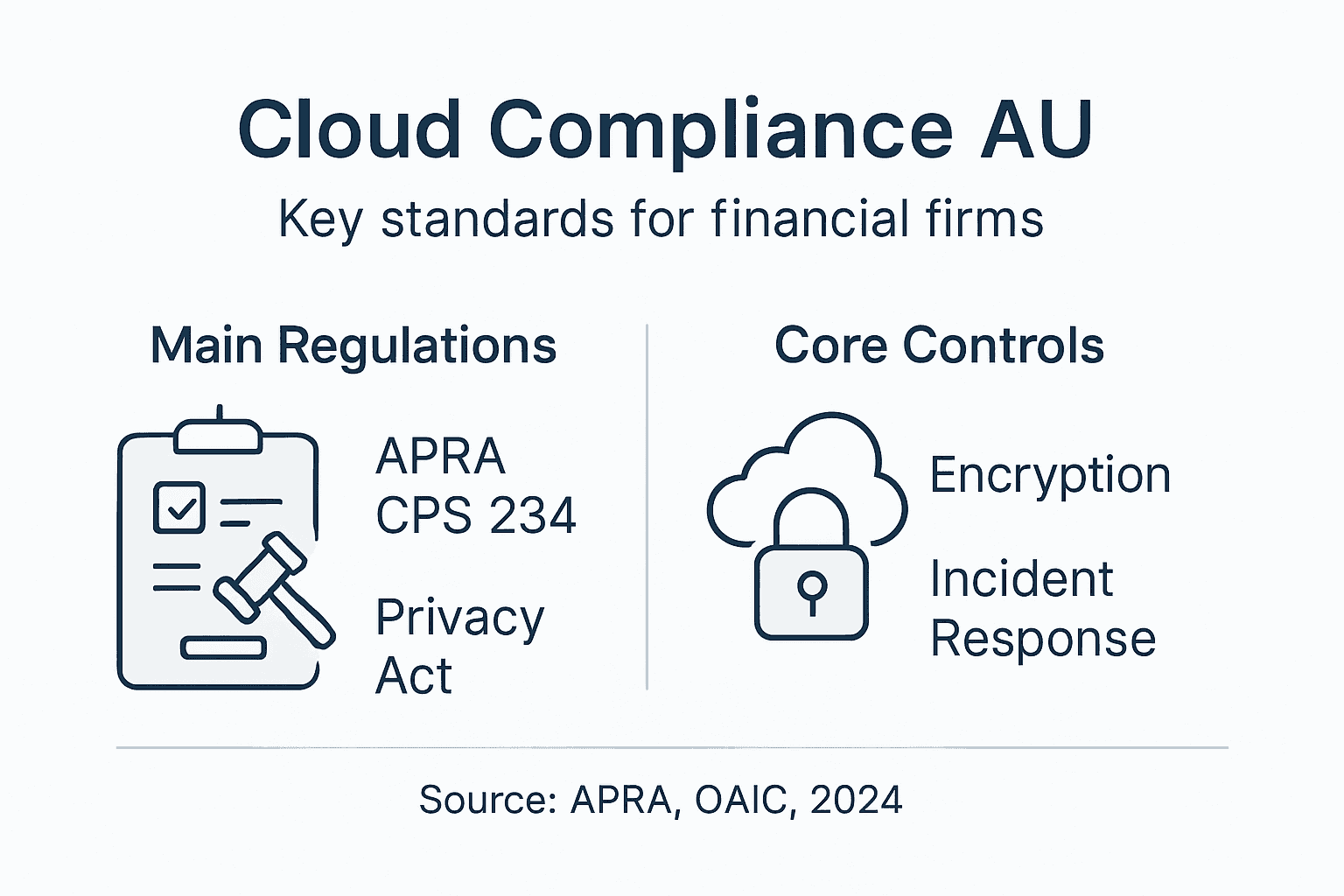
Beyond general data protection laws, Australian digital financial services regulations emphasise safe and trustworthy financial systems through operational resilience measures and consumer protection standards. This means your cloud infrastructure must remain available and functional during attacks, your backup systems must work as advertised, and your staff must understand their roles in maintaining security. You cannot simply rely on your cloud provider’s security without verifying that it meets Australian standards. Your firm bears responsibility for ensuring compliance even when using third-party services. Many Brisbane financial firms struggle here because they outsource security to their cloud provider, then assume they’re compliant. Regulators don’t see it that way. You remain accountable for data protection regardless of which vendor stores your information. This accountability extends to your supply chain. If your payment processor, backup provider, or email service provider experiences a breach, regulators will ask why your firm didn’t verify their security practices beforehand.
Compare key Australian cloud compliance frameworks relevant to financial firms:
| Regulation/Standard | Focus Area | Applicability | Key Requirement |
|---|---|---|---|
| Australian Privacy Act | Data protection and privacy | All financial firms | Safeguard personal information |
| APRA CPS 234 | Information security | Regulated institutions | Demonstrate robust cyber resilience |
| ASIC Regulatory Guide 255 | Managed IT and cloud services | Licensed firms | Ensure third-party data security |
| Australian Consumer Law | Consumer protections | Any client data holders | Maintain transparency and data safety |
Pro tip: Schedule a compliance audit with your IT provider specifically focused on cloud services to document which regulations apply to your firm, verify that your current controls meet those requirements, and identify any gaps before a regulator asks about them.
Risks, costs, and common cloud pitfalls
Moving financial data to the cloud introduces real risks that don’t exist in traditional on-premises systems. Your firm is trading one set of security challenges for another. You lose direct physical control over servers and infrastructure, but you gain scalability and flexibility. That trade-off creates new vulnerabilities. The most dangerous pitfall is assuming that moving to the cloud automatically makes your security better. Cloud providers offer robust infrastructure, but they cannot protect you from your own mistakes. Misconfigured access controls, weak passwords, unpatched systems, and unmonitored data movement create openings that attackers exploit relentlessly. The financial costs of getting cloud security wrong are staggering. A single breach can cost your Brisbane firm hundreds of thousands of dollars in direct incident response, notification requirements, regulatory fines, and lost business when clients discover their data wasn’t protected properly.
The financial impact of cloud security failures extends beyond immediate breach costs. Data breaches, ransomware attacks, and supply chain vulnerabilities create cascading costs that compound over time. Direct losses include stolen funds or fraudulent transactions. Operational disruption means your firm cannot serve clients whilst responding to an incident. Reputational damage drives clients away long after you’ve fixed the technical problem. Regulatory penalties add financial weight on top of everything else. Australian regulators can fine financial firms significantly for security failures, especially if you failed to implement reasonable protections. The costs pile up so quickly that many small firms don’t survive a major breach. Firms that invested properly in cloud security beforehand recover faster and experience lower overall costs because their security controls limited the damage scope. Those that cut corners on security end up paying far more when something goes wrong.
Common pitfalls arise from misunderstanding how cloud security actually works. Misconfigurations, inadequate monitoring, and failure to understand shared responsibility create weaknesses that attackers exploit systematically. Many Brisbane financial firms configure their cloud storage with public access by accident, then wonder how client data leaked. Others implement encryption on databases but forget to encrypt backups, leaving sensitive information exposed in unexpected locations. Staff training failures represent another major pitfall. Employees who don’t understand cloud security basics make poor decisions about data handling, fall for phishing attempts targeting cloud credentials, and accidentally expose information through shared folders or misconfigured email rules. The firms that avoid these pitfalls invest in three areas simultaneously: proper technical configuration verified by external audits, continuous monitoring that catches suspicious activity quickly, and staff training that makes security part of your firm’s culture rather than an IT department burden.
Pro tip: Request a cloud security assessment from your IT provider that specifically tests your current configurations for common pitfalls like public access settings, unencrypted backups, and weak access controls, then prioritise fixing the highest-risk findings before expanding your cloud usage.
Strengthen Your Financial Firm’s Cloud Security with IT Start
Financial firms in Brisbane face unique challenges when safeguarding sensitive client data in the cloud. The risks of misconfigured access controls, unencrypted backups, and evolving cyber threats can jeopardise trust, regulatory compliance, and your firm’s stability. Understanding the shared responsibility model and implementing encryption, continuous monitoring, and data loss prevention are critical steps—but navigating these complexities alone can be overwhelming.
IT Start specialises in providing tailored managed IT support and comprehensive cybersecurity solutions designed specifically for small to medium-sized financial businesses in Queensland. Our local Brisbane expertise, proactive security assessments, and compliance-focused approach help you identify vulnerabilities early and build robust protections that meet Australian regulatory standards. Don’t wait for a breach to expose weaknesses—take control of your cloud security today.
Explore how we can help you enhance encryption, streamline access controls, and implement threat detection so your financial data stays safe and your firm remains compliant. Ready to safeguard your client information and grow with confidence? Contact IT Start now for a free security assessment and personalised consultation.
Frequently Asked Questions
What are the key security controls for cloud data protection in financial services?
Essential cloud security controls include encryption, access control, data loss prevention, continuous monitoring, and security audits. These controls work together to protect sensitive financial data and maintain regulatory compliance.
How does shared responsibility work in cloud security for financial firms?
In a shared responsibility model, the cloud provider secures the underlying infrastructure, while the financial firm is responsible for securing its data, managing user access, and continually monitoring security practices.
What are the main risks of moving financial data to the cloud?
The primary risks include loss of direct physical control over data, potential misconfigurations, vulnerabilities in third-party services, and the possibility of breaches due to inadequate monitoring or employee errors.
How can financial firms in Brisbane ensure compliance with Australian regulations regarding cloud security?
Firms should conduct compliance audits, implement necessary security controls, maintain documented processes, and regularly review their adherence to regulations like the Australian Privacy Act and APRA CPS 234.