

TL;DR:
- Managed services pricing in Australia for SMEs typically ranges from AU$100 to AU$250 per user monthly, depending on scope and security. Providers use various models, with per-user being most common, but total costs include support, licensing, and security tools. Businesses should compare detailed quotes based on scope, exclusions, and provider maturity to budget accurately and manage costs effectively.
Managed services pricing for Australian SMEs is defined as a recurring monthly fee, most commonly charged per user, that covers IT support, monitoring, and security to a defined scope. Per-user fees typically range from AU$100 to AU$250 per user per month, excluding GST, software licences, and hardware. That range is wide because the scope of what is included varies enormously between providers. A business owner comparing two quotes at AU$130 and AU$200 per user may be looking at completely different services. Understanding what drives managed services pricing is the only way to compare quotes fairly and budget with any confidence.
What are the common managed services pricing models?
The pricing model your provider uses determines how predictable your IT costs will be each month. Per-user pricing is the dominant model for Australian SMEs because it covers all devices a single employee uses under one flat fee. It scales cleanly as your headcount grows or shrinks, which suits most businesses with 10 to 50 staff.
Per-device pricing charges a flat fee for each piece of equipment, such as desktops, laptops, and servers, regardless of who uses them. This model suits environments with shared workstations, manufacturing floors, or a high ratio of devices to users. The downside is that costs can spike quickly when you add equipment without adding staff.
Hybrid models combine a per-user base fee with per-device charges for servers or specialised hardware. These are common in businesses with on-premises infrastructure alongside cloud services. They offer flexibility but require careful review of the contract to avoid bill shock.
All-inclusive flat-rate pricing sets a fixed monthly fee for the entire business. This works well for very stable environments but can become expensive if your provider builds in a large buffer for unpredictable support demand. Break-fix hourly billing, where you pay only when something goes wrong, is the opposite extreme. It feels cheap until a major incident arrives.
| Model | Best for | Advantage | Disadvantage |
|---|---|---|---|
| Per-user | SMEs with standard office setups | Predictable, scales with headcount | Can be costly if users have few devices |
| Per-device | Device-heavy or shared environments | Accurate for hardware-intensive sites | Costs rise fast with equipment growth |
| Hybrid | Businesses with servers and cloud mix | Flexible and detailed | Contract complexity requires careful review |
| All-inclusive flat rate | Stable, low-change environments | Maximum budget certainty | Provider may over-price to cover risk |
| Break-fix hourly | Very small or low-risk setups | Low base cost | Unpredictable, reactive, and expensive at scale |
What factors influence managed IT pricing?
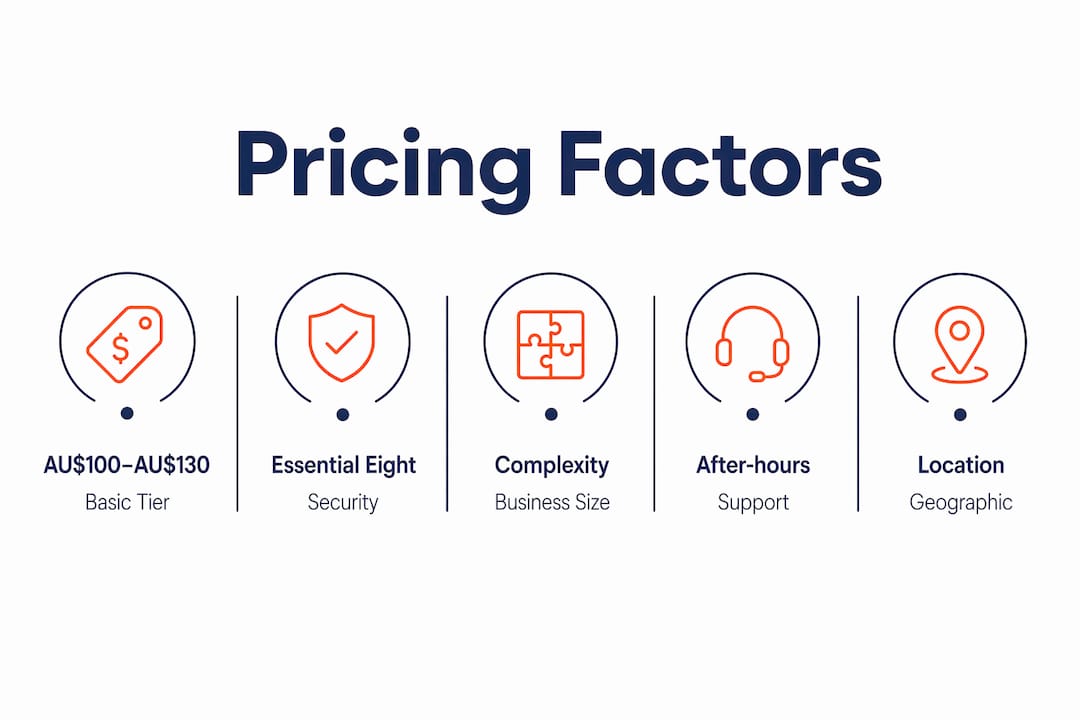
Service tier is the single biggest driver of cost variation. Tier 1 basic support runs AU$100–$130 per user per month, covering business-hours helpdesk and standard monitoring. Tier 2 extends to longer hours and adds security tools like endpoint detection and response (EDR), landing at AU$150–$180. Premium tiers with managed detection and response (MDR), Essential Eight baseline controls, and 24/7 live support can push past AU$250 per user.

Security requirements have become a major cost driver in 2026. The Australian Cyber Security Centre’s Essential Eight framework sets a baseline that many professional services firms now need to meet for insurance or client contracts. Adding managed network security tools, EDR, and security awareness training adds real cost. Businesses that skip these controls often pay more later through incident response fees or insurance claims.
Business size and infrastructure complexity also shift the price. A 15-user firm running everything in Microsoft 365 with no on-premises servers is straightforward to manage. A 40-user firm with an on-premises file server, a legacy accounting application, and three physical locations is not. Complexity means more engineer time, more monitoring points, and higher risk for the provider.
Support scope is where many contracts get murky. After-hours support is often billed separately at 1.5x to 2x standard hourly rates. “24/7 monitoring” does not always mean a human responds at 2AM. Clarifying exactly what happens outside business hours before you sign is not optional.
Geographic location adds cost too. Onsite visits in regional Queensland cost more than a quick drive across Brisbane. If your business needs regular onsite presence, factor travel time and fees into your monthly estimate.
Pro Tip: Ask every provider to give you a written scope of work (SOW) before comparing prices. Without a matching SOW, you are comparing apples with oranges.
How to evaluate and compare managed services quotes
Getting three quotes is a good start. Reading them properly is the harder part. Most business owners focus on the headline per-user fee and miss the detail that determines real cost.
-
Request a full inclusions and exclusions list. Ask what is explicitly not covered. Common exclusions include project work, new device setup, after-hours calls, and vendor liaison for third-party software.
-
Identify all pass-through costs. Microsoft 365 Business Premium costs around AU$32.20 per user per month and is typically billed separately, not bundled. Backup software, cybersecurity tools, and DNS filtering are often the same.
-
Check SLA terms carefully. Response time guarantees mean nothing without a clear definition of what constitutes a “critical” issue versus a “standard” one. Vague SLA language protects the provider, not you.
-
Ask about onboarding fees. Onboarding fees range from zero to several thousand dollars depending on the provider and contract structure. A low monthly fee with a large onboarding charge can cost more in year one than a higher monthly rate with no setup fee.
-
Look for auto-renewal and price escalation clauses. Some contracts include annual CPI increases or automatic rollover into new terms. Know what you are agreeing to before you sign.
-
Assess provider maturity. Process maturity in MSPs correlates with lower total cost of ownership because automated monitoring and standardised delivery reduce outages and reactive support calls. A provider charging AU$180 per user with mature processes often costs less over three years than one charging AU$130 with ad-hoc delivery.
Pro Tip: Ask the provider how they handle a situation where a critical system goes down at 7PM on a Friday. The answer tells you more about their actual support model than any SLA document.
What should SMBs budget for managed IT services?
Realistic budgeting requires looking beyond the per-user fee. A 25-user business with full security and backup coverage typically spends AU$3,500 to AU$6,000 per month on managed IT services. That range reflects the difference between a basic support tier and a security-first model with EDR, backups, and compliance controls.
Software licences sit on top of that. Microsoft 365 Business Premium at AU$32.20 per user adds AU$805 per month for a 25-user business before a single support ticket is raised. Backup software, password management tools, and security awareness training platforms each add further monthly costs.
| Cost component | 25-user estimate (monthly) |
|---|---|
| Managed IT support (mid-tier) | AU$3,500–$4,500 |
| Microsoft 365 Business Premium | AU$805 |
| Backup and disaster recovery | AU$200–$500 |
| Security tools (EDR, DNS filtering) | AU$300–$600 |
| After-hours and project buffer | AU$200–$400 |
| Total estimated range | AU$5,005–$6,805 |
The trade-off between a lower headline fee and total cost of ownership is real. Providers with lower fees often rely on reactive support, which means you pay extra every time something breaks. Providers with higher process maturity fix problems before they become incidents, which reduces unplanned costs over time.
The benefits of managed services go beyond cost control. Predictable monthly fees make budgeting straightforward, and a good provider reduces the risk of a costly security incident. For most SMBs, the right question is not “how do I pay less?” but “what level of risk am I comfortable carrying?”
Key takeaways
Managed IT services pricing in Australia is best understood as a total monthly spend across support fees, software licences, and security tools, not just the per-user headline rate.
| Point | Details |
|---|---|
| Per-user fees vary by tier | Basic support starts at AU$100–$130; security-first tiers reach AU$250+ per user per month. |
| Licences are billed separately | Microsoft 365 Business Premium adds AU$32.20 per user on top of managed support fees. |
| Total monthly spend is higher | A 25-user business with full coverage typically spends AU$5,000–$6,800 per month all-in. |
| SOW comparison is non-negotiable | Always compare quotes against a matching scope of work, not just the headline price. |
| Provider maturity reduces total cost | Automated, process-driven MSPs cost more monthly but generate fewer expensive incidents. |
What I have learned about managed services pricing after years in the field
Honestly, the biggest mistake I see SMBs make is treating managed IT pricing like a commodity purchase. They get three quotes, pick the cheapest one, and then spend the next 12 months paying for reactive support that was never included in the base fee.
We see this constantly. A business signs at AU$110 per user because it looks affordable. Six months later they are getting invoiced for after-hours calls, a server migration that was “out of scope,” and a security incident response that cost more than a year of premium-tier support would have. The cheap quote was never cheap. It was just incomplete.
The other thing that frustrates me is how vague the word “support” is in most contracts. I have read agreements that promise “24/7 monitoring” where the fine print means an automated alert fires but no human responds until 9AM Monday. That is not support. That is a false sense of security, and for a business in financial services or healthcare, it is a genuine compliance risk.
My honest advice: prioritise provider process maturity over sticker price. Ask how they handle incidents, what their escalation path looks like, and whether they have documented runbooks. A provider who can answer those questions clearly is worth paying more for. A provider who gets vague is telling you something important.
Align your IT budget to your actual risk profile. A 20-user legal firm handling client data needs a security-first approach. A 10-user retail business with no sensitive data can probably get away with a mid-tier model. The right spend is the one that matches your exposure, not the one that looks good on a spreadsheet.
— Matt
IT Start’s approach to transparent managed IT pricing
IT Start works with Brisbane-based SMBs across professional services, healthcare, and financial services, providing managed IT support with clear monthly fees and no hidden extras. Every engagement starts with a detailed scope of work so you know exactly what is covered before you commit. IT Start’s service tiers include Microsoft 365 management, endpoint security, and backup as standard, with cloud services and cyber security available as part of a security-first package. If you want a realistic cost estimate for your business size and setup, contact IT Start for a free assessment with no obligation.
FAQ
What is the average managed IT services cost per user in Australia?
Australian SMEs typically pay AU$100 to AU$250 per user per month for managed IT services, excluding GST, software licences, and hardware. The exact figure depends on service tier, security scope, and support hours included.
Are software licences included in managed services pricing?
Software licences like Microsoft 365 are almost always billed separately and not bundled into the per-user managed services fee. Microsoft 365 Business Premium costs around AU$32.20 per user per month and is passed through as an additional line item.
What does a 25-user business typically spend on managed IT per month?
A 25-user business with full security and backup coverage typically budgets AU$3,500 to AU$6,000 per month for managed IT support alone, with total all-in costs including licences and security tools often reaching AU$5,000 to AU$6,800.
Does 24/7 monitoring mean someone responds at any hour?
Not always. After-hours support is frequently billed separately at 1.5x to 2x standard rates, and 24/7 monitoring often means automated alerts rather than live human response. Always confirm the actual after-hours escalation process before signing.
How do I compare managed services quotes fairly?
Request a detailed scope of work from every provider and compare inclusions, exclusions, SLA terms, and pass-through costs side by side. A lower per-user fee with a narrow scope often costs more in total than a higher fee with full coverage.