

Cyber security training is the fastest, cheapest way to cut the odds that one staff mistake turns into a full breach. It works because most incidents start with a person, not a firewall gap. Done properly, training also gets you closer to meeting Australian obligations under the ISM and the Privacy Act, and it shortens the time between “something’s wrong” and “we’ve reported it.” The catch is it has to be regular and matched to the person’s role, not a once-a-year click-through everyone forgets by lunchtime.
TL;DR:
- Regular, role-specific cybersecurity training reduces phishing success rates and shortens incident detection and reporting times.
- Training must be continuous and tailored, with at least annual refreshers and simulations, to be effective and meet Australian ISM requirements.
- Tracking training completion and measuring click rates, response times, and incident reports demonstrate compliance and improve overall security posture.
- Focusing solely on technical controls like firewalls neglects human error, which remains the leading cause of breaches.
- Basic quick wins include implementing MFA, testing backups, and providing targeted training for privileged users to prevent most common attack paths.
Table of Contents
- Why is cyber security training important for your bottom line?
- What effective cyber security training should include
- Evidence and statistics: how training reduces risk
- What most businesses get wrong about training
- How to build an effective cyber security training programme
- Measuring impact, ROI and meeting compliance
- MSP perspective: what we actually fix and quick wins
- How IT Start can help with training and managed security
- Sources
- FAQ
Why is cyber security training important for your bottom line?
Honestly, most of the breaches we get called into start the same way. Someone clicks a link, someone reuses a password, someone approves an invoice that looks slightly off. None of that is a technology failure. It’s a training gap, and training gaps are one of the cheaper problems to fix compared to rebuilding a network after ransomware.
The Australian Signals Directorate’s ISM guidance treats awareness training as a baseline control, not an extra. That’s the standard most Queensland businesses get measured against when a client, insurer or auditor asks how you manage risk.
Here’s what decent training actually changes for a business:
- Fewer successful phishing attempts. Staff who’ve seen a realistic simulation stop clicking on the real thing at a much higher rate.
- Faster detection and reporting. A team that knows what to look for reports incidents in hours, not weeks, which limits how far an attacker gets.
- Better client and partner trust. Compliance-heavy clients (legal, healthcare, finance) increasingly ask about your security posture before signing a contract.
- Lower incident costs. Catching a compromised account on day one costs a lot less than remediating a domain-wide breach three weeks in.
- Stronger audit position. Training records support your case against ISM, ISO 27001 and Notifiable Data Breaches (NDB) requirements.
Statistic callout: The OAIC is explicit that human error, things like sending data to the wrong person or skipping identity checks before disclosure, is a major driver of the breaches it deals with under the NDB scheme, and it expects businesses to have taken reasonable steps such as staff training to prevent that.
We see this a lot with businesses that think a firewall and antivirus are “the security budget sorted.” They’re not wrong to have those, but they’re solving a different problem. The person clicking the phishing email doesn’t care how good your firewall is.
What effective cyber security training should include
A lot of training programmes fail because they’re generic. One module, everyone watches it, done. That’s not how attackers work, and it’s not how good training works either.
A properly built programme covers:
- Phishing and social engineering — how to spot fake invoices, urgent “CEO” requests, and dodgy links, with real examples pulled from actual attempts your business has seen.
- Passwords and multi-factor authentication (MFA) — why reused passwords are a liability and how MFA stops most account takeovers cold.
- Secure data handling — what can go in email, what needs encryption, and how to check before sending sensitive files.
- Remote and hybrid work safety — home Wi Fi risks, personal device use, and public network hygiene.
- Incident reporting — what to do the moment something looks wrong, and who to tell first.
On top of that baseline, privileged users (your IT admins, finance approvers, anyone with elevated access) need separate, tailored modules. Their access is the front line if an attacker gets in, so generic training isn’t enough for them.
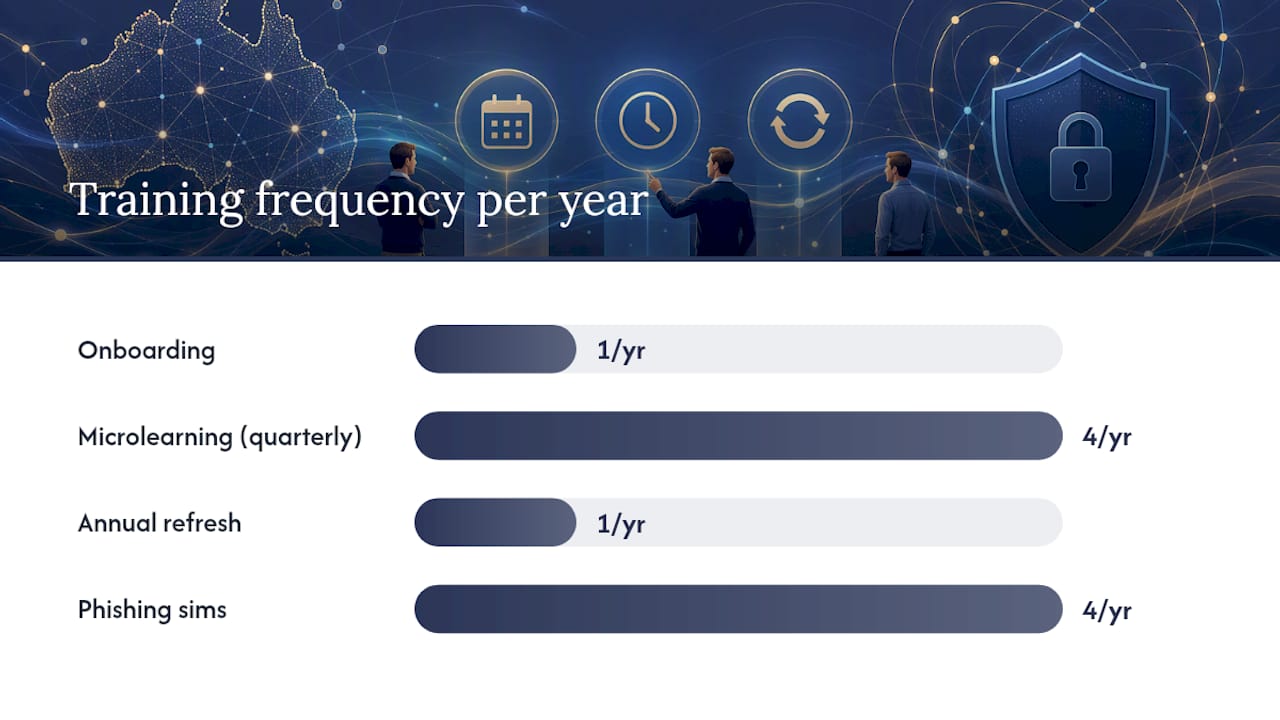
Delivery matters too. Microlearning (five minute modules, not hour long lectures), regular phishing simulations, and short workshops tend to stick better than a single annual seminar. The ISM’s own guidance recommends annual refreshers for general staff and additional annual training for privileged users, plus training triggered by specific events like a new system rollout or a recent incident.
Pro Tip: Run your first phishing simulation before you announce the training programme. The baseline click rate you get is the most honest number you’ll have all year, and it’s the one that gets budget approved.
Evidence and statistics: how training reduces risk
The regulatory backing for training isn’t vague guidance, it’s specific. Two controls in the ISM, ISM-0252 and ISM-1565, require annual awareness training for all personnel and additional tailored training for privileged users respectively. That’s a checkable, auditable obligation, not a suggestion.
The ACSC’s guidance on business email compromise is blunt about it too: regular, updated training on suspicious email indicators is a core defence, alongside technical filters.
Real incidents back this up. In one OAIC investigation into a data breach, the lack of role specific and repeated training was flagged as a contributing factor, and regular targeted training was part of the fix recommended afterwards.
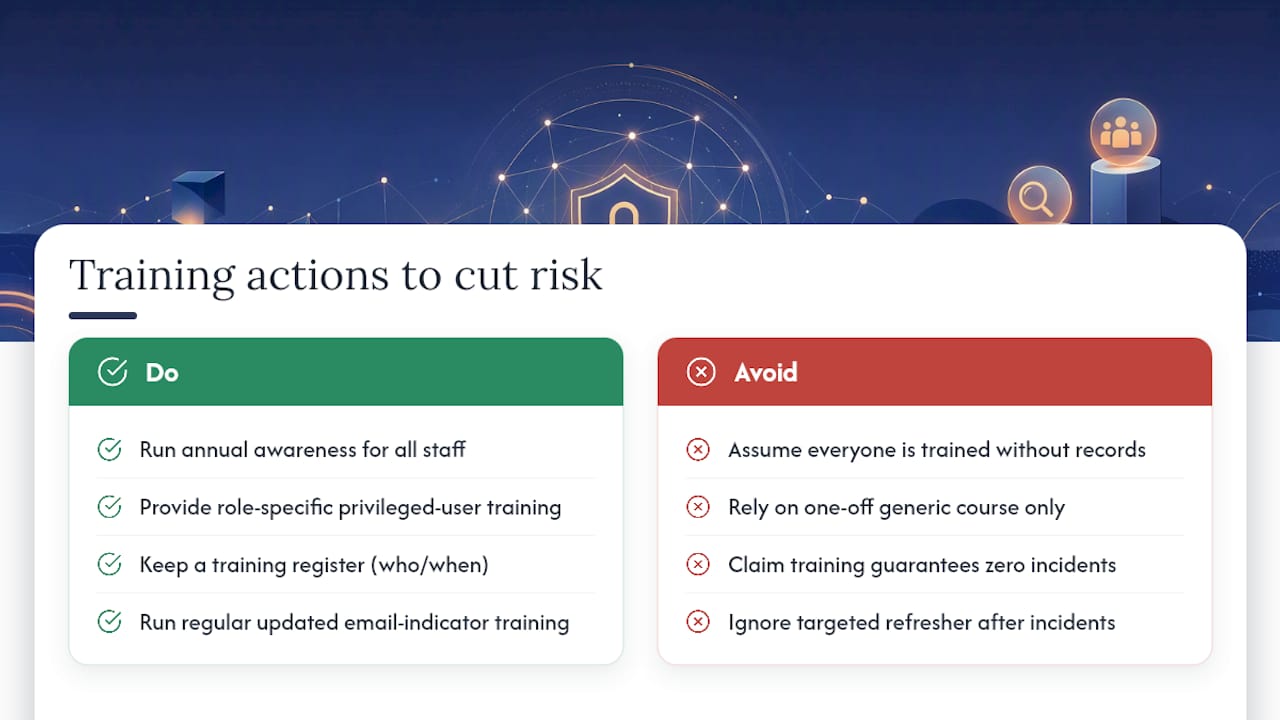
Statistic callout: ISM-2022 recommends businesses keep a training register, a simple record of who’s done what training and when. It sounds bureaucratic, but it’s the difference between “we think everyone’s trained” and being able to prove it to an auditor or insurer.
One honest caveat: these sources tell you training reduces risk and is expected practice, not that any single course guarantees zero incidents. Training lowers the odds and shortens response time. It doesn’t make you immune, and nobody selling you a training platform should be claiming otherwise.
What most businesses get wrong about training
We see the same handful of mistakes on repeat, across almost every SMB we onboard.
- Treating it as a checkbox. One session at onboarding, then nothing for two years. Behaviour change needs repetition, not a single event.
- No role tailoring. The finance team approving invoices needs different training to the receptionist, and privileged IT users need different training again. One size fits nobody well.
- No measurement. Businesses run training then never check if click rates on simulated phishing actually dropped, or chase up staff who never completed it.
- Assuming tech alone covers it. Spam filters and endpoint protection are necessary, but they don’t stop someone approving a fake invoice over the phone. You still need staff trained to verify unusual requests through a separate channel.
Honestly, the biggest gap we find on client audits isn’t the training content, it’s that nobody’s tracking who’s actually done it.
How to build an effective cyber security training programme
If you’re starting from scratch, or fixing a programme that’s gone stale, here’s the practical order to do it in.
- Define your outcomes first. Decide what “working” looks like: lower phishing click rates, faster incident reporting times, or a specific completion percentage. Without a target, you can’t tell if the programme is doing anything.
- Map staff to role risk tiers. Split people into general staff, finance and data handling roles, and privileged users. Each tier gets different content and cadence.
- Pick a delivery mix and set the calendar. Onboarding training in week one, quarterly microlearning bursts, and a full annual refresh. Add a phishing simulation every quarter, not once a year.
- Pair training with the technical controls it depends on. Training someone to recognise a suspicious login attempt means nothing if MFA isn’t switched on. We still walk into businesses with 30 to 40 staff running zero MFA on their Microsoft 365 accounts. Training without that control fixed first is basically wasted effort.
- Keep a training register. Record who did what and when, per the ISM’s own recommendation. Review it every time there’s an incident, near miss or new system rollout, and update the content if the same mistake shows up twice.
Pro Tip: Don’t run your annual refresh in December. Attention is shot, everyone’s checked out for the break, and completion rates tank. January or February gets you far better engagement.
Executive buy-in matters here too. The ACSC’s guidance on cyber security roles flags board level cyber literacy and oversight as part of a properly governed programme. If leadership skips the training, staff notice, and completion rates drop across the board.
Measuring impact, ROI and meeting compliance
The metrics that actually mean something are simple: phishing click rate trend over time, time to report a suspected incident, and completion rate including remedial follow up for people who failed a simulation or missed a module.
- Phishing click rate falling quarter on quarter shows the training is landing.
- Reporting time shrinking from days to hours shows staff know what to do when something looks wrong.
- Completion rate, tracked in a training register per ISM-2022, is what you show an auditor, insurer or client who asks for evidence.
Statistic callout: Under the NDB scheme, the OAIC expects organisations to show reasonable steps were taken to prevent a breach, and a documented training programme is one of the clearest ways to demonstrate that if you ever need to.
Building the business case for leadership isn’t complicated. Compare the cost of quarterly training and simulations against the cost of even one serious incident, remediation, downtime, possible regulatory reporting, reputational fallout with clients and partners. It’s rarely a close call.
MSP perspective: what we actually fix and quick wins
Most of our first visits with a new client turn up the same three gaps: no MFA, backups that haven’t actually been tested, and no privileged-user policy separating admin accounts from daily-use ones. Fix those three plus run one phishing simulation, and you’ve closed off the paths that cause most of the incidents we get called about.
We’ve had clients where a fake invoice email nearly went through, and the only thing that stopped it was a staff member who’d been trained to call the supplier directly rather than reply to the email. That’s the whole point of training. It’s not glamorous, but it works.
— Matt
How IT Start can help with training and managed security
IT Start builds training around what your business actually looks like, not a generic module library. As a Brisbane based managed IT provider, we combine tailored cyber security services, including risk assessment, endpoint protection and privileged-user support, with the practical side most SMBs miss: verifying MFA is actually switched on, checking your backups genuinely restore, and running phishing simulations that reflect the emails your industry actually receives.
Being local matters when an incident happens and you need someone on the phone who understands Queensland compliance expectations and can walk into your office if needed. We also handle the broader IT support that training depends on, patching, network management and help desk, so training isn’t operating in isolation from the rest of your security posture.
If you’re not sure where your training programme stands, or whether one exists at all, book a free assessment with IT Start and we’ll tell you honestly what’s missing.
Sources
For businesses concerned about reputational fallout after an incident, this guide to managing online reputation covers practical steps worth reading alongside your security planning.
FAQ
Why is it important to learn about cyber security at work?
Because most breaches start with a person, not a piece of software. Staff who understand phishing, password hygiene and how to report something suspicious stop far more incidents before they escalate than any single technical tool does.
What is the purpose of cybersecurity training?
The purpose is to reduce human error as an attack vector and speed up detection when something does go wrong. It also supports compliance obligations under frameworks like the ISM and the Privacy Act’s NDB scheme.
What are the main reasons cyber security training matters for a business?
The core reasons are fewer successful phishing attempts, faster incident reporting, stronger client trust, lower incident costs, and better audit readiness against ISM and ISO 27001 expectations. It also helps meet the annual training obligations Australian guidance sets out for general staff and privileged users.
What are the benefits of taking a cybersecurity course?
Staff who complete role relevant training recognise scams faster and know exactly who to notify when something looks wrong, which shortens response time significantly. For businesses, that translates to lower breach costs and a documented training register to show auditors, insurers or clients.
How often should cyber security training happen?
Australian government guidance recommends annual training for general staff, with additional tailored annual training for privileged users under ISM controls ISM-0252 and ISM-1565. Event driven refreshers, after an incident or new system rollout, should sit on top of that baseline.