

TL;DR:
- IT certifications are now valued for proving practical, hands-on skills rather than mere memorization. Employers increasingly reward certified staff with higher pay, positive ROI, and better security and AI expertise, making certifications strategic workforce assets. Maintaining up-to-date credentials and integrating practical testing into hiring and development processes is essential for competitive advantage in 2025.
Most IT professionals think certifications are just about memorising answers and passing a multiple-choice exam. That view is increasingly out of date. The role of IT certifications 2025 has shifted toward proving you can actually do the work, not just recall facts under pressure. Employers are paying more for certified staff, skills gaps in AI and cybersecurity are making credentials more critical, and the way certifications are tested has changed significantly. Whether you’re an IT professional planning your next move or a business leader trying to build a capable team, this article gives you the real picture.
Table of Contents
- Key takeaways
- How IT certifications are being tested in 2025
- The business case for certified staff
- IT certification trends shaping 2025
- What most businesses get wrong
- Applying certifications to career and talent strategy
- My take on certifications in practice
- How IT Start supports certified IT teams in Brisbane
- FAQ
Key takeaways
| Point | Details |
|---|---|
| Practical testing is now standard | Certifications increasingly use scenario-based and performance assessments, not just multiple choice. |
| Certified staff deliver measurable ROI | Employers report certified employees add an average of USD 17,646 in additional value annually. |
| AI and security creds pay more | Pay premiums for certified IT skills rose in 2026 while noncertified skill pay dropped. |
| Maintenance is non-negotiable | Letting certifications lapse can block promotions, access, and compliance standing. |
| Certifications need strategy | Treat certification programmes as workforce investment, not résumé decoration. |
How IT certifications are being tested in 2025
For years, the knock on IT certifications was fair. Plenty of people could memorise a study guide, sit a multiple-choice exam, and walk away with a cert that told employers almost nothing about their real ability. That era is ending.
Certification testing now shifts toward hands-on, scenario-based, and system-based assessments that require candidates to actually solve problems, configure systems, and demonstrate judgement. Vendors like CompTIA and SAP now include performance-based questions (PBQs) and open-book problem solving that mirror real job tasks. You don’t just answer “what would you do?” You show that you can do it.
This matters for employers more than anything else. Practical testing confirms skills in a way that memorisation never could, and it increases confidence when hiring or assigning responsibility. If someone holds a current security cert earned through scenario testing, you have a far better signal about their actual capability than you would from a badge earned through a 90-question multiple-choice paper in 2018.
There’s another angle that often gets overlooked. Hands-on assessments also validate soft skills like critical thinking, adaptability, and communication, qualities that matter in AI-augmented work environments where the ability to reason through unfamiliar situations is as valuable as knowing a specific command syntax.
Pro Tip: When preparing for a certification in 2025, prioritise labs and practice environments over flashcard drilling. Most vendors now weight practical components heavily, and candidates who only study theory tend to struggle with scenario-based questions under time pressure.
Nearly half of IT professionals planned to pursue certifications specifically to demonstrate particular skillsets in 2025. That number reflects a shift in attitude. Certifications are no longer seen purely as career entry tickets. They’re becoming signals of genuine, current capability.
The business case for certified staff
Let’s talk numbers, because this is where the role of certifications in IT becomes very hard to argue against.
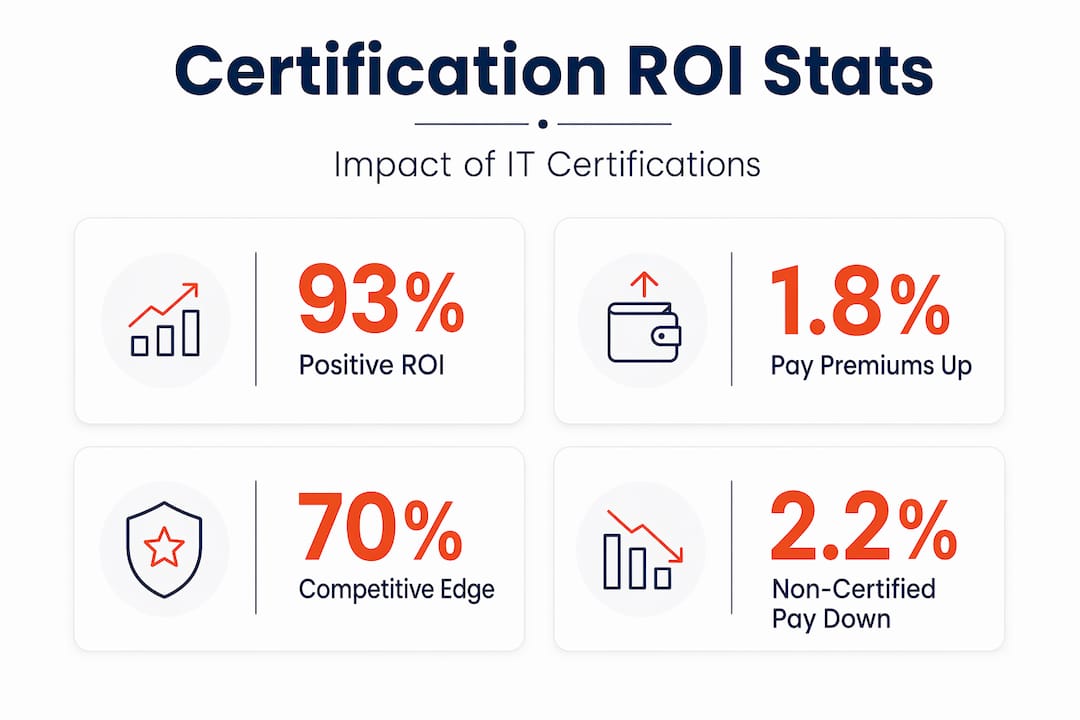
A Pearson study found that 93% of employers report positive ROI from certified IT employees, with an average additional annual value of approximately USD 17,646 per certified staff member. That’s not a marginal benefit. For a team of five certified professionals, you’re looking at well over USD 88,000 in attributed value above and beyond their noncertified equivalents.

The same research shows organisations that require certification have greater competitive advantage, with 70% reporting gains compared to 57% in organisations that don’t. The gap is meaningful.
| Metric | Organisations requiring certification | Organisations not requiring certification |
|---|---|---|
| Competitive advantage reported | 70% | 57% |
| Average added value per certified employee | USD 17,646/year | Not measured |
| Employer-reported positive ROI | 93% | Not comparable |
The pay data reinforces this. Recent figures show that pay premiums for 663 IT certifications rose 1.8% while pay for 746 noncertified IT skills dropped 2.2%. That’s not a coincidence. Employers are repricing talent based on verifiable skills, particularly in infrastructure, security, and AI-related roles.
Honestly, what this tells you is that the market is separating certified and noncertified IT professionals in a very direct way. Business leaders who treat certifications as optional extras are paying opportunity costs in team capability and competitive positioning, even if they can’t see the number on a spreadsheet.
The IT certifications impact on career is equally clear for individual professionals. In a tightening job market, the question isn’t whether to get certified. It’s which certifications carry the most weight for your specific domain right now.
IT certification trends shaping 2025
The future of IT certifications is being shaped by three things: the explosion of AI-related demand, stricter maintenance requirements, and the integration of certifications into formal workforce planning.
On the AI side, the numbers are striking. Over 275,000 U.S. job postings referenced AI skills in early 2026. AI certifications relevant to prompt engineering, machine learning operations, and AI governance are among the fastest-growing categories. For IT professionals, ignoring AI credentials is increasingly a career risk, not just a missed opportunity.
Maintenance requirements are getting more serious too. The CISSP, one of the most respected security credentials, requires 120 CPE credits over a three-year cycle plus an annual fee of USD 125. Fail to meet either requirement and the certification can be suspended. That’s a significant ongoing commitment, and many professionals don’t fully account for it when they decide to pursue the cert in the first place.
Here’s what that means for IT certifications trends in 2025:
- AI and cloud skills are the highest-demand certification domains, particularly roles involving security architecture and AI-assisted operations.
- Renewal tracking is now a professional discipline in itself. Letting a credential lapse mid-cycle can affect your access to sensitive systems and your eligibility for certain roles.
- Employers are treating certifications as auditable qualifications that influence promotions and access permissions, not just interview talking points.
- Soft skills validation through practical certification testing is increasingly relevant as organisations use AI tools to handle routine tasks and expect certified staff to manage exception handling and governance.
Pro Tip: Map your certification renewal dates to your performance review calendar. If your cert lapses before an annual review, you may miss a pay or promotion conversation where that credential was expected to be current.
What most businesses get wrong
We see this a lot with SMB clients. The gap between what organisations think certifications represent and how they should actually use them in practice is significant. Here are the most common mistakes:
-
Treating old certifications as still valid signals. A security certification from 2019 that hasn’t been renewed says very little about someone’s current capability. The threat landscape has shifted fundamentally since then. We’ve walked into client environments where the “qualified” person managing their network hadn’t maintained a single credential in four years.
-
Confusing a certification with a demonstrated skill. Certification and competence are related but not the same thing. Someone who passed an exam does not automatically configure your backup environment correctly. We’ve seen this play out more times than we’d like, where a certified staff member was assumed capable of managing a Microsoft 365 environment but had never actually done it in practice.
-
Ignoring hands-on validation during hiring. Most SMBs don’t have a technical assessment process for IT hires. They look at the cert, assume the skills are there, and find out months later that theory and practice are different things. With scenario-based certs now available, there’s no good excuse for not asking candidates to demonstrate something practical.
-
Not factoring in maintenance costs. Certification renewal is a real cost, in time, credits, and fees. Businesses that pay for initial certification but don’t budget for renewal end up with staff whose credentials lapse, which can have compliance and access implications depending on the role and the regulation.
Employers should view IT certifications as strategic workforce investments rather than individual résumé decorators. The distinction matters enormously when you’re trying to close a skills gap in cybersecurity or AI, not just fill a vacancy.
Applying certifications to career and talent strategy
For IT professionals and business leaders who want to get this right, the approach needs to be deliberate, not reactive. Here’s what actually works based on current trends and what we see in practice:
- Prioritise certifications with practical components. CompTIA Security+, AWS Certified Solutions Architect, and Microsoft Azure certifications all include scenario-based testing. Certifications that still rely on memorisation-heavy multiple-choice formats carry less weight with informed employers.
- Align certifications to your skills gap analysis. If you don’t know where your team’s weakest domains are, a certification strategy won’t fix them. Start with an honest assessment of where the risk sits, whether that’s cloud management, endpoint security, or AI governance, and match certifications to those gaps.
- Track renewals formally. Build a shared register for team certifications including expiry dates, CPE credit requirements, and renewal fees. Treat it like software licence management, which is to say, not something you leave to memory.
- Use certifications in performance frameworks. Tying certification attainment and maintenance to formal reviews and career pathways creates accountability and sustained motivation. It also gives managers an auditable record of who is qualified for what.
For more on how cybersecurity certifications apply to SMB contexts, the specifics matter more than the general list. Not every credential maps to the risks a Brisbane business actually faces.
Pro Tip: When evaluating top IT certifications for 2025, check whether the vendor publishes pass rate data and the percentage of performance-based questions. A cert with 30% or more PBQ weighting is a substantially better hiring signal than one without.
| Certification type | Practical weighting | Best suited for |
|---|---|---|
| CompTIA Security+ | High (PBQs included) | Security generalists, SMB IT teams |
| AWS Certified Solutions Architect | High (scenario-based) | Cloud infrastructure roles |
| CISSP | Moderate, scenario-based | Senior security professionals |
| Microsoft Azure Fundamentals | Moderate | Cloud entry points, business IT teams |
| CompTIA AI+ (emerging) | Scenario-based | AI integration roles |
My take on certifications in practice
I’ve been working with SMBs for long enough to have opinions on this that don’t always match the official narrative. Here’s what I’ve actually observed.
Most organisations that say they value certifications don’t really act like it. They’ll pay for one exam, celebrate when someone passes, and then do nothing to support renewal or continued learning. Three years later, the credential has lapsed and nobody noticed until it blocked a compliance audit.
I’ve also seen the opposite problem. Businesses that hire based on cert lists alone end up with people who passed the right exams but can’t troubleshoot a real incident under pressure. The shift toward practical testing is genuinely good news here. When a certification requires you to actually configure, diagnose, and defend a decision in a simulated environment, it tells you a lot more than “this person studied hard for six weeks.”
My honest take on the evolving role of IT certifications is this: they’re becoming more valuable, not less. But only if you treat them as living credentials, not static badges. The why get IT certified question has a clear answer in 2025. Certified pay is rising, noncertified pay is falling, and employers are scrutinising qualifications more formally than ever.
What I’ve found works is being deliberate. Know which certifications carry weight in your sector, understand the maintenance requirements before you start, and build renewal into your professional development budget from day one. What sounds good but falls short is picking a certification because it looks impressive, skipping the lab work, and assuming the badge does the rest.
— Matt
How IT Start supports certified IT teams in Brisbane
Holding the right certifications means little if the IT infrastructure underneath doesn’t match the standard those credentials represent. At IT Start, we work with Brisbane SMBs to make sure the practical side of IT, covering backups, cloud configuration, network security, and compliance, actually reflects what your certifications promise. If your team has cybersecurity credentials but your backup environment hasn’t been tested or your Microsoft 365 tenant has no MFA enabled, the certification is outpacing the reality.
We offer managed cloud services and business IT support that complement certified skills with real operational infrastructure. If you want a free assessment of where your current setup sits against best practice, get in touch with the team at IT Start.
FAQ
What is the role of IT certifications in 2025?
IT certifications in 2025 serve as verified signals of current, practical skills, not just educational credentials. Employers use them to close skills gaps, determine pay grades, and control access to sensitive systems.
Are IT certifications worth it for career growth?
Yes. Pay premiums for certified IT skills rose 1.8% while noncertified skill pay dropped 2.2%, making certification a direct factor in compensation and career advancement.
What are the top IT certifications for 2025?
CompTIA Security+, AWS Certified Solutions Architect, CISSP, and Microsoft Azure certifications rank among the most recognised, particularly those with scenario-based testing components and alignment to AI or security domains.
How do IT certification maintenance requirements work?
Most certifications require ongoing education credits and periodic fees. The CISSP, for example, requires 120 CPE credits over three years plus an annual maintenance fee of USD 125. Missing either requirement can result in suspension.
How should businesses use IT certifications in workforce planning?
Treat certifications as part of a formal skills gap analysis, map them to specific risk areas like cloud, security, or AI, and include renewal tracking in your team’s professional development budget.