

Choosing the right IT support model isn’t just a technical decision, it’s a strategic one that affects your bottom line, security posture, and ability to scale. Brisbane SMEs face mounting cyber threats, skill shortages, and compliance pressures that make this choice critical. Downtime costs thousands per hour, yet many businesses remain dissatisfied with their current IT arrangements. This guide walks you through the criteria, options, and decision framework you need to select IT support that truly fits your business.
Table of Contents
- How to choose your IT support: Key criteria for Brisbane businesses
- Managed IT support: Proactive partnership for growth
- Break/fix IT support: Fast fixes when you need them
- In-house IT: Direct control, but at a cost
- Hybrid and co-managed IT: Combining the best of both worlds
- Side-by-side: Which IT support type suits your business best?
- Making the right choice for your Brisbane SME
- Unlock tailored IT support for your Brisbane business
- Frequently asked questions
Key Takeaways
| Point | Details |
|---|---|
| Support type matters | The right IT support model can boost your business efficiency and reduce costly downtime. |
| Managed IT leads for most | Managed support fits Brisbane SMEs needing proactive solutions, compliance, and growth. |
| Hybrid is flexible | Hybrid or co-managed options suit businesses wanting both control and special expertise. |
| Decision is ongoing | Regular reviews ensure your IT services keep pace with your changing business goals. |
How to choose your IT support: Key criteria for Brisbane businesses
Before exploring support models, clarify what your business actually needs. Start by identifying current pain points: frequent downtime, slow response times, security gaps, or difficulty scaling infrastructure. SMEs cite skill gaps and risk management as their top IT challenges, making external expertise increasingly valuable.
Consider these evaluation criteria:
- Security and compliance requirements — Industries like healthcare, legal, and financial services face strict regulatory obligations that demand proactive monitoring and documentation
- Cost of downtime — Calculate what an hour of system failure costs your business in lost revenue, productivity, and customer trust
- Internal IT capability — Assess whether your team has the skills to handle cloud migrations, cybersecurity threats, and emerging technologies
- Growth trajectory — Rapid expansion requires scalable IT infrastructure that can adapt without constant reinvestment
Understanding IT support’s business impact helps frame this decision as an investment rather than an expense. The right support model prevents problems before they occur, rather than simply reacting to crises.
Pro Tip: Many top Brisbane providers offer free IT health checks or risk assessments. Use these to benchmark your current setup against industry standards before committing to a support model.
The benefits of IT support for Brisbane SMEs extend beyond troubleshooting. Strategic IT partnerships drive operational efficiency, competitive advantage, and long-term resilience.
Managed IT support: Proactive partnership for growth
Managed IT support represents the gold standard for Brisbane SMEs seeking reliability and strategic value. This ongoing service model typically operates on a monthly fee structure covering your entire technology stack, from endpoints to cloud infrastructure.
Key features include:
- Unlimited helpdesk support — Your team gets immediate assistance without worrying about per-incident charges
- Regular system maintenance — Proactive updates, patches, and optimisations prevent issues before they impact operations
- Cybersecurity monitoring — Continuous threat detection and response protect against evolving risks
- Quarterly business reviews — Strategic planning sessions ensure your IT aligns with business goals
The primary advantage? Managed IT dramatically reduces downtime and security incidents compared to reactive approaches. Skill gaps are best addressed through proactive managed services, especially as AI and machine learning become standard security tools.
Tiered helpdesk structures and quarterly reviews optimise outcomes by matching issue complexity to appropriate expertise levels. Simple password resets get handled immediately, while complex infrastructure challenges escalate to senior engineers.
“Managed IT transforms technology from a cost centre into a strategic asset. When systems run smoothly and securely, businesses focus on growth rather than firefighting.”
Compare managed IT vs in-house approaches to understand cost implications. While managed services require monthly investment, they eliminate recruitment costs, training expenses, and the risk of key person dependency.
Explore details on managed IT support to see how comprehensive service packages work in practice. Understanding types of managed services helps you select the right tier for your business size and complexity.
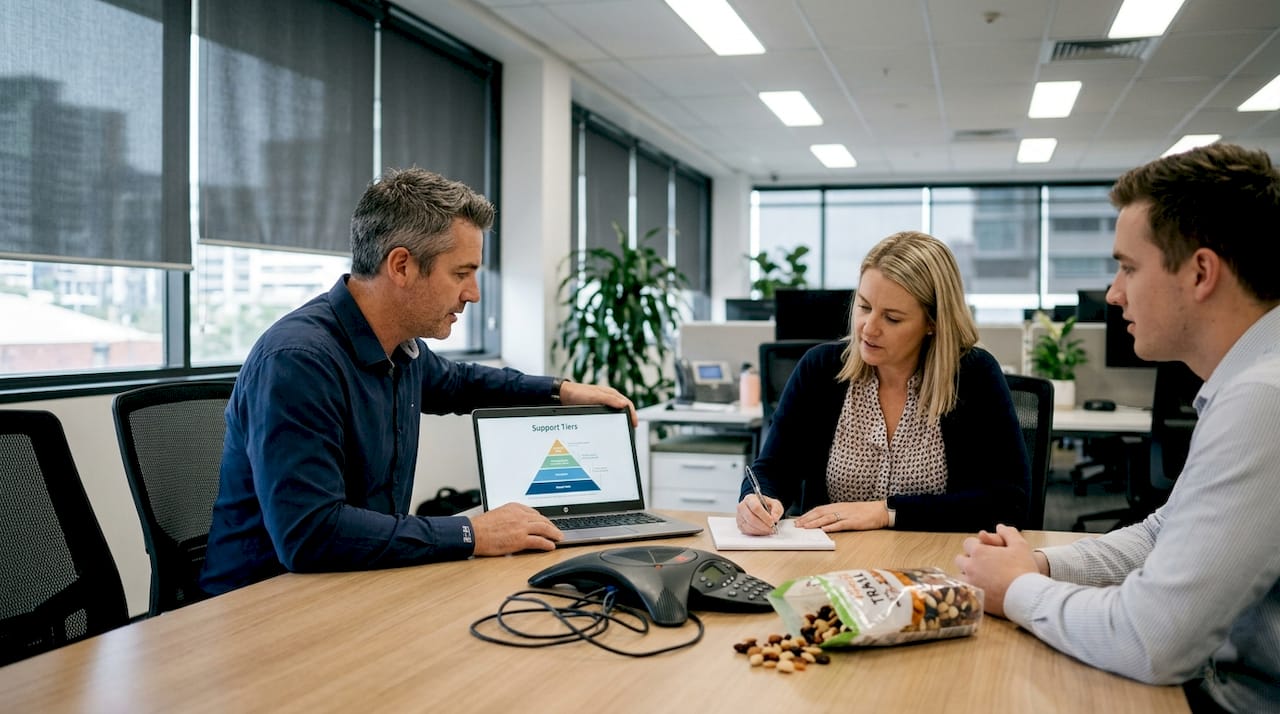
Pro Tip: Confirm your managed IT plan includes quarterly business reviews. These strategic sessions deliver maximum ROI by aligning technology investments with business objectives.
Break/fix IT support: Fast fixes when you need them
Break/fix support operates on a pay-per-incident basis. You call an IT provider only when something breaks, paying hourly rates or fixed callout fees. This model suits businesses with minimal technology dependence or very tight budgets.
When break/fix works:
- Small operations — Businesses with fewer than five employees and basic IT needs
- Low tech reliance — Companies where technology supports rather than drives operations
- Budget constraints — Startups or seasonal businesses needing flexibility
The risks are significant. SMEs with minimal digital reliance may opt for ad hoc models, but downtime costs remain high when issues occur. Unpredictable expenses spike during crises, response times lag without service level agreements, and no one monitors for emerging problems.
Break/fix isn’t recommended where compliance matters or advanced security is essential. Without ongoing monitoring, vulnerabilities accumulate until they’re exploited. Typical pricing ranges from $150 to $250 per hour, with callout minimums often applying.
For businesses outgrowing break/fix limitations, core IT management services offer structured alternatives that balance cost with reliability.
In-house IT: Direct control, but at a cost
Maintaining your own IT staff provides immediate, on-site support and complete control over processes and priorities. This model suits larger SMEs with complex infrastructure or strict regulatory requirements demanding dedicated resources.
Advantages include:
- Immediate availability — Your team is always present during business hours
- Deep business knowledge — Internal staff understand your specific workflows and culture
- Direct oversight — You control priorities, methodologies, and security protocols
The drawbacks are substantial. In-house teams face skill shortages and may lack access to advanced tools like AI-driven security platforms. Costs extend beyond salaries to include recruitment, training, benefits, and ongoing professional development.
Scaling presents challenges. Hiring additional staff for growth or specialised projects takes months, while redundancy becomes expensive during slower periods. Single-person IT departments create dangerous key person dependencies.
For businesses considering internal hires, hiring IT staff locally provides insights into Brisbane’s competitive IT employment market and realistic salary expectations.
Hybrid and co-managed IT: Combining the best of both worlds
Hybrid and co-managed models blend internal and external resources for optimal flexibility. Co-managed IT lets you retain internal talent while outsourcing specialised functions like cybersecurity, cloud management, or compliance.
This approach works when:
- Skill gaps exist — Your internal team handles day-to-day support while experts manage complex security or infrastructure
- 24/7 coverage is needed — External partners provide after-hours monitoring and response
- Rapid technology access matters — Outsourced specialists bring cutting-edge tools without capital investment
Best approach for SMEs with some IT staff but lacking specialty skills, co-managed models optimise costs while maintaining control over core operations.
Key benefits include:
- Scalability — Add or reduce external support as business needs change
- Cost optimisation — Pay only for specialised expertise when required
- Knowledge transfer — Internal staff learn from external experts over time
Pro Tip: Set clear boundaries for responsibilities between internal and external teams. Document who handles what to avoid gaps where critical tasks fall through cracks.
Explore how IT support engineers in hybrid models collaborate with internal teams to deliver comprehensive coverage without redundancy.
Side-by-side: Which IT support type suits your business best?
Comparing support models clarifies which approach aligns with your business profile, budget, and growth plans.
| Model | Features | Pros | Cons | Best for |
|---|---|---|---|---|
| Managed IT | Unlimited helpdesk, proactive monitoring, QBRs, security management | Predictable costs, reduced downtime, strategic planning | Higher monthly investment | Growing SMEs, compliance-heavy industries, businesses prioritising security |
| Break/fix | Pay-per-incident, on-demand support | Low upfront commitment, flexibility | Unpredictable costs, reactive only, no prevention | Very small businesses, minimal tech dependence, tight budgets |
| In-house | Dedicated staff, full control, immediate availability | Deep business knowledge, direct oversight | High costs, skill gaps, scaling challenges | Larger SMEs, complex infrastructure, strict regulatory requirements |
| Hybrid/Co-managed | Blended internal and external resources | Flexibility, cost optimisation, specialist access | Requires coordination, clear boundaries needed | SMEs with some IT staff, need for 24/7 coverage, specialty skill requirements |
Each support model fits different priorities, with no universal best choice. Your decision should reflect business size, industry regulations, growth trajectory, and risk tolerance.
For comprehensive guidance on unlocking SME growth through IT support, consider how technology enables rather than constrains your strategic objectives. Understanding SME benefits and compliance helps frame IT support as a competitive advantage.
Making the right choice for your Brisbane SME
Selecting IT support requires a structured approach that balances current needs with future growth. Follow these steps:
- Audit current state — Document existing pain points, security gaps, and resource constraints
- Define requirements — List must-have capabilities based on industry compliance, growth plans, and risk tolerance
- Shortlist providers — Research Brisbane IT support companies with relevant industry experience and certifications
- Request assessments — Use free IT health checks to benchmark your infrastructure against industry standards
- Compare proposals — Evaluate not just price but service scope, response times, and strategic value
- Start with a trial — Many providers offer initial periods to prove value before long-term commitment
Quarterly business reviews improve outcomes for managed clients by ensuring ongoing alignment between technology investments and business objectives. Schedule these proactively rather than waiting for problems to emerge.
Pro Tip: Review your IT support arrangement every quarter, even if you’re satisfied. Technology evolves rapidly, and what works today may not serve tomorrow’s needs. Regular assessments prevent you from outgrowing your support model without realising it.
The role of IT support in business success extends beyond technical troubleshooting to strategic enablement. The right partner helps you leverage technology for competitive advantage rather than simply keeping systems running.
Unlock tailored IT support for your Brisbane business
Now that you understand the support models available, it’s time to find a partner who truly understands Brisbane SMEs. IT Start has spent years helping local businesses navigate exactly these decisions, delivering proactive managed IT support that drives real business outcomes.
Whether you need comprehensive cloud services to modernise infrastructure, robust cyber security solutions to protect against evolving threats, or end-to-end managed IT that lets you focus on growth, we tailor solutions to your specific industry and business stage.
Our approach combines local Brisbane expertise with enterprise-grade tools and certifications like SMB 1001 Gold. We don’t just fix problems, we prevent them through proactive monitoring, strategic planning, and quarterly business reviews that keep your technology aligned with your goals.
Ready to explore what tailored IT support looks like for your business? Visit IT Start to schedule a free IT health check and discover how the right support model transforms technology from a cost centre into a strategic asset.
Frequently asked questions
What is the difference between managed and break/fix IT support?
Managed support is ongoing and proactive with predictable monthly costs, while break/fix is pay-as-you-go for specific issues with unpredictable expenses. Managed services reduce risk and prevent downtime through continuous monitoring.
How do I know which IT support model suits my business?
Assess your technology dependence, security requirements, budget constraints, and internal expertise. Skill gaps and risk management influence support choice, with managed IT fitting most growing SMEs seeking reliability and strategic value.
Can I mix types of IT support?
Yes, hybrid models fill skill gaps and can be cost-effective. Co-managed arrangements let you retain internal staff while outsourcing specialised functions like cybersecurity or cloud management for greater flexibility.
Are managed IT support contracts expensive for small businesses?
Costs are often offset by reduced downtime and comprehensive security. Downtime costs thousands per hour, making managed support worthwhile. Many Brisbane providers tailor packages to small budgets with scalable options.
How often should I review my IT support arrangement?
Quarterly reviews ensure ongoing alignment between technology and business goals. Even if satisfied, regular assessments prevent you from outgrowing your support model as your business evolves and technology advances.
Recommended
- Business IT support for Brisbane SMEs: unlock growth – IT Start
- IT Support Benefits Explained: Value for Brisbane SMEs – IT Start
- How to choose the best IT managed services for a small business? – IT Start
- Managed IT vs Inhouse: Complete Guide for Brisbane SMEs – IT Start
- 3 UK SME SEO Case Studies: From Invisible to In‑Demand – Gregg King SEO