

Cybercrime costs for Australian SMBs surged past $56,000 per incident in 2025, a 14% jump from the previous year. For Queensland small and medium enterprises, this escalating threat landscape makes robust IT infrastructure and proactive security measures non-negotiable. Managed IT support delivers critical advantages that transform how your business handles technology, from reducing downtime to strengthening defences against cyber threats. This guide explores the top managed IT support benefits that help Queensland SMEs achieve greater operational efficiency and security in 2026.
Table of Contents
- Understanding Managed IT Support And Its Role
- Enhancing Operational Efficiency With Managed IT Support
- Strengthening Cybersecurity For Queensland SMEs
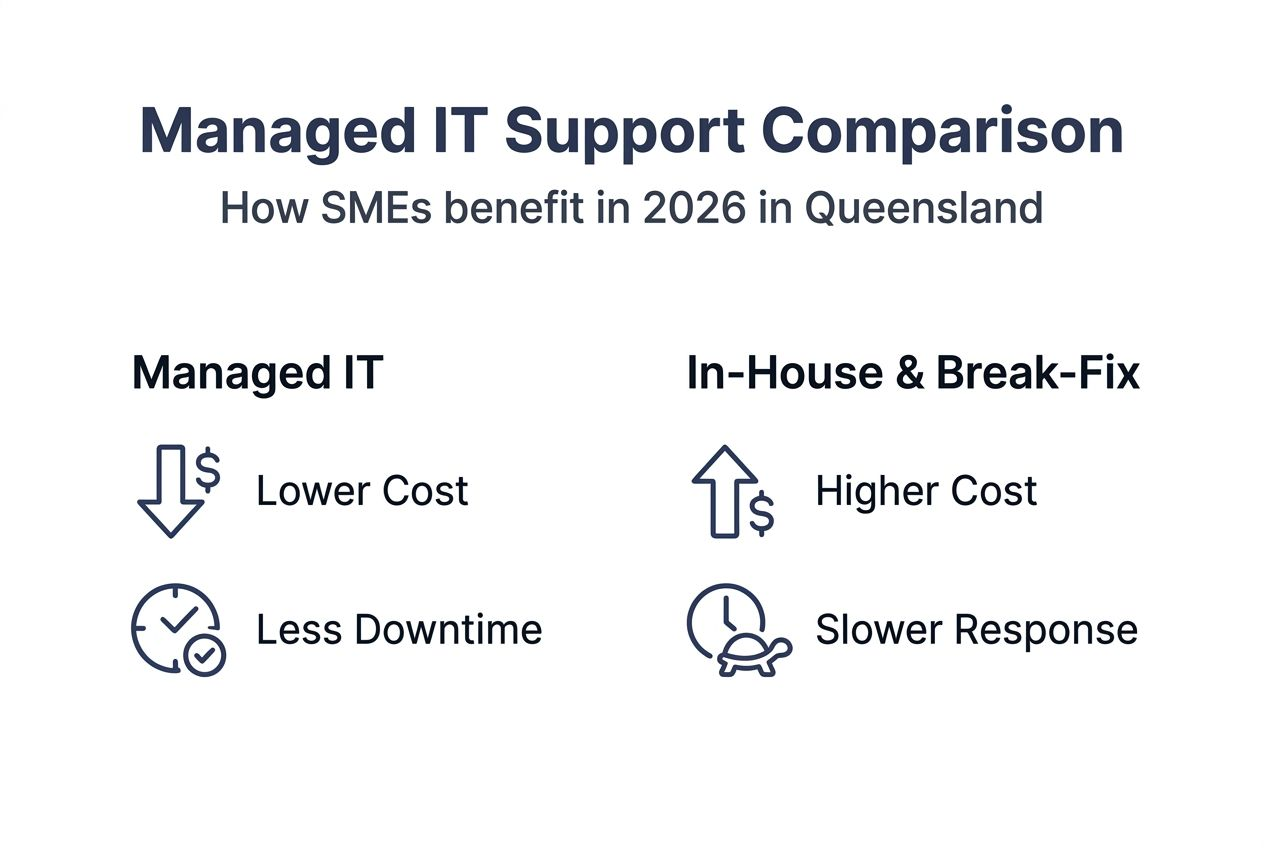
- Comparing Managed IT Support With In-House And Break-Fix Models
- Explore Professional Managed IT Support Solutions
- Frequently Asked Questions About Managed IT Support Benefits
Key takeaways
| Point | Details |
|---|---|
| Downtime reduction | Managed IT services cut IT-related downtime by up to 40% through proactive monitoring and maintenance. |
| Security enhancement | Businesses using managed security services experience 30% fewer security breaches compared to those without professional support. |
| Compliance support | Managed IT providers help SMEs implement frameworks like ACSC Essential Eight to meet regulatory and supplier security requirements. |
| Scalable growth | MSPs adapt IT infrastructure as your business expands without requiring major capital investment in hardware or staff. |
| Cost predictability | Fixed monthly fees replace unpredictable break-fix expenses, enabling better budget planning and financial control. |
Understanding managed IT support and its role
Managed IT support represents a fundamental shift from traditional reactive IT models to proactive, continuous technology management. Instead of waiting for systems to fail, managed service providers (MSPs) monitor your infrastructure around the clock, identifying and resolving potential issues before they disrupt operations.
MSPs employ Remote Monitoring and Management (RMM) tools to track network performance, server health, security threats, and system updates in real time. This constant vigilance allows technicians to patch vulnerabilities, optimise performance, and prevent failures during business hours. The proactive approach contrasts sharply with break-fix models where businesses only engage IT support after problems occur.
Core managed IT support functions typically include:
- 24/7 network and server monitoring with automated alerting
- Help desk support for end user technical issues
- Regular software updates and security patch management
- Data backup and disaster recovery planning
- Cybersecurity monitoring and threat response
- Strategic IT planning aligned with business objectives
MSPs maintain your IT infrastructure consistently, ensuring systems remain secure, compliant, and optimised for performance. This structured approach eliminates the chaos of reactive IT management and provides predictable service delivery. Understanding why use managed IT services helps Queensland SMEs recognise how this model supports business continuity and growth.
The remote monitoring capability means your MSP can often fix issues without stepping foot in your office, reducing response times and minimising disruption. This efficiency gain alone justifies the investment for many growing businesses.
Enhancing operational efficiency with managed IT support
IT downtime devastates SME productivity and revenue. Every minute your systems are offline translates to lost sales, frustrated customers, and idle employees. Businesses with managed IT support experience up to a 40% reduction in downtime compared to those managing IT reactively.

Managed IT providers deliver this efficiency improvement through several mechanisms. Proactive maintenance identifies failing hardware before it crashes, allowing scheduled replacements during off-hours. Regular system health checks catch performance bottlenecks early, preventing slowdowns that frustrate users. Automated patch management keeps software current without disrupting workflows.
The speed of issue resolution improves dramatically under managed support models. When problems do occur, your MSP already knows your infrastructure intimately and can diagnose issues rapidly. Managed IT services reduce downtime by maintaining detailed documentation of your systems, configurations, and historical issues, enabling faster troubleshooting.
| Efficiency metric | Without managed IT | With managed IT | Improvement |
|---|---|---|---|
| Average downtime per incident | 4-6 hours | 1-2 hours | 60-70% reduction |
| Monthly IT issues requiring attention | 12-15 | 4-6 | 65% reduction |
| Time to resolve critical issues | 24-48 hours | 2-8 hours | 75% faster |
| Planned maintenance windows | Ad hoc | Scheduled monthly | 100% predictability |
Streamlined IT infrastructure represents another significant efficiency gain. MSPs standardise systems, eliminate redundant applications, and optimise configurations for your specific business needs. This standardisation reduces complexity and makes support more efficient across your organisation.
Exploring IT support benefits Brisbane businesses experience reveals how local MSPs understand Queensland-specific requirements like NBN connectivity challenges and regional compliance considerations.
Pro Tip: Schedule quarterly IT infrastructure reviews with your MSP to identify optimisation opportunities before they impact performance. These strategic sessions ensure your technology investment aligns with evolving business needs and maximises efficiency gains.
Strengthening cybersecurity for Queensland SMEs
Cybersecurity represents the most critical managed IT support benefit for Queensland SMEs in 2026. Companies using managed security services see a 30% decrease in security breaches, a compelling statistic when considering that 60% of small businesses close within six months of a cyberattack.
Managed IT providers deliver layered security that most SMEs cannot implement independently. This defence-in-depth approach includes endpoint protection on every device, next-generation firewalls at network boundaries, email filtering to block phishing attempts, and security information and event management (SIEM) systems that correlate threat data across your infrastructure.
Proactive threat detection distinguishes managed security from basic antivirus software. MSPs monitor your systems for indicators of compromise, unusual network traffic patterns, and emerging threat signatures. When suspicious activity appears, security analysts investigate immediately rather than waiting for automated alerts that might arrive too late.
Cybercrime costs continue rising sharply for Australian SMBs, making robust security measures essential for business survival. The threat landscape evolves constantly, with attackers developing new techniques faster than most internal IT staff can track.
Compliance frameworks provide structured approaches to cybersecurity that managed IT providers implement systematically. The ACSC Essential Eight maturity model offers Queensland businesses a clear roadmap for security improvements. MSPs guide you through implementing these controls at appropriate maturity levels for your industry and risk profile.
Key Essential Eight controls managed IT providers implement include:
- Application control preventing unauthorised software execution
- Patch management for operating systems and applications
- Multi-factor authentication for all users
- Regular backups tested for restoration capability
- Microsoft Office macro restrictions
- Application hardening reducing attack surfaces
- User privilege restrictions limiting lateral movement
- Network segmentation isolating critical assets
Modern Defensible Architecture principles underpin effective managed security services. This approach designs IT infrastructure assuming breaches will occur, focusing on rapid detection, containment, and recovery rather than perimeter defence alone. Your MSP architects networks with segmentation that limits attacker movement and monitoring that reveals suspicious activity quickly.
“The question is not if you will be attacked, but when. Queensland SMEs need security architecture that detects and contains breaches before significant damage occurs. Managed IT providers deliver this capability through continuous monitoring and layered defences that most businesses cannot maintain independently.”
Understanding managed IT security Brisbane approaches helps local businesses recognise how regional MSPs address Queensland-specific threats and compliance requirements. Detailed guidance on ACSC Essential 8 Brisbane implementation demonstrates practical steps for improving security posture.
Pro Tip: Implement security in layers rather than relying on single solutions. Combine endpoint protection, network security, email filtering, user training, and incident response planning for comprehensive defence. Your MSP should coordinate these elements into a cohesive security programme tailored to your specific risks.
Comparing managed IT support with in-house and break-fix models
Queensland SMEs face three primary IT management approaches, each with distinct advantages and limitations. Understanding these differences helps you make informed decisions about technology support that aligns with your business size, budget, and growth trajectory.
| Factor | Managed IT | In-house IT | Break-fix |
|---|---|---|---|
| Upfront cost | Low to moderate monthly fee | High salary plus benefits | Very low until issues occur |
| Long-term cost | Predictable monthly expense | Fixed high ongoing cost | Unpredictable, often highest total |
| Average downtime | 1-2 hours per incident | 2-4 hours per incident | 4-8 hours per incident |
| Security capability | Enterprise-grade tools and expertise | Limited by staff knowledge | Reactive only, minimal prevention |
| Scalability | Easily scales with business | Requires hiring additional staff | No scalability support |
| Response time | Typically under 1 hour | Depends on availability | 4-24 hours or longer |
| Proactive maintenance | Core service feature | Depends on staff priorities | Not included |
The break-fix model is reactive and often results in prolonged downtime and higher costs because problems compound before technicians address them. You only pay when something breaks, but emergency rates typically exceed managed service fees, and the business impact of unexpected failures far outweighs any apparent savings.
In-house IT staff provide immediate physical presence and deep knowledge of your specific environment. However, hiring qualified IT professionals in Queensland’s competitive market requires salaries exceeding $80,000 annually plus benefits and training costs. Small IT teams lack coverage for holidays, sick leave, and knowledge gaps in specialised areas like cybersecurity or cloud infrastructure.
Managed IT support combines the best elements of both approaches. You gain access to entire teams of specialists covering networks, security, cloud, and applications without the overhead of full-time employees. The monthly fee structure provides budget predictability while eliminating the risk of catastrophic repair bills.
Hidden costs of non-managed approaches include:
- Lost productivity during extended downtime
- Security breaches resulting from delayed patching
- Compliance violations due to inadequate documentation
- Inefficient systems never properly optimised
- Knowledge loss when key IT staff depart
- Emergency support premiums during crises
Comparing managed IT vs in-house options reveals that most Queensland SMEs benefit from managed services until reaching 50-100 employees, at which point hybrid models combining MSP support with dedicated internal IT staff become cost-effective.
Scalability represents a crucial advantage for growing businesses. Your MSP adjusts service levels as you add locations, hire staff, or adopt new technologies without requiring major capital investment. This flexibility supports business growth without IT infrastructure becoming a constraint.
Explore professional managed IT support solutions
Implementing the managed IT support benefits discussed throughout this guide requires partnering with experienced providers who understand Queensland business environments and security requirements. IT Start delivers comprehensive business IT support designed specifically for Brisbane SMEs seeking to improve operational efficiency and strengthen cybersecurity posture.
Our proactive approach combines 24/7 monitoring, rapid response help desk support, and strategic IT planning aligned with your business objectives. We help Queensland businesses implement frameworks like ACSC Essential Eight, achieve compliance requirements, and build Modern Defensible Architecture that protects against evolving threats.
Explore our specialised cyber security services to understand how layered defences, threat monitoring, and incident response capabilities protect your business from the rising cybercrime costs impacting Australian SMEs. Our cloud services support scalable growth and business continuity through reliable infrastructure and data protection.
Frequently asked questions about managed IT support benefits
What does managed IT support typically cost for Queensland SMEs?
Most Queensland MSPs charge between $100 and $200 per user monthly, depending on service levels and complexity. This predictable expense replaces unpredictable break-fix costs and includes proactive monitoring, help desk support, security services, and regular maintenance. The ROI typically appears within 3-6 months through reduced downtime and improved productivity.
How quickly can managed IT services adapt as my business grows?
Managed IT providers scale services immediately as you hire staff, open locations, or adopt new technologies. Your MSP provisions new users, devices, and applications within hours rather than the weeks required for recruiting and training in-house staff. This flexibility ensures IT infrastructure supports rather than constrains business growth.
What security improvements should I expect from managed IT support?
Typical security enhancements include 30% fewer breaches, faster threat detection, comprehensive endpoint protection, regular vulnerability assessments, and compliance framework implementation. Your MSP monitors systems continuously, applies security patches promptly, and responds to incidents immediately rather than waiting for internal staff availability.
How does managed IT support differ from traditional break-fix services?
Managed services prevent problems through proactive monitoring and maintenance, while break-fix models only respond after failures occur. This fundamental difference reduces downtime by 60-70%, provides predictable monthly costs, and delivers superior security through continuous threat monitoring rather than reactive responses.
Can managed IT providers help with compliance frameworks like Essential Eight?
Yes, experienced MSPs guide Queensland businesses through implementing ACSC Essential Eight controls at appropriate maturity levels for your industry. They conduct initial assessments, develop implementation roadmaps, deploy required technologies, and maintain ongoing compliance through regular reviews and updates as frameworks evolve.
What happens if my managed IT provider experiences technical issues?
Reputable MSPs maintain redundant infrastructure, backup support teams, and documented escalation procedures ensuring service continuity. They typically guarantee response times through service level agreements and provide alternative communication channels if primary systems fail. This reliability far exceeds what most SMEs can achieve independently.