

For many financial services firms in Brisbane, keeping pace with digital threats while managing complex IT systems can feel overwhelming. Robust cybersecurity and continuous technological oversight are no longer optional. A Managed Services Provider offers proactive support, 24/7 monitoring, and expert guidance that transform IT from a cost centre into a value driver. This article helps clarify what MSPs really deliver, dispelling common myths and showing how a tailored approach safeguards operations for growth-minded Australian businesses.
Table of Contents
- Managed Services Provider Explained And Misconceptions
- Common Types And Variations Of MSP Services
- How MSPs Deliver Proactive IT And Support
- Key Cybersecurity, Cloud And Compliance Measures
- Legal, Contractual And Financial Responsibilities
- Risks, Costs And Common MSP Pitfalls
Key Takeaways
| Point | Details |
|---|---|
| Proactive Support Advantage | Managed Service Providers (MSPs) focus on preventing IT issues before they occur, enhancing operational stability and budget predictability. |
| Diverse Service Models | MSPs offer various models, from break-fix support to advanced cybersecurity and cloud management, tailored to different business sizes and needs. |
| Robust Cybersecurity Measures | With increasing digital threats, MSPs provide comprehensive cybersecurity strategies that include continuous monitoring and rapid response to incidents. |
| Legal and Financial Responsibilities | MSPs must comply with stringent legal requirements and maintain clear contractual obligations to ensure effective risk management and data protection. |
Managed services provider explained and misconceptions
A Managed Services Provider (MSP) is a technology support partner that proactively manages a business’s entire IT infrastructure, offering comprehensive solutions beyond traditional break-fix support models. Unlike reactive IT support that responds only when problems arise, MSPs monitor, maintain, and optimise a company’s technology ecosystem continuously.
Businesses often misunderstand the scope of managed services. Here are key misconceptions about what MSPs actually provide:
- Reactive vs Proactive Support: Many assume MSPs merely fix issues when they occur
- Cost Perception: Some believe managed services are too expensive for small businesses
- Security Capabilities: Not all understand the depth of cybersecurity protection MSPs offer
- Technological Breadth: Companies underestimate the range of technological solutions MSPs can implement
The core value of a managed IT services strategy lies in transforming technology from a potential business disruption into a strategic advantage. MSPs don’t just manage technology; they align technological capabilities with business objectives, ensuring that every IT investment contributes directly to organisational goals.
Here’s a comparison of proactive MSP support with traditional reactive IT approaches:
| Approach | Issue Handling | Business Impact | Cost Predictability |
|---|---|---|---|
| Reactive IT | Fixes problems after outages | Higher risk of downtime | Variable costs after incidents |
| Proactive MSP | Prevents issues before disruption | Consistent operations and planning | Predictable, stable budgeting |
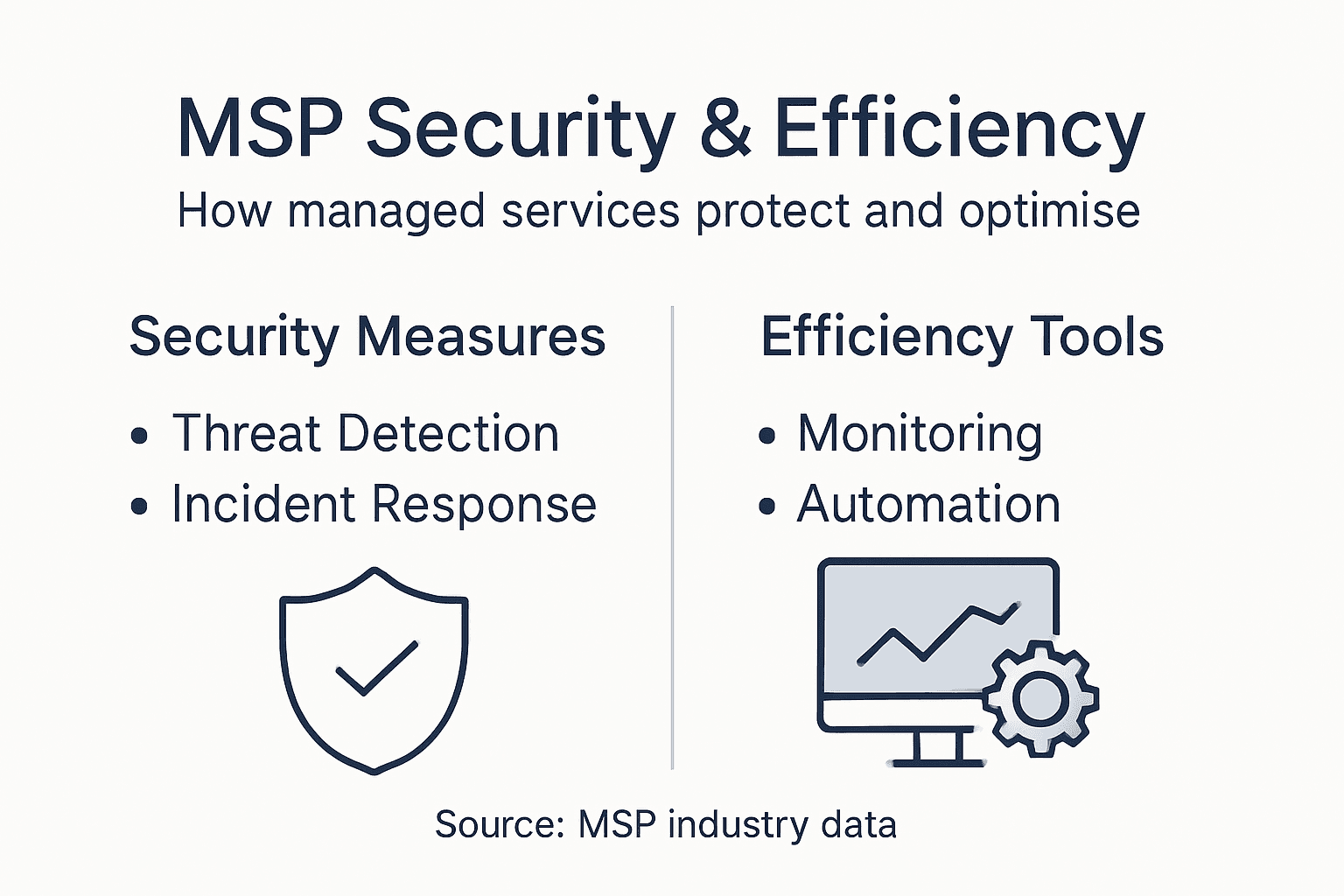
Cybersecurity represents a critical component of managed services. Australian businesses face increasing digital threats, making professional IT management more crucial than ever. MSPs provide comprehensive security strategies that include:
- Continuous network monitoring
- Threat detection and prevention
- Regular security audits
- Compliance management
- Rapid incident response
Managed services are not just about fixing problems, but preventing them before they impact your business operations.
Pro tip: Schedule a comprehensive IT infrastructure assessment to understand your current technological vulnerabilities and potential improvement areas.
Common types and variations of MSP services
Managed Service Providers (MSPs) offer diverse service models tailored to different business technology needs. Multiple MSP models have emerged to address specific technological challenges, ranging from basic IT support to advanced cloud and security solutions.
The primary variations of MSP services include:
- Break-Fix Support: Traditional reactive model addressing issues after they occur
- Managed Security Services Provider (MSSP): Specialised cybersecurity protection and threat management
- Cloud MSP: Infrastructure and application management in cloud environments
- Strategic IT Consulting: Proactive technology planning and digital transformation guidance
- Network Management MSP: Comprehensive network infrastructure monitoring and optimisation
Each MSP model serves unique business requirements. Break-fix models remain suitable for smaller organisations with minimal technology complexity, while comprehensive MSPs provide end-to-end technological support integrating multiple service dimensions.

Here’s a summary of MSP service model focus areas:
| Service Model | Main Focus | Typical Client Size |
|---|---|---|
| Break-Fix | Immediate problem solving | Micro and small businesses |
| Cloud MSP | Cloud migration and management | Mid-size to large enterprises |
| MSSP | Advanced cyber defence | Regulated or high-risk sectors |
| Strategic IT Consulting | Long-term technology planning | Growth-focused organisations |
Cloud-based managed services represent a particularly dynamic segment, helping businesses migrate, manage, and optimise their cloud infrastructure. These providers offer scalable solutions that adapt to changing technological landscapes, ensuring businesses remain agile and technologically competitive.
Modern MSPs are strategic partners, not just technical support providers.
Pro tip: Evaluate your business’s specific technological needs before selecting an MSP to ensure alignment with your strategic objectives.
How MSPs deliver proactive IT and support
Managed Service Providers (MSPs) revolutionise business technology management through comprehensive 24/7 monitoring strategies that anticipate and prevent potential IT challenges before they disrupt operations. Unlike traditional reactive support models, modern MSPs focus on continuous technological surveillance and strategic intervention.
The proactive approach of MSPs involves several critical strategies:
- Continuous Network Monitoring: Real-time tracking of system performance and potential vulnerabilities
- Predictive Maintenance: Identifying and addressing potential hardware and software issues before failure
- Automated Threat Detection: Implementing advanced cybersecurity protocols to prevent potential breaches
- Performance Optimization: Regular system assessments and strategic technology upgrades
- Scalable IT Infrastructure: Designing flexible technological ecosystems that grow with business needs
Businesses benefit from MSPs’ strategic technological management by transforming IT from a potential cost centre to a value-generating component of organisational strategy. Proactive support means businesses can focus on core operational objectives while maintaining robust, secure, and efficient technological infrastructure.
Cloud management represents a particularly sophisticated aspect of proactive IT support. MSPs help organisations seamlessly migrate, integrate, and optimise cloud-based systems, ensuring maximum performance, security, and cost-effectiveness across complex technological environments.
Proactive IT support is about preventing problems, not just fixing them after they occur.
Pro tip: Request a comprehensive IT infrastructure audit to identify potential vulnerabilities and optimization opportunities.
Key cybersecurity, cloud and compliance measures
Managed Service Providers (MSPs) play a critical role in implementing robust cybersecurity compliance frameworks that protect businesses from evolving digital threats. These comprehensive strategies go beyond traditional security measures, integrating multiple layers of protection and regulatory adherence.
Key cybersecurity and compliance measures include:
- Risk Management: Comprehensive assessment and mitigation of potential technological vulnerabilities
- Shared Responsibility Models: Collaborative security approaches between service providers and businesses
- Regulatory Compliance: Adherence to Australian cybersecurity legislation and industry-specific regulations
- Continuous Monitoring: Real-time threat detection and immediate response mechanisms
- Data Protection: Advanced encryption and secure access control strategies
Australian businesses must navigate complex regulatory landscapes, particularly in sectors like finance and healthcare. Compliance frameworks such as the Essential Eight maturity model and APRA CPS 234 require sophisticated, adaptive security approaches that MSPs are uniquely positioned to deliver.
Cloud security represents a sophisticated dimension of modern cybersecurity strategies. MSPs help organisations implement robust cloud protection mechanisms that balance accessibility, performance, and stringent security protocols, ensuring data remains protected across diverse technological environments.
Effective cybersecurity is not about perfect protection, but about intelligent risk management and rapid response.
Pro tip: Conduct regular security audits and maintain updated incident response plans to stay ahead of emerging cyber threats.
Legal, contractual and financial responsibilities
Managed Service Providers (MSPs) must navigate complex legal obligations and contract management that extend far beyond traditional service agreements. These responsibilities encompass comprehensive risk management, financial transparency, and rigorous compliance with Australian regulatory frameworks.
Key legal and contractual responsibilities include:
- Cybersecurity Compliance: Adherence to national digital security standards
- Data Protection: Ensuring client information remains confidential and secure
- Risk Mitigation: Proactive identification and management of potential technological vulnerabilities
- Financial Transparency: Clear reporting and cost management practices
- Regulatory Alignment: Meeting industry-specific legal requirements
Contractual frameworks for MSPs demand sophisticated approaches to risk management and service delivery. This involves developing detailed service level agreements (SLAs) that precisely define technological responsibilities, performance metrics, and liability boundaries between the service provider and the client.
Incident response protocols represent a critical legal consideration for MSPs. These frameworks must outline clear processes for managing potential security breaches, including immediate notification procedures, comprehensive forensic analysis, and structured remediation strategies that protect both the client’s interests and the MSP’s legal standing.
Legal compliance is not a checkbox, but a continuous commitment to maintaining the highest standards of technological and ethical practice.
Pro tip: Regularly review and update your MSP contract to ensure alignment with current cybersecurity regulations and technological standards.
Risks, costs and common MSP pitfalls
Managed Service Providers face significant challenges in maintaining robust cybersecurity risk management that protect both their own and their clients’ technological ecosystems. These risks extend beyond simple technical vulnerabilities, encompassing complex operational, financial, and strategic dimensions.
Common MSP pitfalls include:
- Inadequate Security Protocols: Insufficient protection against sophisticated cyber threats
- Cost Management Challenges: Balancing service quality with competitive pricing
- Talent Shortage: Difficulty recruiting and retaining skilled cybersecurity professionals
- Vendor Dependency: Over-reliance on specific technological ecosystems
- Customisation Limitations: Struggling to meet unique client requirements
Operational costs represent a critical consideration for MSPs. The increasing complexity of technological landscapes demands continuous investment in skills, infrastructure, and adaptive security mechanisms. Businesses must carefully evaluate the total cost of managed services against potential risks and efficiency gains.
Cybersecurity vulnerabilities pose the most significant threat to MSP effectiveness. A single compromised MSP can potentially expose multiple client networks, creating cascading security risks that extend far beyond immediate technological boundaries. This necessitates rigorous, multi-layered security approaches and transparent incident response strategies.
The greatest risk in managed services is not a technological failure, but a failure of comprehensive risk management.
Pro tip: Conduct thorough due diligence and maintain ongoing security assessments to mitigate potential MSP-related risks.
Secure Your Business Future with Strategic Managed IT Services
The article highlights the critical challenge of balancing proactive IT management with robust cybersecurity and cost-effective solutions. If you are concerned about unpredictable downtime, complex compliance requirements, or evolving cyber threats, these are real obstacles that Queensland businesses face daily. Concepts such as continuous network monitoring, predictive maintenance, and cloud security are essential to turning your IT from a liability into a strategic advantage. Every business deserves tailored support that not only prevents disruptions but also aligns IT with your goals.
At IT Start, we understand these pain points deeply. As a Brisbane-based managed services provider, we offer local expertise with industry-leading certifications like SMB 1001 Gold to deliver transparent, high-standard managed IT support, cloud solutions, and cybersecurity. Our proactive approach ensures that your technology infrastructure is secure, compliant, and optimised for growth. Explore how our customised IT strategies can ease your cybersecurity worries and improve operational efficiency by booking a free IT assessment.
Ready to transform your IT from a source of stress into a competitive edge? Connect with the trusted Brisbane team at IT Start today to start your journey towards more secure and efficient technology management. Take the next step by contacting us here for expert guidance and tailored solutions designed for your business needs.
Frequently Asked Questions
What is the primary role of a Managed Services Provider (MSP)?
A Managed Services Provider proactively manages and optimises a business’s entire IT infrastructure, offering continuous technical support and aligning technological capabilities with business objectives.
How do MSPs enhance cybersecurity for businesses?
MSPs implement comprehensive cybersecurity strategies, including continuous network monitoring, threat detection, regular security audits, and compliance management to protect businesses from digital threats.
What are the differences between proactive MSP support and traditional reactive IT support?
Proactive MSP support focuses on preventing issues before they arise, ensuring consistent operations and predictable costs, while traditional reactive IT support addresses problems only after they occur, often leading to higher downtime and variable costs.
Why should businesses consider cloud-managed services from an MSP?
Cloud-managed services allow businesses to seamlessly migrate, manage, and optimise cloud-based systems, providing scalability, security, and performance that adapt to changing technological needs.
Recommended
- Role of Managed IT in Security for Brisbane SMEs – IT Start
- Core IT Management Services for Brisbane Businesses – IT Start
- Managed Network Security: Why Brisbane SMEs Benefit – IT Start
- Managed IT Services: Complete Guide for Brisbane SMBs – IT Start
- Role Of VPS In Forex Trading: Boosting EA Efficiency
- DLL Path Resolution: Ensuring Reliable Windows Fixes – FixDlls Blog