

Choosing the right talent for cyber security roles can feel daunting when the safety of patient data and reputation is at stake. For business owners in Brisbane’s healthcare sector, understanding what sets a cyber security degree apart from general IT training is vital for real-world protection. Australian universities design degrees that blend theory and hands-on learning, focusing on skills like risk assessment and cybercrime investigation, helping you build a team ready to defend sensitive information against today’s threats. Industry alignment ensures graduates are up to date with modern defence strategies.
Table of Contents
- Defining Cyber Security Degrees In Australia
- Comparing Degree Types And Specialisations
- Key Skills And Course Outcomes For Graduates
- Healthcare Cyber Security Needs And Compliance
- Alternatives To Formal Qualifications For Roles
- Common Credentialing Mistakes And How To Avoid Them
Table of Contents: Cyber Security Degree Pathways & Topics in Brisbane
| Point | Details |
|---|---|
| Cyber Security Degrees in Australia | Formal education in cyber security is vital for addressing organisational security needs, focusing on relevant skills and methodologies. |
| Diverse Qualification Pathways | Various qualifications are available, including Bachelor, Graduate Diplomas, and Master’s degrees, catering to different skill levels and specialisations. |
| Importance of Practical Skills | Graduates emerge with hands-on experience, enabling them to tackle real-world security threats effectively. |
| Healthcare Compliance Awareness | It’s crucial for cyber security professionals to possess knowledge of healthcare-specific compliance regulations to protect sensitive patient data. |
Defining cyber security degrees in Australia
Cyber security degrees in Australia represent formal educational pathways designed to prepare graduates for rapidly expanding security roles across organisations. These degrees go far beyond generic IT qualifications. They focus specifically on designing and implementing cyber security solutions across businesses, government agencies, and individual protection strategies. Universities like Griffith University offer structured Bachelor of Cyber Security programs that equip students with practical skills to address current and future threats. The curriculum typically balances theoretical knowledge with hands-on experience, covering essential areas such as risk and vulnerability assessments, cybercrime investigation techniques, and cyber defence strategies.
What makes Australian cyber security degrees distinctive is their alignment with industry needs. Cyber Security Education Australia brings together universities and industry partners to ensure degree programs reflect real-world requirements and emerging digital threats. This collaborative approach means your degree won’t teach outdated practices. Instead, you’ll learn methodologies that organisations actually deploy today. Healthcare providers in Brisbane, for instance, benefit from graduates who understand both technical defence mechanisms and compliance frameworks specific to patient data protection. The curriculum emphasis on risk assessment directly translates to identifying vulnerabilities in your own systems.
Australian degrees differ from shorter certifications or bootcamps in their depth. A Bachelor degree typically requires three years of full-time study, allowing students to develop foundational knowledge in mathematics, networking, and software development before specialising in cyber security. This foundation matters when you’re hiring. Graduates understand not just how to respond to threats but why those threats exist and how systems interact. Beyond the degree itself, many Australian graduates pursue relevant security certifications that complement their qualification, creating security professionals with both breadth of knowledge and specialised credentials.
Pro tip: When evaluating cyber security degrees for your hiring pipeline, verify whether the program maintains accreditation with industry bodies and check if graduates have pursued credentials like CISSP or CEH, which indicate commitment to ongoing professional development beyond their initial qualification.
Comparing degree types and specialisations
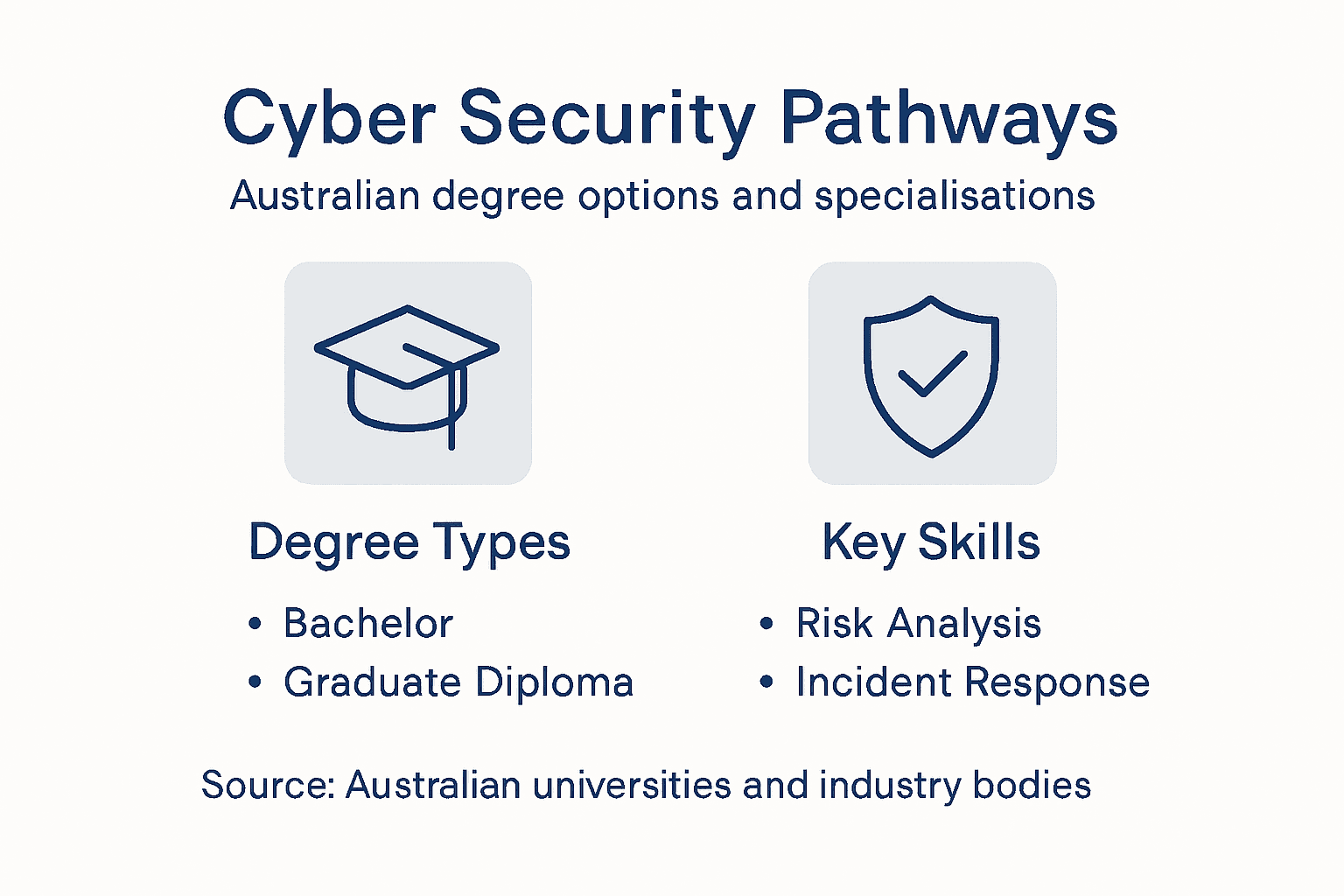
Australian cyber security education offers multiple pathways beyond the standard Bachelor degree. You’ll find Graduate Diplomas that compress learning into shorter timeframes for professionals transitioning into security roles, Master’s degrees for those seeking advanced expertise and research opportunities, and Bachelor degrees providing foundational knowledge across broader IT and security concepts. The choice depends on your hiring needs, budget constraints, and the specific skill gaps in your organisation. A healthcare provider in Brisbane might benefit from recruiting graduates with different qualification levels. Entry-level security analysts could come from Bachelor programs, whilst senior roles like Chief Information Security Officers often require Master’s-level thinking.
Specialisations within these degrees vary significantly based on institution and program focus. Cybersecurity education in Australia spans technical specialisations such as network security, digital forensics, and ethical hacking through to emerging areas like artificial intelligence in cyber security and cloud security. Some universities take unique approaches. Western Sydney University, for example, combines technical cyber security with behavioural science, integrating concepts like psychology of online fraud and human-centred security design. This matters for healthcare organisations where understanding how staff interact with security systems directly impacts your breach risk. A graduate trained in behavioural aspects understands why employees click malicious links, not just how to block them.
When comparing programs, look beyond the degree name. Some degrees emphasise management and legal frameworks, which suits candidates aiming for compliance or governance roles. Others focus purely on hands-on technical skills like penetration testing and vulnerability assessment. Master’s programs often include capstone projects or industry-integrated work, meaning graduates arrive with real-world experience tackling problems similar to those in your organisation. Graduate Diplomas suit professionals with existing IT backgrounds who need rapid upskilling in security-specific domains.
Here’s how key cyber security qualifications in Australia compare:
| Qualification Type | Typical Duration | Focus Area | Ideal For |
|---|---|---|---|
| Bachelor Degree | 3 years full-time | Broad IT and security foundations | Entry-level analysts |
| Graduate Diploma | 1 year full-time | Intensive security upskilling | IT professionals transitioning |
| Master’s Degree | 1.5-2 years full-time | Advanced technical and research | Future CISOs, managers |
| Bootcamp/Certificate | 3-24 weeks | Practical, job-ready skills | Rapid entry to junior roles |
Pro tip: When recruiting, ask candidates which specialisation they studied and request examples of projects from their degree programme, as these directly indicate whether their training aligns with your organisation’s specific security needs.
Key skills and course outcomes for graduates
Cyber security graduates from Australian universities emerge with a blend of technical competencies and professional capabilities that directly address your organisation’s security challenges. Beyond coding and network knowledge, these graduates develop critical problem-solving abilities, ethical decision-making frameworks, and teamwork skills essential for functioning within security operations teams. RMIT’s Bachelor of Cyber Security, for instance, emphasises technical and professional skill development alongside practical experience through supervised internships. This internship component matters significantly. Your healthcare organisation benefits when candidates arrive having already implemented security solutions in real-world environments, building networks with security professionals before joining your team.
Specific technical outcomes vary by institution but consistently include risk assessment capabilities, digital forensics expertise, and computer crime investigation knowledge. Deakin University graduates, for example, develop competencies in identifying vulnerabilities, conducting security audits, and understanding the legal and ethical dimensions of cyber operations. They understand not just how to block threats but the compliance implications when incidents occur. For healthcare providers handling sensitive patient data, this legal awareness proves invaluable. Graduates grasp why HIPAA compliance matters and how security decisions intersect with privacy obligations. They can communicate technical findings to non-technical stakeholders, translating complex vulnerabilities into business impact language your management team understands.

Most Australian degrees balance theoretical knowledge with applied practice. Internships, capstone projects, and industry partnerships mean graduates haven’t simply memorised concepts; they’ve troubleshot actual systems, analysed real network traffic, and documented vulnerabilities using professional tools. They arrive understanding modern security frameworks, cloud environments, and emerging threat landscapes rather than outdated methodologies. When recruiting, assess whether candidates can articulate specific projects they completed, tools they used, and problems they solved. This reveals depth of practical experience beyond credential possession.
Summary of skills Australian cyber security graduates bring to healthcare organisations:
| Key Skill Area | Practical Application | Organisational Benefit |
|---|---|---|
| Risk Assessment | Identifying threats in hospital systems | Reduced risk of breaches |
| Digital Forensics | Investigating unauthorised access | Faster incident resolution |
| Legal Compliance | Navigating data privacy laws | Fewer regulatory penalties |
| Communication | Explaining risks to management | Improved decision making |
Pro tip: During interviews, ask graduates to walk you through a specific security project from their degree, requesting details about their analysis process and recommendations, which demonstrates both technical depth and communication ability essential for your security team.
Healthcare cyber security needs and compliance
Healthcare organisations in Brisbane operate in a uniquely vulnerable position. Patient data ranks among the most valuable information on the dark web, commanding higher prices than credit card numbers. Your facility stores not just names and addresses but medical histories, diagnoses, and treatment plans. A single breach exposes your organisation to regulatory penalties, reputational damage, and patient trust erosion. Beyond the data itself, healthcare relies on critical infrastructure that directly impacts patient safety. Healthcare cyber security challenges include protecting digital health records, medical devices, and continuous service availability whilst managing threats like ransomware attacks designed specifically to cripple hospital operations. Compliance isn’t optional; it’s mandated through frameworks like the Australian Privacy Principles and the Security of Critical Infrastructure Act.
The Australian regulatory environment demands specific protections tailored to healthcare’s unique risks. Your organisation must implement robust access controls ensuring only authorised personnel access patient records, encryption standards protecting data both in transit and at rest, and incident response procedures tested before crises occur. The 2023-2030 Australian Cyber Security Strategy specifically addresses healthcare, mandating risk management protocols, workforce training requirements, and regulatory compliance frameworks designed to improve institutional resilience. This isn’t theoretical compliance work. When ransomware hits a Brisbane healthcare facility, you need staff trained to recognise suspicious emails, documented procedures for isolating affected systems, and backup systems that function independently from compromised networks. Graduates from cyber security degree programmes understand these healthcare-specific requirements because their curricula now incorporate compliance frameworks rather than treating security as purely technical.
Why this matters for hiring decisions becomes clear when you consider breach consequences. A healthcare data breach costs Australian organisations an average of 3.86 million dollars when accounting for notification expenses, regulatory fines, and operational disruption. Recruiting graduates trained in healthcare compliance frameworks accelerates your organisation’s ability to meet mandatory requirements. They understand why patient data classification matters, how to conduct risk assessments aligned with healthcare standards, and the documentation requirements regulators demand. Your team needs individuals who grasp not just firewalls and passwords but the intersection of technology, regulation, and patient safety that defines modern healthcare security.
Pro tip: When interviewing cyber security graduates, ask specifically about their experience with healthcare compliance frameworks or similar regulated environments, as this directly translates to faster onboarding and fewer compliance gaps in your organisation.
Alternatives to formal qualifications for roles
Formal degrees aren’t your only recruitment pathway. The reality of cyber security talent acquisition means you’ll find qualified professionals through multiple routes, each with distinct advantages. Industry certifications like CompTIA Security+, Cisco CCNA Security, and ISC2’s CISSP demonstrate hands-on competency in specific security domains. A candidate holding a CompTIA Security+ has proven knowledge of threat analysis, incident response, and compliance requirements without necessarily completing a three-year degree. Bootcamps compress learning into weeks or months, targeting professionals transitioning from IT support roles into security-focused positions. These intensive programmes emphasise practical skills over theory, meaning graduates emerge ready for entry-level security roles immediately. Apprenticeships create structured pathways combining on-the-job experience with formal training, particularly valuable for developing junior security analysts who learn your organisation’s systems whilst building foundational knowledge.
The Australian government actively supports these alternatives. The 2023-2030 Cyber Security Strategy emphasises flexible development options and partnerships between industry and education providers. This strategic focus recognises that rigid degree-only hiring excludes talented professionals who’ve built expertise through alternative routes. For Brisbane healthcare organisations facing security skill shortages, this opens recruitment possibilities. A candidate with five years of IT experience, relevant CompTIA certifications, and bootcamp training in incident response might outperform a fresh graduate without professional context. The difference lies not in credentials but in readiness. Someone who’s already managed production systems understands operational pressures that pure theory graduates haven’t encountered.
However, alternatives require careful evaluation. Bootcamp quality varies dramatically. Some deliver genuine technical competency whilst others produce graduates who’ve memorised concepts without understanding underlying principles. When recruiting non-degree candidates, request evidence of practical work. Can they describe real incidents they’ve handled? Do they understand your healthcare compliance environment? Have they used security tools professionally? Certifications carry more weight when paired with demonstrable experience. Your ideal candidate might combine a bootcamp credential with two years supporting a managed security provider, having gained exposure to multiple organisation types and threat landscapes. This hybrid approach often produces security professionals who grasp both technical depth and business context.
Pro tip: When evaluating candidates without formal degrees, request references from previous employers who can attest to specific security skills demonstrated, and consider offering paid trial projects before hiring to assess both technical ability and cultural fit with your team.
Common credentialing mistakes and how to avoid them
When recruiting cyber security professionals, many Brisbane healthcare organisations make predictable mistakes that undermine their hiring success. The most damaging error involves prioritising credentials that look impressive on paper whilst ignoring practical capability. A candidate might hold multiple certifications yet lack any real-world experience troubleshooting actual systems. This happens when organisations focus solely on degree completion or certification names without examining what candidates actually did to earn them. Common credentialing mistakes in cyber security include selecting programmes emphasising theory over hands-on practice, pursuing qualifications misaligned with current industry needs, and failing to verify that curriculum covers emerging threats your organisation faces. A candidate trained on outdated security frameworks won’t recognise modern attack patterns. When evaluating credentials, ask what specific projects informed their learning. Did they conduct vulnerability assessments on real systems? Have they written incident response procedures from scratch? Did their degree include industry internships or capstone projects with actual organisations?
Another widespread mistake involves treating certifications as static achievements rather than ongoing development. Cyber security threats evolve constantly, meaning certifications expire not just administratively but practically. A CompTIA Security+ earned five years ago addressed threats from that era. Today’s threat landscape includes ransomware variants, supply chain attacks, and cloud misconfigurations that didn’t dominate discussions then. Professionals who haven’t pursued continuous education and renewed certifications aligned with industry standards become progressively less effective. Your hiring process should ask candidates when they last renewed certifications, what emerging areas they’re currently studying, and how they stay informed about new threats. Someone actively pursuing advanced credentials or attending security conferences demonstrates commitment to relevance.
For healthcare organisations specifically, credentialing mistakes take on additional weight. Hiring a cyber security professional without healthcare compliance background creates costly knowledge gaps. They understand firewalls but not HIPAA requirements. They know incident response but not healthcare breach notification timelines. Before hiring, verify that candidates understand regulated environments. Ask whether they’ve worked with healthcare data, understood compliance frameworks, or studied healthcare-specific security controls. A degree covering cloud security doesn’t automatically translate to healthcare cloud security. The best candidates combine current credentials, practical experience, and healthcare-relevant knowledge demonstrating they can protect patient data effectively from day one.
Pro tip: During recruitment, request that candidates explain their most recent certification or qualification in detail, specifically asking what real problems they solved and how their learning directly applies to your healthcare organisation’s security challenges.
Strengthen Your Brisbane Business with Expert Cyber Security Support
Navigating the complex landscape of cyber security degrees and specialised skills in Brisbane businesses reveals a clear challenge: bridging the gap between academic knowledge and real-world protection for sensitive data and critical systems. Healthcare providers and professional services face increasing risks from evolving threats that demand more than theoretical understanding. Key concerns involve ensuring compliance with rigorous frameworks, implementing practical risk assessments, and building resilience against ransomware and data breaches.
At IT Start, we recognise these unique challenges and offer tailored cyber security solutions that complement the expertise emerging from Australian degree pathways. Our proactive managed IT support and cloud security services are designed to enhance your existing capabilities, reduce breach risks, and streamline compliance efforts through local Brisbane-based specialists who speak your language and understand your environment. By partnering with us, you gain access to a strategic ally equipped to translate security frameworks into everyday protection.
Ready to secure your organisation with trusted professionals who understand both the theory and practice of cyber security in Brisbane? Discover how our managed IT support, cloud solutions, and comprehensive cyber defence strategies can empower your business today. Don’t wait for the next threat—contact IT Start now for a free consultation to assess your unique security needs and build your strongest defence.
Frequently Asked Questions
What types of cyber security degrees are available in Australia?
Australian institutions offer various pathways, including Bachelor degrees, Graduate Diplomas, Master’s degrees, and shorter Bootcamp or Certification programs. Each caters to different career levels and focuses on various aspects of cyber security.
How do cyber security degrees differ from certifications or bootcamps?
Cyber security degrees provide in-depth knowledge over a longer duration, typically three years, covering foundational subjects alongside specialisations. In contrast, certifications and bootcamps are shorter and focused on practical skills, often preparing individuals for entry-level roles without the broader theoretical context provided by degrees.
What key skills do graduates from cyber security degrees gain?
Graduates typically acquire technical competencies such as risk assessment, digital forensics, and incident response, as well as soft skills like problem-solving, teamwork, and communication, which are essential for effective functioning within security operations teams.
Why is it important for cyber security graduates to understand healthcare compliance frameworks?
Understanding healthcare compliance frameworks is crucial for cyber security professionals working in healthcare settings. It ensures they can navigate data privacy laws and implement appropriate security measures to protect sensitive patient information and comply with regulations.