

Every Brisbane financial services business faces the challenge of keeping technology secure and efficient while dealing with growing complexity. Pinpointing your exact IT support needs may feel daunting, especially as new threats and demands emerge every year. By focusing on a clear assessment, leveraging trusted resources from the Australian Computer Society, and recognising the importance of specialised expertise, you can set a strong foundation for safeguarding your operations and supporting your business goals.
Step-by-Step Guide to Finding Local IT Support Services in Brisbane
- Step 1: Define Local IT Support Needs
- Step 2: Research Qualified Providers Near You
- Step 3: Compare Services and Certifications
- Step 4: Arrange Consultations With Preferred Providers
- Step 5: Verify Fit and Commence Partnership
Quick Summary
| Key Point | Explanation |
|---|---|
| 1. Assess IT support needs | Conduct a thorough evaluation of your technological infrastructure to identify specific support requirements. |
| 2. Research local providers | Use professional networks and industry directories to find reputable IT support professionals in your area. |
| 3. Compare services and certifications | Evaluate providers based on technical expertise, certifications, and compatibility with your business needs. |
| 4. Arrange consultations | Schedule meetings to assess technical skills and communication style of potential IT support providers. |
| 5. Verify fit and establish partnership | Review qualifications and draft a clear contract to ensure alignment and support for your business goals. |
Step 1: Define local IT support needs
Identifying your organisation’s specific IT support requirements is the crucial first step in finding the right technical professionals for your business. Understanding these needs will help you pinpoint the precise skill sets and roles that align with your operational goals.
To define your local IT support needs effectively, start by conducting a comprehensive assessment of your current technological infrastructure. This involves mapping out your existing systems, evaluating performance gaps, and determining the specific technical challenges your business faces. The Australian Computer Society’s professional standards can provide valuable guidance in understanding the range of ICT roles and skill classifications that might suit your requirements. Consider factors such as network management, cybersecurity, cloud services, hardware maintenance, and software support.
Breakdown your requirements into specific categories like technical complexity, response time, support hours, and specialised skills needed. For financial services businesses in Brisbane, this might include roles such as network administrators, cybersecurity specialists, cloud engineers, and IT project managers. Each role brings unique capabilities that can address different technological challenges your organisation might encounter.
Here is a summary of common IT support roles and the main benefits each brings to a business:
| IT Support Role | Key Capabilities | Typical Business Benefit |
|---|---|---|
| Network Administrator | Manages network infrastructure | Ensures reliable connectivity |
| Cybersecurity Specialist | Protects against cyber threats | Mitigates security risks |
| Cloud Engineer | Deploys and monitors cloud systems | Enhances scalability and flexibility |
| IT Project Manager | Oversees IT initiatives | Delivers projects on time, on budget |
Pro tip: Schedule a detailed technology audit with your internal team to create a precise roadmap of your IT support needs before beginning your recruitment process.
Step 2: Research qualified providers near you
After defining your specific IT support needs, the next crucial step is identifying reputable local providers who can meet your technological requirements. Research serves as the foundation for finding IT support professionals who understand the unique challenges of Brisbane businesses.

Start by leveraging professional associations like the Australian Computer Society’s professional network, which offers comprehensive resources for connecting with qualified ICT professionals. Explore local industry directories, professional forums, and certification platforms that validate technical expertise. Look for providers with demonstrated experience in your specific industry sector, particularly those with proven track records in financial services or similar professional environments. Pay close attention to their technical certifications, years of operational experience, specialised skill sets, and client testimonials.
Conduct detailed due diligence by requesting detailed service portfolios, checking references, and scheduling initial consultation meetings with potential IT support providers. During these consultations, assess their communication skills, technical understanding of your specific business requirements, and their ability to provide scalable solutions that align with your organisational goals.
Pro tip: Request detailed case studies from potential IT support providers that demonstrate their problem solving capabilities in scenarios similar to your business environment.
Step 3: Compare services and certifications
Comparing IT support services and professional certifications is critical for identifying the most suitable provider for your business needs. This step helps you differentiate between potential providers based on their technical expertise, professional credentials, and alignment with your specific technological requirements.
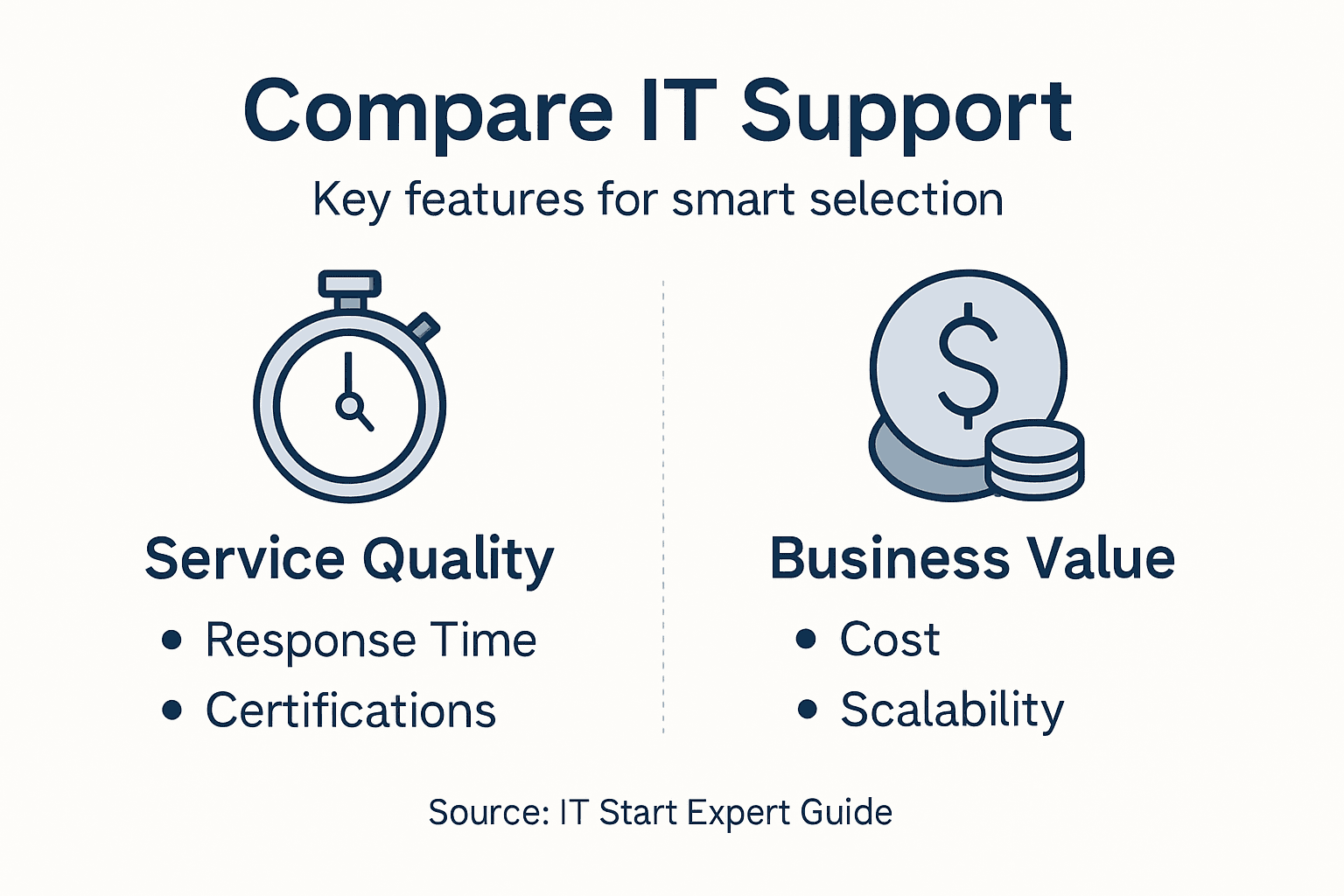
Start by examining professional certification frameworks that validate technical competencies. The Australian Computer Society offers comprehensive certification standards that provide a reliable benchmark for assessing IT professional qualifications. Focus on key areas such as technical specialisations, industry experience, service level agreements, response times, and the breadth of support offerings. Consider how each provider’s certifications match your organisation’s specific technological infrastructure and strategic objectives.
Evaluate providers holistically by reviewing their technical capabilities, compliance with national training standards, and proven track records in your industry sector. Request detailed documentation demonstrating their regulatory compliance and quality assurance through recognised Australian vocational training authorities. Pay particular attention to their ability to provide scalable solutions, demonstrate technical expertise across multiple IT domains, and offer proactive support strategies that go beyond basic technical maintenance.
Pro tip: Create a comprehensive comparison matrix that ranks potential IT support providers across multiple criteria to objectively assess their capabilities and fit for your business.
The following table compares key features to evaluate when choosing between IT support providers:
| Evaluation Feature | Why It Matters | What to Look For |
|---|---|---|
| Industry Certifications | Validates technical expertise | ACS, Microsoft, Cisco certificates |
| Service Level Agreements | Defines expected response/uptime | Guarantees for resolution times |
| Industry Experience | Shows familiarity with sector needs | Past work with similar clients |
| Support Scalability | Measures ability to grow with you | Flexible packages, resource options |
Step 4: Arrange consultations with preferred providers
After thoroughly researching and comparing potential IT support providers, the next critical step is scheduling initial consultations to validate their capabilities and assess their compatibility with your business requirements. These meetings provide an invaluable opportunity to gain deeper insights into their technical expertise and service approach.
Begin by coordinating support consultation strategies through structured communication channels. Prepare a comprehensive list of discussion points that cover your specific technological infrastructure, current challenges, future scalability needs, and expected service outcomes. Request detailed meetings that allow you to explore their technical capabilities, understand their problem solving methodologies, and evaluate their responsiveness to your organisation’s unique requirements. During these consultations, pay close attention to the provider’s communication style, technical knowledge depth, and ability to translate complex technological concepts into clear, actionable strategies.
Ensure you discuss critical aspects such as response times, support availability, escalation procedures, and their approach to proactive system maintenance. Centralise communication channels by establishing a single point of contact who can manage ongoing interactions and coordinate between your organisation and the IT support provider. This approach helps streamline communication and ensures consistent, efficient problem resolution.
Pro tip: Develop a structured evaluation scorecard during consultations to objectively rate each provider’s technical competence, communication skills, and alignment with your business goals.
Step 5: Verify fit and commence partnership
Verifying the right fit with an IT support provider is a critical decision that requires careful evaluation of their technical capabilities, cultural alignment, and long-term potential to support your business objectives. This final step transforms your research and consultations into a strategic partnership that can drive technological excellence.
Begin by conducting a comprehensive review of the provider’s professional qualifications and credentials. Examine their technical certifications, industry experience, and specific expertise relevant to your organisation’s technological ecosystem. Scrutinise their ANZSCO classification to ensure their skill sets precisely match your operational requirements. Validate their professional credentials through recognised Australian industry bodies, paying particular attention to their ability to deliver consistent, reliable support that aligns with your strategic technology roadmap.
Prepare a detailed contract that clearly outlines service level agreements, performance metrics, communication protocols, and escalation procedures. Verify qualification standards through the Australian Qualifications Framework to confirm the legitimacy of their professional training. Schedule an initial trial period that allows both parties to assess compatibility, establish working rhythms, and identify potential areas of collaboration or improvement. This approach ensures a robust, transparent partnership that can adapt to your evolving technological needs.
Pro tip: Draft a comprehensive partnership agreement that includes specific performance indicators and quarterly review mechanisms to maintain ongoing alignment and continuous improvement.
Secure Your Business Future with Trusted Local IT Support
Finding the right IT support roles near you is essential to overcoming challenges like unreliable connectivity, cybersecurity threats, and the need for scalable cloud solutions. As highlighted in the article, building a strategic partnership hinges on understanding specialised IT roles and verifying professional certifications to ensure your business stays secure and compliant. The pain of navigating technical complexities and achieving fast response times can be overwhelming without expert guidance.
At IT Start, we bring Brisbane businesses trusted, proactive managed IT support backed by certifications like SMB 1001 Gold. Our local expertise in delivering tailored IT services including cloud solutions, cybersecurity, and comprehensive project management means you gain a dedicated partner focused on enhancing operational efficiency and mitigating risks. Discover how our transparent approach and industry experience make IT Start the ideal choice for your business needs.
Ready to bridge the gap between your IT support requirements and expert local providers Do not wait to safeguard your operations Schedule a free assessment or consultation today through our Contact Us page or learn more about how IT Start can help you overcome your unique IT challenges by visiting IT Start. Your business deserves the best local IT support tailored for long-term success.
Frequently Asked Questions
How can I assess my business’s IT support needs?
Identifying your business’s IT support needs involves evaluating your current technology infrastructure and pinpointing performance gaps. Conduct a technology audit and document specific technical challenges to create a clear roadmap for the roles and skills necessary for support.
What steps should I follow to find local IT support providers?
Start by researching local IT support providers through professional networks and industry directories. Compile a list of potential providers, assess their qualifications, and schedule consultations to evaluate their fit with your business.
How can I compare the qualifications of different IT support providers?
Create a comparison matrix that includes key features such as certifications, service level agreements, and industry experience. Rank each provider based on these criteria to objectively evaluate which one aligns best with your needs.
What should I discuss during consultations with potential IT support providers?
During consultations, focus on your specific IT challenges, support expectations, and response times. Assess their communication style and technical knowledge to determine if they can effectively meet your requirements and work within your organisational culture.
How can I ensure a good long-term partnership with an IT support provider?
To establish a successful long-term partnership, draft a detailed contract that outlines service agreements and performance metrics. Regularly review the partnership’s effectiveness using established feedback mechanisms to ensure ongoing alignment with your business goals.
What are the common IT support roles that my business might need?
Common IT support roles include Network Administrators, Cybersecurity Specialists, Cloud Engineers, and IT Project Managers. Each role offers specific capabilities, so assess your unique technological challenges to determine which positions are necessary for your business.