

Juggling operational demands while keeping sensitive client data secure is a daily reality for Brisbane’s small and medium-sized financial services firms. The right help desk solution does more than just fix technical problems—it acts as the vital bridge between staff and technology, boosting productivity and resilience. With evolving cyber threats and increasingly complex IT systems, professional help desk support gives IT managers the confidence to address incidents quickly, keep business running smoothly, and limit security risks.
Help Desk Guide: Functions, Services, Benefits, Security & Pitfalls
- Defining The Help Desk In IT Support
- Types Of Help Desk Services For SMEs
- How Help Desks Enable Operational Success
- Cybersecurity Risk Mitigation Via Help Desk
- Stakeholder Benefits And Common Pitfalls
Key Takeaways
| Point | Details |
|---|---|
| Help Desk Importance | Help desks are essential for maintaining operational continuity and resolving technical challenges in organisations. They act as a crucial communication channel between technical experts and end-users. |
| Service Types for SMEs | Small and medium enterprises benefit from tailored IT support services, including remote technical support, on-site troubleshooting, and cybersecurity monitoring, to efficiently manage their unique technological needs. |
| Operational Success Drivers | Help desks drive operational efficiency by enabling rapid problem resolution, knowledge management, and continuous improvement, ultimately supporting organisational performance and resilience. |
| Cybersecurity Role | Help desks play a critical role in cybersecurity risk mitigation by managing user access, detecting threats, and providing security awareness training, ensuring the protection of digital assets. |
Defining the Help Desk in IT Support
A help desk represents the frontline support function within an organisation’s information technology infrastructure, serving as a critical communication channel between technical experts and end-users. In the context of Australian businesses, help desks play a pivotal role in maintaining operational continuity and resolving technical challenges efficiently.
The Australian Computer Society outlines help desk operations as essential for managing organisational IT support, with professionals responsible for:
- Receiving and triaging technical support requests
- Troubleshooting hardware and software issues
- Managing user access and permissions
- Documenting and escalating complex technical problems
- Providing first-line resolution for IT-related challenges
Help desk teams function as the nerve centre of an organisation’s technological ecosystem, ensuring that employees can maintain productivity by quickly addressing technical disruptions. They serve as both problem solvers and knowledge repositories, translating complex technical concepts into understandable solutions for non-technical staff.
Help desk professionals are the unsung heroes who keep businesses running smoothly by transforming technical obstacles into manageable solutions.
With the increasing complexity of digital infrastructure, help desks have evolved from simple troubleshooting units to strategic partners in maintaining cybersecurity frameworks and ensuring technological resilience.

Pro tip: Implement a robust ticketing system and knowledge management platform to streamline help desk operations and reduce resolution times.
Types of Help Desk Services for SMEs
Small and medium enterprises (SMEs) require flexible and responsive IT support services that can adapt to their unique technological needs. Business support services in Australia offer a diverse range of help desk solutions designed to address the specific challenges faced by smaller organisations.
Typical help desk services for SMEs include:
- Remote Technical Support: Immediate assistance for hardware and software issues
- On-Site Troubleshooting: Physical interventions for complex technical problems
- Network Management: Monitoring and maintaining network infrastructure
- Cybersecurity Monitoring: Proactive threat detection and prevention
- User Training and Support: Skill development and technology guidance for staff
These services are critical for maintaining operational efficiency, with each type addressing different aspects of technological management. Some help desk providers offer tiered support models, allowing SMEs to select packages that match their budget and complexity requirements.
Here’s how common help desk services for Australian SMEs differ in focus and business impact:
| Service Type | Main Focus | Typical Business Impact |
|---|---|---|
| Remote Technical Support | Immediate off-site assistance | Fast issue remediation, reduced costs |
| On-Site Troubleshooting | Physical device intervention | Resolves complex or hardware problems |
| Network Management | Infrastructure performance | Stable connectivity, fewer outages |
| Cybersecurity Monitoring | Proactive threat detection | Reduces risk of cyber incidents |
| User Training and Support | Staff skill development | Improved staff confidence, fewer errors |
Effective help desk services act as a strategic partner, transforming technical challenges into opportunities for business growth and innovation.
The Department of Employment and Workplace Relations recognises the importance of tailored support for small businesses, highlighting how specialised help desk services can significantly enhance an organisation’s technological capabilities.
Pro tip: Conduct a comprehensive technology audit before selecting a help desk service to ensure the chosen package precisely matches your business’s unique IT requirements.
How Help Desks Enable Operational Success
Help desks are the strategic nerve centre of organisational efficiency, transforming technical challenges into opportunities for sustained business performance. Operational technology environments rely on help desk functions to maintain critical infrastructure and ensure seamless technological operations.
The key mechanisms through which help desks drive operational success include:
- Rapid Problem Resolution: Minimising downtime and productivity disruptions
- Knowledge Management: Centralising technical insights and solutions
- Performance Monitoring: Tracking system health and identifying potential issues
- Continuous Improvement: Providing feedback loops for technological enhancement
- Risk Mitigation: Identifying and addressing potential cybersecurity vulnerabilities
By serving as a critical interface between technology and human resources, help desks enable organisations to maintain operational continuity while adapting to evolving technological landscapes. They transform potential technological obstacles into strategic opportunities for business growth and innovation.
Help desk professionals are the unsung architects of organisational resilience, bridging technological challenges and business objectives.
The Victorian Business Information Portal emphasises that help desk functions are essential for measuring and achieving critical success factors, providing organisations with actionable insights into their operational performance.
Pro tip: Implement a comprehensive performance tracking system within your help desk to continuously measure and improve technological support effectiveness.
Cybersecurity Risk Mitigation via Help Desk
Cybersecurity risk mitigation represents a critical function of modern help desk operations, transforming technical support into a proactive defence mechanism for organisational digital infrastructure. Cyber security mitigation strategies are fundamental to protecting businesses from evolving digital threats and maintaining technological resilience.
Key cybersecurity risk mitigation strategies implemented by help desks include:
- User Access Management: Controlling and monitoring system entry points
- Threat Detection: Identifying and escalating potential security vulnerabilities
- Security Awareness Training: Educating staff about potential cyber risks
- Patch Management: Ensuring timely software and system updates
- Incident Response Coordination: Developing and executing rapid response protocols
Help desk professionals serve as the first line of defence against potential cybersecurity breaches, combining technical expertise with strategic risk management. Their role extends beyond simple technical support to become critical guardians of organisational digital security.
Cybersecurity is not just a technological challenge, but a human-centric approach to protecting an organisation’s most valuable digital assets.
The Australian Business Cyber Security Checklist emphasises the importance of comprehensive security practices that help desks can implement to reduce organisational vulnerabilities and enhance overall security posture.
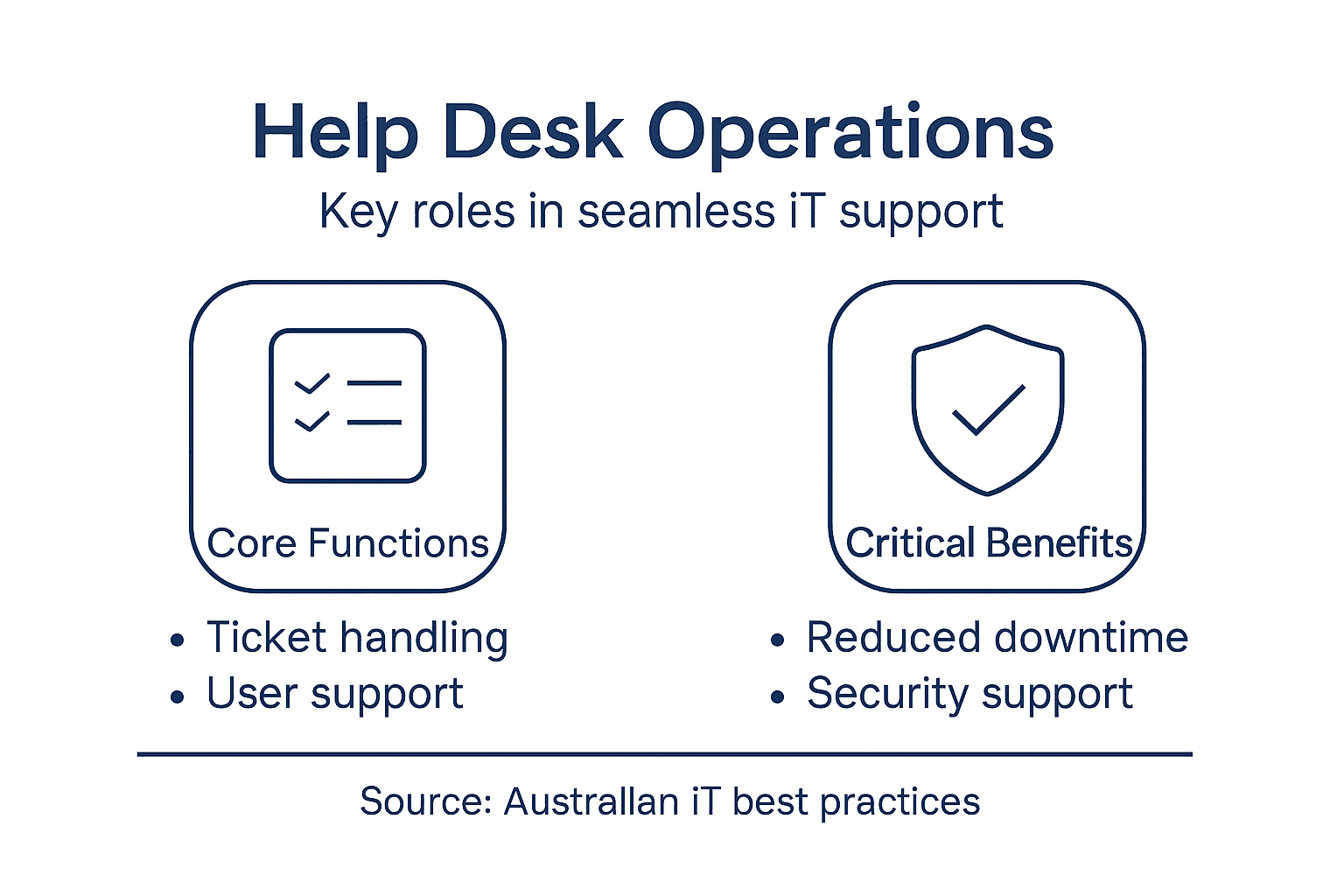
Pro tip: Develop a comprehensive cybersecurity training program that empowers help desk staff to become proactive security ambassadors within your organisation.
Stakeholder Benefits and Common Pitfalls
Effective help desk operations require a nuanced understanding of stakeholder engagement that balances technical expertise with interpersonal communication. Stakeholder engagement strategies play a crucial role in transforming help desk interactions from transactional encounters to collaborative problem-solving experiences.
Key stakeholder benefits of robust help desk operations include:
- Improved Operational Efficiency: Faster problem resolution and reduced downtime
- Enhanced User Satisfaction: Personalised and responsive technical support
- Knowledge Transfer: Systematic sharing of technical insights across the organisation
- Proactive Risk Management: Early identification of potential technological challenges
- Continuous Improvement: Feedback mechanisms that drive service quality
Common pitfalls in help desk operations can significantly undermine organisational performance. These challenges often emerge from communication breakdowns, inadequate training, or inflexible support protocols that fail to address the dynamic needs of modern businesses.
The table below summarises the main pitfalls of help desk operations and their potential consequences:
| Common Pitfall | Consequence for Organisation |
|---|---|
| Poor communication | User frustration, unresolved issues |
| Lack of staff training | Ineffective problem resolution |
| Inflexible support protocols | Slow adaptation to business needs |
| Minimal feedback mechanisms | Missed opportunities for improvement |
Successful stakeholder engagement is not about perfect solutions, but about creating trusted partnerships that adapt and evolve.
The Department of Health’s Stakeholder Engagement Framework highlights the importance of maintaining transparency, respect, and timely communication in professional service delivery.
Pro tip: Develop a structured feedback loop that allows stakeholders to provide continuous input and helps help desk teams iteratively improve their support mechanisms.
Empower Your Business with Expert Help Desk Support from IT Start
The article highlights how critical a well-managed help desk is for Australian businesses to maintain seamless IT operations and mitigate cybersecurity risks. If you are facing challenges such as prolonged downtime, ineffective problem resolution, or struggling to keep up with evolving cybersecurity threats, these pain points can directly impact your organisation’s productivity and resilience. Help desks are no longer just reactive troubleshooting teams but strategic partners that drive operational efficiency, knowledge management, and proactive risk mitigation.
At IT Start, we specialise in providing Brisbane businesses with tailored managed IT support, cloud solutions, and cybersecurity services designed to transform your help desk into a powerhouse of seamless IT performance. Our certified team understands that rapid problem resolution and robust stakeholder communication are key to minimising disruptions and empowering your staff. Experience the difference of a proactive IT partner with local expertise and a strong focus on compliance and security.
Are you ready to strengthen your IT operations and safeguard your business from cyber risks today? Explore how our bespoke solutions can meet your specific needs by visiting IT Start. Take advantage of our free consultation to assess how we can enhance your help desk performance and operational success right now.
Frequently Asked Questions
What is the primary function of a help desk in IT support?
The primary function of a help desk is to serve as a communication channel between technical experts and end-users, providing first-line technical support, troubleshooting issues, and managing support requests to ensure operational continuity.
How can help desks enhance operational efficiency for businesses?
Help desks enhance operational efficiency by rapidly resolving technical problems, centralising knowledge management, and providing continuous monitoring, which minimises downtime and maximises productivity.
What types of services do help desks typically offer to small and medium enterprises (SMEs)?
Help desks for SMEs typically offer services such as remote technical support, on-site troubleshooting, network management, cybersecurity monitoring, and user training to address the unique IT needs of smaller organisations.
How do help desks contribute to cybersecurity risk mitigation?
Help desks contribute to cybersecurity risk mitigation by managing user access, providing threat detection, conducting security awareness training, ensuring timely software updates, and coordinating rapid incident response protocols.
Recommended
- How to Find IT Support Roles Near Me for Businesses – IT Start
- IT Support Engineer – The Backbone of Brisbane SMEs – IT Start
- 7 Main Types of Managed Services for Brisbane Businesses – IT Start
- IT Managed Services: Everything You Need to Know – IT Start
- Roller i nätverksadministration – Så påverkar de ditt nätverk