

Client trust can disappear in an instant when sensitive information falls into the wrong hands. For IT managers in Brisbane’s financial services sector, keeping personal and financial data safe means more than basic compliance. With frameworks like the Australian Privacy Principles defining strict requirements, every detail matters. This guide delivers practical steps for identifying, classifying, and defending your business’s most valuable assets so you can confidently protect your clients from growing cyber threats.
Table of Contents
- Step 1: Identify And Classify Sensitive Client Data
- Step 2: Implement Robust Access Controls And Permissions
- Step 3: Enforce Data Encryption Across All Channels
- Step 4: Conduct Regular Employee Security Training
- Step 5: Monitor And Audit Data Use Continuously
- Step 6: Verify Protection Through Periodic Security Assessments
Contents: Step-by-Step Guide to Securing Brisbane SME Data
| Key Point | Explanation |
|---|---|
| 1. Identify and classify sensitive data | Establish a systematic approach to accurately recognise and categorise sensitive client information for better protection. |
| 2. Implement robust access controls | Regularly define and review user access permissions to ensure the principle of least privilege is maintained. |
| 3. Enforce data encryption everywhere | Apply strong encryption consistently across all data channels to safeguard against unauthorised access. |
| 4. Conduct ongoing employee security training | Educate staff continuously to ensure they can recognise threats and respond effectively to cyber risks. |
| 5. Perform regular security assessments | Regularly evaluate your security measures to identify vulnerabilities and improve your organisation’s defences. |
Step 1: Identify and classify sensitive client data
Identifying and classifying sensitive client data represents a critical first defence in protecting your Brisbane business’s most valuable information assets. In this crucial step, you’ll develop a systematic approach to recognising which data requires the highest levels of security protection.
To effectively identify sensitive client data, start by understanding what constitutes sensitive information. This includes personal details like financial records, healthcare information, contact details, and strategic business documents. The Australian Privacy Principles guidelines provide a comprehensive framework for determining data sensitivity.
Here are key strategies for identifying and classifying sensitive client data:
- Review all client documentation and digital records
- Categorise data based on potential impact if breached
- Determine legal and regulatory compliance requirements
- Create a hierarchical data classification system
Specifically, focus on classifying data into these primary categories:
- Confidential: Highly sensitive information with significant breach risks
- Internal: Important but less critical business information
- Public: Information suitable for general distribution
Sensitive data classification is not a one-time activity but an ongoing process that requires regular review and updating.
By meticulously mapping your data landscape, you create a foundational strategy for robust information protection. The next step involves implementing specific security controls tailored to each data classification level.
Here’s a quick reference comparing key data classification categories and their business implications:
| Classification Level | Example Types of Data | Breach Impact | Recommended Security Approach |
|---|---|---|---|
| Confidential | Financial records, health info | Severe financial/legal | Strict access, encryption, regular audits |
| Internal | Business plans, employee info | Moderate operational risk | Role-based access, monitored access |
| Public | Marketing materials, press releases | Low to none | Minimal restrictions, open access |
Pro tip: Conduct an annual comprehensive data audit to ensure your classification system remains current and aligned with evolving business and regulatory requirements.
Step 2: Implement robust access controls and permissions
Securing your organisation’s sensitive data requires a strategic approach to managing user access and permissions. In this critical step, you’ll learn how to create a comprehensive system that protects your Brisbane business’s most valuable digital assets from potential security breaches.
Begin by developing a systematic access management framework that aligns with Australian Signals Directorate’s security guidelines. This involves implementing the principle of least privilege, which means giving employees only the minimum access required to perform their specific job functions.
Key strategies for establishing robust access controls include:
- Define clear user roles and access levels
- Implement multi-factor authentication
- Create a centralised access management system
- Develop a formal process for granting and revoking access
- Regularly audit and review user permissions
When designing your access control strategy, focus on these critical components:
- Role-based access control (RBAC)
- Comprehensive user authentication mechanisms
- Detailed access logging and monitoring
- Regular permission reviews
Effective access control is not a one-time setup but an ongoing process of continuous monitoring and adjustment.
By meticulously managing user permissions, you create a dynamic security environment that adapts to your business’s changing needs while minimising potential vulnerabilities.
Pro tip: Implement an automated access review process that triggers quarterly permission audits to ensure your access controls remain current and aligned with your organisation’s evolving structure.
Step 3: Enforce data encryption across all channels
Protecting your Brisbane business’s sensitive information requires a comprehensive approach to data encryption that safeguards data during transmission, storage, and access. This step will guide you through implementing robust encryption strategies that shield your organisation’s critical digital assets from potential cyber threats.

Begin by implementing comprehensive encryption protocols that cover all potential data vulnerability points. Encryption must be applied consistently across multiple channels including email, cloud storage, network communications, and endpoint devices to create a comprehensive security ecosystem.
Key encryption strategies for SMEs include:
- Use strong, industry-standard encryption algorithms
- Implement end-to-end encryption for communication channels
- Encrypt data both in transit and at rest
- Utilise secure key management practices
- Regularly update and rotate encryption keys
Consider these critical encryption implementation steps:
- Select appropriate encryption standards
- Configure encryption across all business systems
- Train staff on encryption protocols
- Establish monitoring mechanisms
- Conduct periodic security audits
Effective encryption is not about perfect security, but creating multiple layers of protection that significantly reduce potential breach risks.
By systematically applying encryption across your organisation’s digital infrastructure, you create a robust defence mechanism that protects sensitive client data from unauthorised access and potential cyber incidents.
Pro tip: Invest in automated encryption management tools that can seamlessly integrate with your existing IT infrastructure and provide real-time reporting on encryption status.
Step 4: Conduct regular employee security training
Transforming your Brisbane business’s cybersecurity posture requires more than technical solutions – it demands a human-centric approach to digital protection. Employee security training represents the most critical line of defence against potential data breaches and cyber threats.
Start by leveraging free online training resources that provide comprehensive cybersecurity awareness programs tailored for Australian small businesses. Effective security training should encompass practical skills that help employees recognise and respond to potential cyber risks before they become serious threats.
Key elements of a robust security training program include:
- Simulate real-world phishing scenarios
- Teach safe browsing and email practices
- Explain data handling protocols
- Demonstrate password management techniques
- Cover social engineering awareness
Implement your training program through these strategic steps:
- Develop a baseline assessment of current employee knowledge
- Create role-specific training modules
- Use interactive learning techniques
- Provide continuous learning opportunities
- Track and measure training effectiveness
Security awareness is not a one-time event but an ongoing cultural transformation within your organisation.
By investing in comprehensive and engaging security training, you empower your team to become proactive guardians of your business’s sensitive information, turning potential vulnerabilities into strengths.
Pro tip: Schedule quarterly micro-learning sessions that are short, engaging, and focused on specific cybersecurity topics to maintain ongoing employee awareness and skill development.
Step 5: Monitor and audit data use continuously
Continuous monitoring represents the final critical layer in protecting your Brisbane business’s sensitive data ecosystem. This step transforms your cybersecurity approach from reactive to proactive, enabling real-time identification and mitigation of potential data risks.
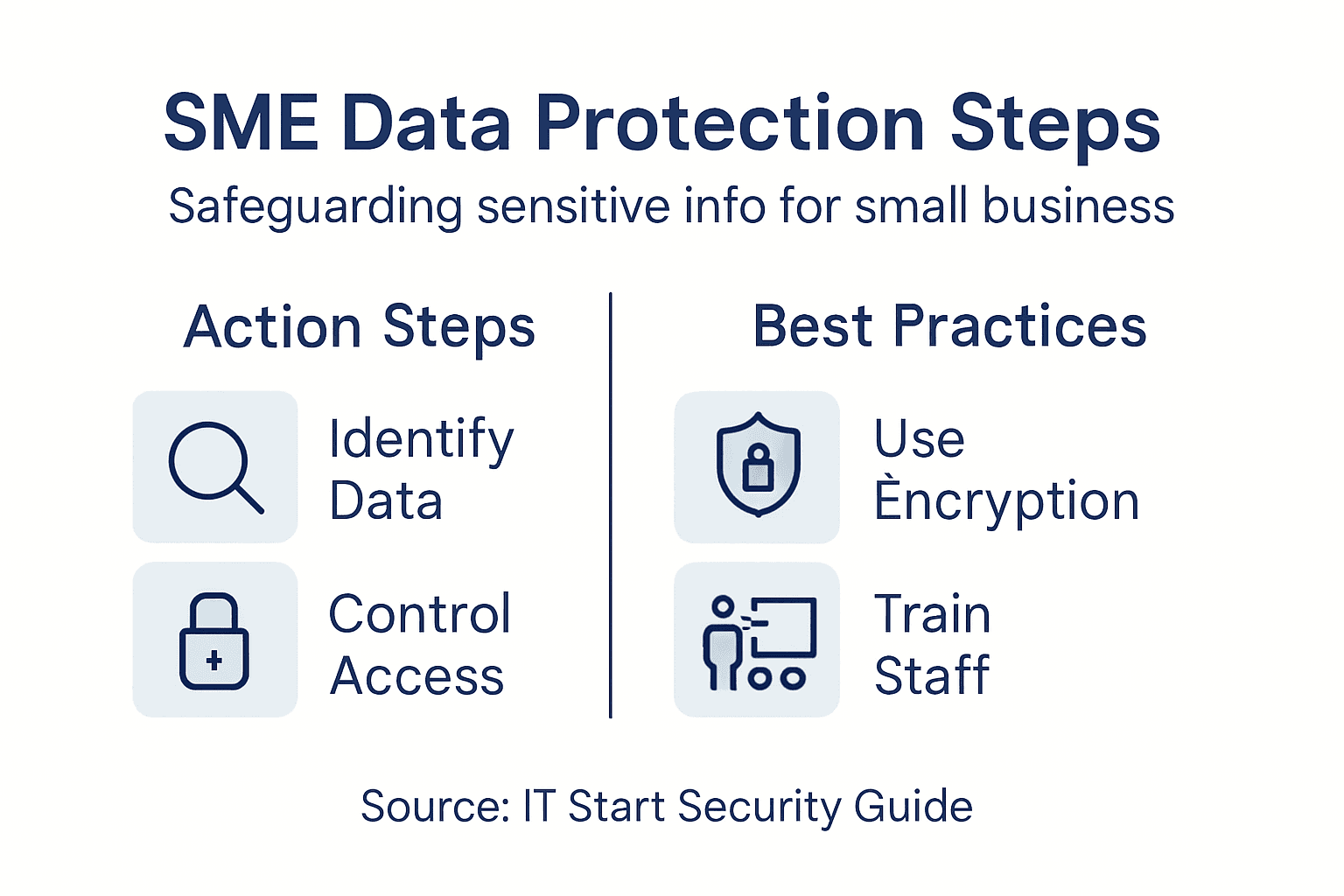
Implement systematic security monitoring processes that provide comprehensive visibility into your organisation’s data usage patterns. Effective monitoring strategies should include automated tools that track user activities, detect anomalies, and generate immediate alerts for suspicious behaviour.
Key elements of a robust continuous monitoring program include:
- Implement real-time logging mechanisms
- Configure automated anomaly detection systems
- Establish clear incident response protocols
- Define specific monitoring metrics and thresholds
- Create comprehensive audit trail documentation
Develop your monitoring strategy through these strategic steps:
- Select appropriate monitoring technologies
- Define baseline normal user behaviour
- Configure automated alert systems
- Develop escalation procedures
- Regularly review and update monitoring parameters
Continuous monitoring is not about capturing every single data point, but understanding meaningful patterns that indicate potential security risks.
By integrating sophisticated monitoring techniques, you transform your data protection approach from static defence to dynamic, intelligent risk management.
Pro tip: Invest in machine learning-powered monitoring tools that can dynamically adapt and learn your organisation’s unique data usage patterns, providing increasingly sophisticated threat detection over time.
Step 6: Verify protection through periodic security assessments
Security is not a set-and-forget proposition for Brisbane SMEs – it demands consistent, proactive validation through strategic security assessment processes. This final step ensures that your carefully constructed data protection framework remains robust and responsive to evolving cyber threats.
Leverage comprehensive security assessment frameworks to systematically evaluate your organisation’s defensive capabilities. Periodic assessments provide critical insights into potential vulnerabilities, helping you continuously refine and strengthen your data protection strategies.
Key components of an effective security assessment strategy include:
- Conduct comprehensive vulnerability scans
- Test existing security controls
- Simulate potential cyber attack scenarios
- Review and update security policies
- Document assessment findings and improvements
Implement your security assessment approach through these structured steps:
- Develop a standardised assessment methodology
- Schedule regular assessment intervals
- Engage internal or external cybersecurity experts
- Analyse assessment results thoroughly
- Create actionable improvement plans
Security assessments are not about finding fault, but about continuously improving your organisation’s defensive capabilities.
By treating security assessments as a dynamic, ongoing process, you transform your data protection from a static defense to an adaptive, intelligent system that evolves with emerging threats.
Below is a summary of how each security step contributes to an overall robust data protection strategy:
| Security Step | Primary Focus | Unique Business Benefit |
|---|---|---|
| Data Classification | Identifying & labelling data | Ensures tailored protection |
| Access Controls | Managing permissions & roles | Reduces insider risk |
| Encryption | Safeguarding data channels | Minimises cyber-attack impact |
| Security Training | Educating users | Prevents human error |
| Continuous Monitoring | Real-time activity oversight | Enables rapid incident response |
| Security Assessment | Evaluating defences | Identifies gaps for improvement |
Pro tip: Consider rotating assessment methodologies and engaging different cybersecurity professionals to ensure you receive diverse perspectives and uncover hidden vulnerabilities.
Strengthen Your Brisbane SME’s Data Security with IT Start
Protecting sensitive client data is a critical challenge for Brisbane SMEs facing constantly evolving cyber threats. This article highlights vital steps like data classification, access controls, and continuous monitoring to safeguard your business. At IT Start, we understand the pressure to maintain compliance and prevent costly breaches while keeping operations efficient and secure.
Our tailored managed IT support and cybersecurity services are designed to implement strategic protections such as role-based access control, end-to-end encryption, and ongoing security assessments. We bring local expertise and industry-leading certifications like SMB 1001 Gold to deliver proactive, transparent support that evolves with your needs.
Don’t wait until a data breach disrupts your business. Visit IT Start today to arrange a free assessment and discover how a trusted Brisbane IT partner can help you take control of your sensitive data and build resilience against cyber risks.
Frequently Asked Questions
How can Brisbane SMEs identify sensitive client data?
Identifying sensitive client data involves reviewing all client documentation and categorising the data based on potential impacts from breaches. Start by creating a hierarchical data classification system to label data as Confidential, Internal, or Public.
What access control measures should Brisbane SMEs implement to protect sensitive data?
Brisbane SMEs should implement the principle of least privilege by defining clear user roles and access levels. Establish a formal process for granting and revoking access, and conduct quarterly audits of user permissions to ensure compliance.
How can I ensure data encryption in my SME’s digital communications?
To ensure data encryption, utilise strong industry-standard encryption algorithms for data both in transit and at rest. Apply end-to-end encryption across all communication channels, and train your staff on best practices for encryption protocols.
What key topics should be included in employee security training for SMEs?
Employee security training should include recognising phishing attacks, safe browsing practices, and data handling protocols. Develop role-specific training modules and schedule regular sessions to maintain ongoing awareness regarding cybersecurity.
How often should Brisbane SMEs conduct security assessments?
Brisbane SMEs should schedule regular security assessments to evaluate their defensive capabilities. Aim to conduct comprehensive assessments at least annually and after any major changes to the business or technology systems to identify areas for improvement.
Recommended
- Data Protection and Privacy – IT Start
- Sensitive Data Protection – Key Compliance for Brisbane Firms – IT Start
- 7 Essential Data Protection Tips for Brisbane Businesses – IT Start
- Is My Data Safe? Protecting Brisbane SMEs in 2026 – IT Start
- 7 B2B Marketing Ideas for Australian Service Businesses – Jarrod Harman